Cost Comparison: WhatsApp API vs SMS
Compare WhatsApp API vs SMS costs to choose the best messaging platform for your business.
 By Aditi Kamini
Published: July 31, 2025
Updated: September 1, 2025
21 min read
By Aditi Kamini
Published: July 31, 2025
Updated: September 1, 2025
21 min read

Compare WhatsApp API vs SMS costs to choose the best messaging platform for your business.
In today’s mobile-centric world, businesses rely heavily on messaging to reach customers. Two of the most popular channels are traditional SMS text messaging and the WhatsApp Business API (the interface for companies to send WhatsApp messages at scale). Both channels can deliver your message effectively – SMS can reach 5.1 billion users (about 67% of the global population) on any mobile phone, while WhatsApp boasts over 2.24 billion active users worldwide.
But when it comes to cost and value, how do WhatsApp and SMS compare? This comprehensive guide will compare the costs of WhatsApp API vs SMS, including pricing structures, real-world examples, ROI considerations, and best-use scenarios. By the end, you’ll know which channel (or combination) is more cost-effective for your business in 2025.
WhatsApp Business API vs SMS: An Overview
| Feature | WhatsApp Business API | SMS (Short Message Service) |
| Launch Year | 2009 | 1980s |
| User Base | 2+ billion monthly active users | ~5 billion mobile phone users worldwide |
| Device Requirement | Smartphone with WhatsApp app and internet connection required | Any mobile phone with a service plan |
| Reach | Limited to WhatsApp users only | Universal—any mobile phone can receive SMS |
| Message Length | Up to tens of thousands of characters | 160 characters per message; longer texts are split and charged separately |
| Media Support | Rich media: images, videos, documents, interactive buttons, etc. | Text only (no media, links are plain text) |
| Security | End-to-end encryption ensures secure conversations | No encryption; messages sent “in the clear” |
| Interactivity | Supports engaging, two-way conversations with rich and interactive elements | Basic one-way or simple two-way communication |
| Cost Structure | Priced per delivered message, varies by country/region, features, and conversation type | Priced per SMS message or segment, varies by country/operator |
| Business Use Cases | Customer service, notifications, promotions, two-way chats, media-rich campaigns | Simple alerts, OTPs, mass notifications, basic reminders |
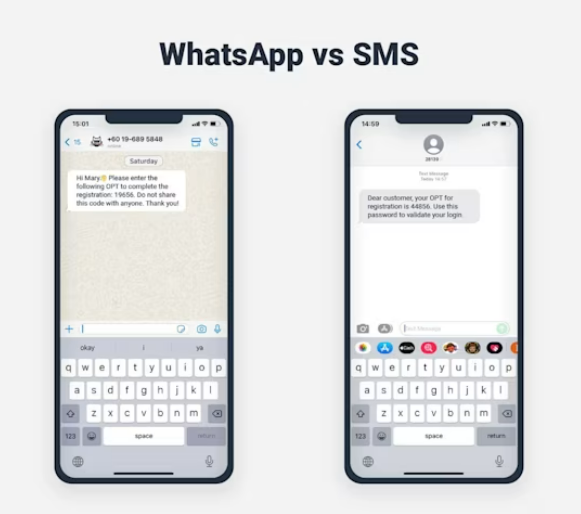
WhatsApp Business API and SMS are both powerful tools for business communication, each with distinct advantages. SMS is the most accessible messaging channel, reaching any mobile phone globally, making it the best way to connect with customers who don’t use smartphones or lack consistent internet access. Its simplicity, however, means messages are short and can’t include images or advanced features.
WhatsApp Business API, in contrast, provides a much richer messaging experience. Businesses can send images, documents, videos, and even interactive buttons straight to customers. Plus, messages are secure thanks to end-to-end encryption. However, it’s only available to WhatsApp users and requires internet access and a smartphone.
Choosing between WhatsApp and SMS depends on your audience and objectives. If your goal is maximum reach, SMS is unmatched. For deeper engagement with interactive, secure conversations, WhatsApp is a top choice. Both channels can play complementary roles in modern business messaging strategies.
Pricing Structure: WhatsApp API vs SMS Costs Explained
One of the most significant differences between WhatsApp and SMS is how you pay for messages on each platform. Let’s break down the pricing models:
| Pricing Aspect | WhatsApp Business API (2025) | SMS (2025) |
| Pricing Model | Per-message billing (effective July 1, 2025) for template messages. Free for service messages within a 24-hour user-initiated window. | Per-message/segment billing—charged for each SMS sent (and sometimes for received) |
| Primary Cost Units | Charges depend on message category: Marketing, Utility, and Authentication (free for Service). | Charged per message (160 characters = 1 SMS), longer messages billed as multiple SMS |
| Typical Domestic Rates | $0.005–$0.02 per WhatsApp message (varies by country, category, volume) | $0.01–$0.05 per SMS in most countries (US/UK averages); international often higher |
| Setup/Number Fees | No separate phone number rental required for Cloud API (Meta-hosted); minimal or no monthly/hosting fees for many providers | Usually requires monthly fees for short code or toll-free number, e.g. $10 to $100+/month (short code can be $500–$1,000/month with setup fee) |
| Volume Discounts | Tiered discounts by message category and region—prices drop as volume increases, especially for authentication messages | Volume bundles/credits; discounts exist, but are less dramatic compared to the WhatsApp API |
| Hidden/Extra Fees | Some 3rd-party providers may add platform or markup fees. No charge for inbound customer messages | Regulatory or compliance charges, number registration fees, and possible charges for incoming SMS |
| Free Messages | All replies to a user within a 24-hour window are free. Utility messages are also free in this window | Generally, no free messages—every outbound (and sometimes inbound) SMS is charged |
| Global Reach Costs | Rates align closely with SMS; the same price to message any WhatsApp user worldwide | International SMS rates are much higher. Carrier and country-specific routing may add complexity and cost |
WhatsApp API Costs at a Glance (2025 Updates)
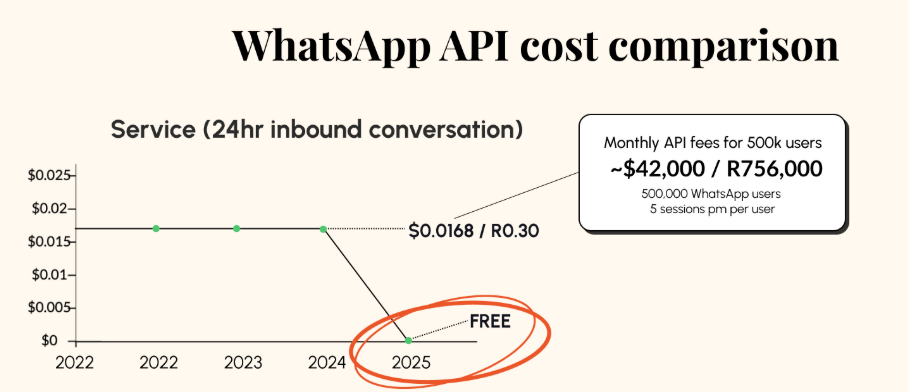
- Per-Message Pricing: WhatsApp charges for each delivered message. Rates vary by message type (marketing, utility, authentication, service) and by country. For example, a marketing message in North America is about $0.014; other regions can range from $0.005 to $0.02.
- Free Messages: When a customer initiates a chat, replies from the business within 24 hours are free. Utility templates sent during that customer service window are also free. Service conversations carry no charge within this timeframe.
- Volume Discounts: High message volumes, especially for authentication or utility purposes, qualify for reduced per-message costs.
- No Number Rental (WhatsApp Cloud API): No separate fee for phone numbers or hosting when using WhatsApp Cloud API. Only WhatsApp’s standard messaging charges apply. Some providers may add platform fees, though the cost is generally low.
SMS Pricing Factors at a Glance
- Per-Message Fees: Each SMS is charged per sent message or segment. Domestic rates typically range from $0.01 to $0.05 per SMS, but international messages cost more. Messages over 160 characters are split into multiple chargeable segments.
- Number and Setup Costs: Businesses require an SMS-enabled phone number (standard, toll-free, or short code). Short codes for high-volume sending can cost $500–$1,000/month in the US plus setup fees. Long code A2P messaging may involve registration and ongoing charges in many regions.
- Incoming Message Fees: Some providers, especially in the US, charge businesses for incoming SMS on long or toll-free numbers. Others may bundle this into larger plans.
- Volume Discounts: SMS platforms may offer volume-based discounts, but these are modest; per-message cost rarely drops sharply even at high volumes.
- Global Reach Costs: International SMS incurs higher and more complex fees, including compliance requirements, carrier routing, and potential restrictions by country. Rates, sender IDs, and legal requirements vary, which increases both cost and complexity for businesses handling global SMS campaigns.
Cost per Message: WhatsApp vs SMS in Practice
Now that we’ve outlined how pricing works, let’s compare the actual cost of sending messages on WhatsApp API versus SMS with a few scenarios and stats:
- One-Way Alerts (Single Message): For simple outbound notifications like a one-time password (OTP) or an order confirmation, SMS is often seen as cheap and quick. For example, sending a single SMS OTP in India might cost only a few paisa (₹0.05, for instance), whereas sending a WhatsApp template message might cost a bit more (₹0.25, hypothetically). In many regions, SMS per message is slightly cheaper than WhatsApp if you’re just sending one message with no reply. In the UK example, an SMS at ~$0.04 is a bit pricier than a WhatsApp message at ~$0.03, but in some other markets like India, WhatsApp may cost more per message than domestic SMS. However, this is not the full story because it ignores what happens when customers start responding or when you send multiple messages.
- Two-Way Conversations: If your use case involves a conversation (multiple back-and-forth messages between you and the customer), WhatsApp can drastically lower costs. With SMS, you pay for each message sent, and possibly for each message received. Imagine a customer support chat that takes 5 messages from your side and 5 messages from the customer – that could be 10 SMS charges (and potentially some inbound charges on top). With WhatsApp in 2025, that entire conversation would fall under a free service window, costing you $0 in WhatsApp fees if the customer initiated the chat. Even for business-initiated chats, WhatsApp previously charged per 24-hour session (e.g., ~$0.03 in that period for unlimited messages in that window), which was very cost-effective compared to paying per SMS. Example: Twilio’s pricing for an SMS conversation in the UK (you send a text and the user replies) would be ~$0.047 for the two messages (out + in), whereas a WhatsApp conversation covering that interaction might cost ~$0.03 total. Now with per-message billing, if you sent, say 3 WhatsApp messages to resolve an issue, you’d pay per message (perhaps 3 × $0.003 = $0.009 in some regions, or a bit more in others) – still on par or cheaper than SMS. Additionally, WhatsApp doesn’t charge for customer replies at all, so you encourage customers to engage without incurring extra cost.
- High-Volume Marketing Campaigns: Consider a marketing blast to 100,000 customers announcing a promotion. Using basic SMS, if the cost per SMS is $0.01, that’s $1,000 for the campaign. If WhatsApp charges, say, $0.008 per message in your region for marketing templates, that would be $800 for the same send – WhatsApp would actually be cheaper in that case. Conversely, in a region where SMS is extremely cheap (e.g., ₹0.12 per SMS in India vs ₹0.25 per WhatsApp message), a 100k campaign might cost ₹12,000 via SMS vs ₹25,000 on WhatsApp – roughly double. In that scenario, SMS saves 52% in direct messaging costs. However, message cost isn’t the only factor – we must consider how many customers actually read and act on those messages.
- Engagement and ROI: This is where WhatsApp often justifies its cost. Both SMS and WhatsApp boast excellent open rates – around 98% of SMS messages are opened, and WhatsApp messages have ~99% open rate, essentially a tie in getting seen. But response and conversion rates diverge. SMS is typically a one-way channel – many people read texts but don’t respond or click links. WhatsApp, being conversational and rich-media friendly, drives more interaction. Studies have found WhatsApp campaigns can achieve 45–60% conversion rates, whereas SMS marketing averages around a 5% conversion rate. That is a staggering difference – it means for every 100 customers reached, maybe 5 act on an SMS offer, but 45 (or more) might act on a WhatsApp message. Even if those figures vary by industry, the trend is that WhatsApp’s interactivity yields higher ROI per message. In another example, businesses report response rates over 40% on WhatsApp, comparable to SMS response rates (around 45%) in purely numeric terms, but the quality of interaction on WhatsApp can be richer (quick replies, multimedia, etc.). Also, customers are more likely to opt in to WhatsApp updates – e.g., Vodafone Germany saw a 45% higher opt-in rate on WhatsApp vs SMS for customer communications. All this means that even if WhatsApp messages cost slightly more, you may get a lot more back in terms of customer engagement, sales, or satisfaction, effectively making the cost per conversion or per engagement lower on WhatsApp.
- Reliability and Hidden Costs: Another practical consideration is deliverability. Sending an SMS doesn’t guarantee it arrives – messages can be filtered by carriers or fail for various reasons, sometimes without clear feedback. For instance, promotional SMS might get blocked as spam by some networks, meaning you paid for a message that never reached the user. WhatsApp messages, on the other hand, have near-100% deliverability as long as the user has WhatsApp and you follow WhatsApp’s policies. WhatsApp provides delivery and read receipts, so you know if the user got or saw the message. This reliability can prevent wasted spend on messages that vanish into the ether. Additionally, SMS requires cell coverage – if a user’s phone is off or out of network, the message may be delayed. WhatsApp works over the internet; if the user’s data is off, they’ll get the message once they connect. These nuances can indirectly affect the effective cost (a message that isn’t delivered or read is money lost).
By now, it is evidently understood that SMS may have a lower sticker price per message in some cases, but WhatsApp often delivers more value per message. If your goal is pure one-way broadcasting at the lowest possible cost and you need to reach every basic phone, SMS could win. But if you aim for rich engagement, two-way conversations, and higher conversion rates, WhatsApp’s slightly higher per-message cost can pay off significantly.
Use Case Comparison: When to Use SMS vs When to Use WhatsApp
Businesses today have more direct ways than ever to reach customers, but choosing between SMS and WhatsApp depends on your audience, goals, and message type. Both channels have unique strengths that make them best suited for specific situations. Here’s how to decide:
1. Time-Sensitive Alerts & Critical Notifications

Best for: SMS (WhatsApp as a backup)
Why: SMS delivers instantly, even without an internet connection, making it the top choice for urgent messages like emergency alerts, OTPs, and bank notifications. SMS reaches any mobile phone and appears within seconds. WhatsApp can also be used, especially where you know users are active, but should not be solely relied on for critical situations, as users may lack internet or not have the app installed. Advanced: WhatsApp’s Authentication template offers cheaper OTPs for large user bases, but SMS remains essential for universal delivery
SMS enjoys a near-universal 98–99% delivery rate and is opened within 3 minutes on average. OTP SMS delivery typically takes 1–3 seconds.
2. Marketing Blasts & Promotions

Best for: WhatsApp for engagement, SMS for broad/low-cost reach
Why: WhatsApp enables richer, interactive content—think images, videos, coupons—that drives better engagement and conversion rates compared to plain text SMS. Users are more likely to interact and respond on WhatsApp, but bulk SMS is often cheaper and reaches anyone with a phone. SMS is effective for simple, wide-reaching campaigns, especially for audiences not on WhatsApp. Many brands blend both: WhatsApp for opt-in users, SMS as a fallback.
SMS marketing open rates average 90–98%, but response rates are usually under 5%. WhatsApp business messages can drive response rates as high as 40–60%, and click-through rates are often 2–10× higher than SMS.
3. Customer Service & Two-Way Engagement

Best for: WhatsApp
Why: WhatsApp is designed for conversations, supporting chat threads, rich media, quick replies, and interactive menus—perfect for customer support and ongoing chats. Most SMS systems are limited to basic text and can feel clunky for back-and-forth interaction. With WhatsApp, customers report higher satisfaction and trust, and service conversations are generally free, letting you manage many inquiries at no cost.
Companies using WhatsApp for customer support report up to 3× higher customer satisfaction compared to SMS. WhatsApp’s service conversations are often free, while SMS is billed per message (e.g., $0.02 per SMS × multiple replies).
4. Global Audience Communications

Best for: WhatsApp
Why: WhatsApp operates globally via the internet, allowing brands to reach users in over 180 countries without worrying about international SMS fees or carrier restrictions. If your audience is international, WhatsApp streamlines global messaging and is typically more cost-effective for cross-border communication. Exceptions apply in markets where WhatsApp is restricted (e.g., China), where SMS or region-specific apps are required.
Turn this learning into your next WhatsApp campaign.
Start with Sendwo’s free plan, explore WhatsApp broadcasts, automation, AI chatbot flows, and upgrade only when your business needs more power.
WhatsApp has over 2.7 billion monthly active users across more than 180 countries. International SMS rates can cost 3–10× domestic rates, and deliverability may be inconsistent due to regional carrier issues.
5. Security and Verification
Best for: Use Both; combine for security
Why: SMS is nearly universal for two-factor authentication (2FA), but not encrypted, and can be vulnerable to SIM swap attacks. WhatsApp offers secure, encrypted delivery and dedicated templates for OTPs. The most secure strategy is to try WhatsApp first for users who have opted in, and quickly fall back to SMS if delivery fails, minimizing cost and maximizing reliability.
Over 80% of internet users have received SMS 2FA codes, but this has increased SIM swap fraud risk (thousands of cases annually). WhatsApp authentication adds encryption; businesses using a hybrid approach minimize cost by sending 20–50% of OTPs through WhatsApp when possible.
Rather than choosing SMS or WhatsApp, successful companies often use both in complementary ways. As one industry guide put it, these channels “greatly complement each other – engage customers over WhatsApp and fall back to SMS for those not on WhatsApp”. For example, you might use WhatsApp as the primary channel for rich engagement, and use SMS as a backup channel for those who can’t be reached on WhatsApp or for truly universal emergency messaging.
In fact, an omnichannel strategy can maximize your reach and optimize costs: send messages on the cheapest or most effective channel depending on the user’s preferences. An e-commerce business might find a 70/30 split (70% WhatsApp, 30% SMS) works well – WhatsApp to handle most marketing, confirmations, and support, and SMS for the critical alerts or non-WhatsApp users. The exact mix will depend on your customer demographics and which regions you operate in, but using the strengths of each channel ensures you’re not leaving any gaps (and not overspending where you don’t need to).
The Bottom Line: Cost and ROI Comparison
Let’s summarize the cost comparison of WhatsApp API vs SMS:
1. Direct Cost Per Message
In many cases, WhatsApp’s per-message fees are in the same ballpark as SMS or even cheaper, especially after the 2025 pricing updates aiming to align with other channels. However, depending on the region, SMS can sometimes be the cheaper option for purely one-way messaging. Always compare the specific rates for your key markets – e.g., North America, WhatsApp marketing messages ~$0.014 vs SMS ~$0.007-$0.01; in India, WhatsApp might be ₹0.30 and SMS ₹0.15, etc. Generally, SMS has an edge in some local markets price-wise, whereas WhatsApp shines in global scenarios and high-message conversations.
2. Hidden/Ancillary Costs
SMS may require spending on short codes, compliance (10DLC registration fees in the US, etc.), and managing deliverability. WhatsApp requires effort in template message creation/approval (for outbound messages, you must use approved templates, which takes some time to set up, but not a monetary cost). With WhatsApp, you don’t pay for phone numbers or monthly service – your costs are mostly just the messages you send (and possibly a platform fee if using a BSP). This often makes WhatsApp simpler and potentially cheaper at scale, whereas SMS might have fixed monthly costs regardless of volume (like number leases).
3. Engagement & Conversion (Value for Money)
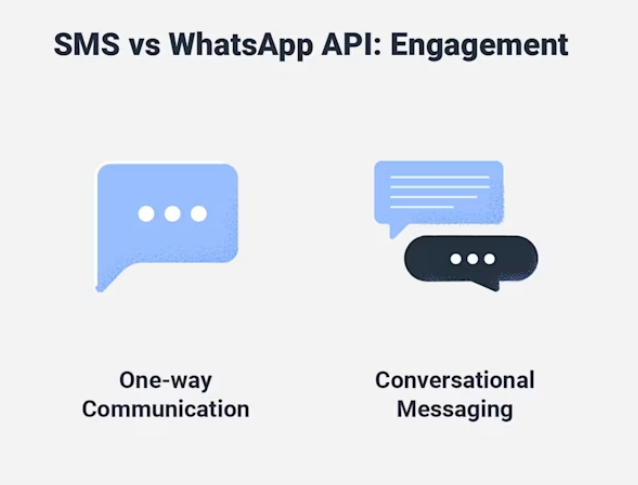
This is where WhatsApp often wins big. You might pay a little more to send a WhatsApp message, but if it generates significantly more customer action (clicks, replies, sales) than an SMS would, the cost per conversion is lower on WhatsApp. For example, spending $100 to get 50 customers to buy via WhatsApp is better than spending $50 to get 5 customers via SMS. Many businesses report higher ROI from WhatsApp campaigns due to the richer interaction. As one source notes, WhatsApp’s popularity and interactive design lead to much better engagement – some have seen conversion rates on WhatsApp an order of magnitude higher than via SMS. Thus, WhatsApp often gives more “bang for your buck.”
4. Reliability & Customer Preference
WhatsApp messages have delivery receipts and tend to reliably reach the user (except in rare cases like app uninstalled or network issues). SMS can sometimes fail silently due to carrier filters, especially for promotional content. Also, today’s consumers (especially younger demographics) may trust and prefer messaging on apps like WhatsApp or iMessage over SMS. A 2019 survey found 53% of consumers are more likely to buy from a company they can contact via a chat app (like WhatsApp). So offering WhatsApp as a channel can improve customer sentiment and outcomes, which is an indirect cost benefit (happier customers = better retention and sales).
In pure dollar terms, SMS vs WhatsApp cost depends on usage: SMS might be cheaper for a one-off blast to a large list, but WhatsApp can save money (or deliver higher value) when you engage in dialogues or multimedia messaging. The good news is you don’t have to choose one exclusively – you can leverage both to optimize costs and customer experience.
Meet SendWo: Cutting Costs on WhatsApp Messaging

If you’re excited about WhatsApp’s potential but worried about costs piling up, SendWo is here to be a game-changer. SendWo is an all-in-one WhatsApp marketing platform that dramatically lowers the cost of WhatsApp campaigns for businesses. In fact, SendWo’s model is unique: no pay-per-message fees – you pay a flat rate for bulk WhatsApp messaging. This means you can send unlimited WhatsApp messages without worrying about each message’s cost, which is revolutionary compared to the typical per-message pricing.
How does SendWo achieve this?
It provides a software platform that lets you connect multiple WhatsApp Business accounts, manage campaigns, and even rotate sender numbers to maximize deliverability. You get tools like bulk messaging, WhatsApp chatbot, autoresponders, multimedia support, contact management, and detailed campaign analytics all in one place. Essentially, SendWo gives you the power of the WhatsApp API without the usual billing meter running for every message.
Some highlights of using SendWo for WhatsApp marketing:
- One-Time Affordable Pricing: Instead of paying every time you send a message, you can choose a SendWo plan (they even have a lifetime unlimited option) and then send messages freely. For example, with SendWo’s Enterprise lifetime plan (~$84 one-time), you get unlimited messages forever across up to 50 WhatsApp accounts. Compare that to spending $84 on perhaps a few thousand SMS or WhatsApp API messages – the savings are clear if you plan to reach large volumes. Even the yearly plans (like $60/year for 360K messages) bring the per-message cost down to near zero.
- No Template Hassles for Marketing: SendWo allows you to send bulk messages directly (it’s built on the official WhatsApp API, but streamlines the process). You don’t need to wait for template approvals for each campaign like you would with a standard BSP – you can craft personalized messages on the fly. This speeds up your marketing and doesn’t hold you back when you want to run a quick promotion (though you should still follow best practices and avoid spamming – SendWo emphasizes a no-spam policy to protect your numbers).
- Advanced Features to Boost ROI: The platform includes features like chatbots, auto-responders, campaign scheduling, and even contact list management to segment and personalize your outreach. These can improve engagement (for example, a chatbot can handle common inquiries instantly, saving your team time and delighting customers with quick answers). You can also send rich media – images, videos, and PDFs – to make your messages compelling. And with analytics tracking, you’ll see open rates, click-through rates, and responses from your WhatsApp campaigns to gauge effectiveness.
- Free Trial to Get Started: SendWo offers a 24-hour free trial with full features. No credit card required – you can test out the platform and send some messages to see the impact, at no cost. This is a great way to compare how your audience responds on WhatsApp vs maybe previous SMS campaigns, without any commitment.
In a direct cost comparison, if you’re using a typical WhatsApp API provider, you might pay, say, $0.005 per message. That’s $5 per thousand messages, or $500 per 100k messages. With SendWo’s unlimited model, your cost for 100k or even 1 million messages doesn’t increase – it’s a fixed subscription or lifetime fee. That can translate to massive savings for businesses doing large-scale outreach. Essentially, SendWo turns WhatsApp into a one-time or fixed cost channel, much like email, rather than a variable cost channel.
Actionable Tip: If you’re currently using SMS for large campaigns due to cost concerns, try SendWo’s free trial. You could potentially reach the same audience on WhatsApp at a fraction of the effective cost and see better results. It’s an opportunity to modernize your customer communication strategy and save money.
Conclusion

When comparing WhatsApp API and SMS costs, there’s no one-size-fits-all answer—it depends on your use case, audience, and how you define “cost.” Per-message fees may make SMS seem cheaper in some cases, while WhatsApp may be less expensive in others. However, when you consider hidden costs and the value generated by each message, WhatsApp often proves more cost-effective for businesses focused on customer engagement and conversions. Its ability to support rich, free-flowing conversations and leverage WhatsApp’s widespread popularity leads to higher revenue and stronger customer loyalty, delivering greater value per dollar spent.
SMS remains important due to its ubiquity and reliability for simple alerts. Many successful businesses use both channels: WhatsApp as the primary channel to capitalize on its high engagement at a reasonable price, and SMS as a backup or supplementary channel when needed. Recent WhatsApp pricing changes, including free service messages and volume discounts, have further reduced cost differences.
Your messaging strategy should align with your customer base. If your customers are active WhatsApp users, ignoring WhatsApp means missing a favored channel, and cost is now less of a barrier. For users not on WhatsApp, SMS ensures you still reach them. Consider the return on investment: spending a bit more on WhatsApp often yields significantly higher engagement, making it worthwhile. Conversely, if a simple SMS suffices at minimal cost, it remains a solid option. The smartest approach is to use each channel where it excels.
Tools like SendWo enhance WhatsApp’s cost advantage by removing per-message fees for WhatsApp campaigns. This innovation allows businesses to reach thousands of customers on WhatsApp without worrying about message costs. Given WhatsApp’s rich features and improved pricing, now is an excellent time to adopt WhatsApp Business messaging.
Ready to improve customer communication while controlling costs? Try WhatsApp Business messaging today and see the engagement difference. Start with SendWo’s free trial to send bulk WhatsApp messages at nearly no cost and experience the impact firsthand. Don’t let outdated channels or cost concerns hold you back—unlock WhatsApp’s power to connect with your customers in a more meaningful and affordable way. Your customers are on chat—your business should be, too!
1. Is WhatsApp Business API cheaper than SMS for businesses?
It can be. WhatsApp’s pricing has evolved to be very competitive with SMS. In many regions, a WhatsApp message costs only a few cents (or less), similar to an SMS. WhatsApp also offers free messages in certain cases (e.g., replying to customers’ inquiries is free). SMS, by contrast, charges for every message sent and sometimes received. If you are sending one-way bulk messages and your local SMS rates are extremely low, SMS might appear cheaper per message. But if you engage in conversations or consider conversion rates, WhatsApp often ends up cheaper per successful interaction because more customers engage with it. Plus, WhatsApp doesn’t require renting expensive short codes or paying monthly fees for numbers, which can make the overall cost lower. With solutions like SendWo (flat pricing for unlimited WhatsApp messages), WhatsApp can become dramatically cheaper than SMS for marketing since you’re not paying per message at all with that model. So, WhatsApp API can be cheaper when you factor in all these aspects, especially for two-way communication and high volumes.
2. What are the actual costs of the WhatsApp API?
As of 2025, WhatsApp Business API charges per message, replacing the previous per-conversation pricing. Costs vary by message type and country: user-initiated service messages are free; utility messages (e.g., updates, reminders) cost about $0.005–$0.01; authentication (OTP) messages are around $0.01 or less; marketing messages range from $0.005 to $0.02+ depending on region. Meta offers free inbound and service messages within a 24-hour customer service window, effectively providing ~1,000 free service messages monthly. Third-party providers (BSPs) may add small fees, though some, like SendWo, offer no extra charges or free trials. Volume discounts can reduce costs to fractions of a cent per message at scale. For exact rates, check Meta’s official pricing or your BSP. Overall, WhatsApp pricing is now transparent and competitive with SMS in most markets.
Aditi Kamini
Aditi, a content marketer at SendWo, is a passionate writer and marketing enthusiast. She excels in driving revenue campaigns, building client relationships, and mastering content creation, SEO, customer service, and project management.