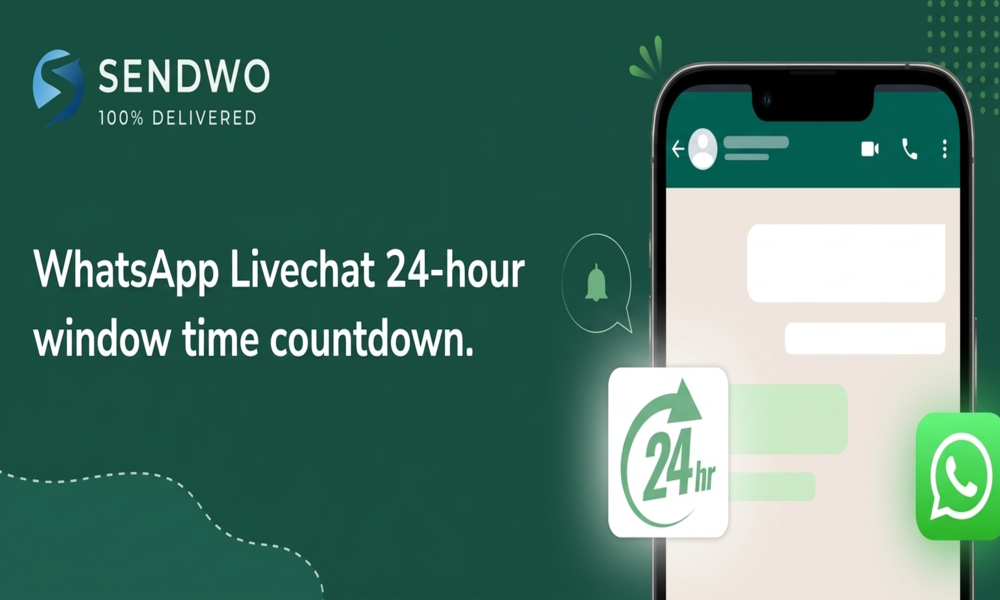
WhatsApp Livechat 24-hour window time countdown - Easy Guide
If you’ve ever typed the “perfect” reply in a WhatsApp Livechat 24-hour window has expired—you know the pain: your message can’t be sent as a normal free-form reply, you risk policy issues, and your team wastes time scrambling for the “right template.”That’s exactly why the “WhatsApp livechat 24-hour window time countdown” concept is more than […]
 By Aditi Kamini
Published: March 11, 2026
Updated: April 4, 2026
9 min read
By Aditi Kamini
Published: March 11, 2026
Updated: April 4, 2026
9 min read
If you’ve ever typed the “perfect” reply in a WhatsApp Livechat 24-hour window has expired—you know the pain: your message can’t be sent as a normal free-form reply, you risk policy issues, and your team wastes time scrambling for the “right template.”That’s exactly why the “WhatsApp livechat 24-hour window time countdown” concept is more than […]
If you’ve ever typed the “perfect” reply in a WhatsApp Livechat 24-hour window has expired—you know the pain: your message can’t be sent as a normal free-form reply, you risk policy issues, and your team wastes time scrambling for the “right template.”That’s exactly why the “WhatsApp livechat 24-hour window time countdown” concept is more than a UI detail. It’s a revenue-protecting, compliance-saving, customer‑experience upgrade—especially when your team is handling dozens (or thousands) of chats a day from one official number. This guide breaks down the rules, the timer logic, the edge cases, and a practical “countdown-first” workflow you can run inside SendWo.
1. WhatsApp’s 24-hour customer service window is the rule behind the countdown
On the WhatsApp Business Platform, you can reply to a user without a template only if you’re within 24 hours of the user’s last message. Once you’re outside that window, you can only message again using approved message templates.
In other words, the countdown is simply a visible way to answer one operational question:
“How much time do we have left to reply normally before we must switch to templates?”
The rule is policy + pricing, not just “best practice”
WhatsApp makes this rule explicit in its business messaging policy:
- You may reply without a template within 24 hours of the last user message.
- Outside the 24‑hour customer service window, you may only send approved message templates.
Separately, WhatsApp’s pricing pages make it clear that:
- WhatsApp Business Platform is priced per delivered message (charged on delivery, not sending).
- Service messaging is designed for inbound support, and when users message a business, a 24‑hour customer service window opens and resets with each user message.
2. WhatsApp livechat 24-hour window time countdown explained
A “24-hour window countdown” inside a team inbox is a session timer that shows the remaining time until the current customer service window closes.
When implemented well, it typically does three things:
- Shows time remaining (e.g., “19h 12m left”) based on the user’s last inbound message.
- Warns you before expiry so agents can respond, escalate, or swap in a template.
- Prevents accidental non-compliant outreach after the window ends.
For SendWo specifically, this isn’t theoretical—SendWo publicly notes improvements to the “WhatsApp livechat 24-hour window time countdown” in its product updates, and also describes a real-time 24-hour countdown plus expiration notifications in its WhatsApp 24‑hour rule content.
3. Why the countdown is now a “must-have” (not a nice-to-have)
WhatsApp is massive—TechCrunch reported that WhatsApp crossed 3+ billion monthly users, based on discussion during Meta’s Q1 results call.
- When your customers choose WhatsApp as their default support channel, they bring “chat expectations” with them: fast replies, clear next steps, and minimal friction. When you miss the 24‑hour window, the experience becomes slower and more expensive (because you must switch to templates and approvals).
- It’s also worth remembering what poor support costs: Zendesk cites benchmark data showing that more than one-half of consumers will switch after only one bad experience, and 73% switch after multiple bad experiences.
- Why the countdown is a growth lever, not just a compliance timer
- Most competitor content stops at “You can’t message after 24 hours.” That’s true—but incomplete.
A countdown helps you win on three fronts:
Customer experience and loyalty
When you reply inside the window, you can keep the conversation natural—contextual, conversational, and fast. This matters because customer support is a loyalty engine: great experiences increase repeat purchasing and trust, while poor experiences drive churn.
Practical outcome: fewer “Where is my order?” follow-ups, fewer repeated questions, fewer escalations.
Sales conversion and “speed-to-lead”
- A countdown mindset forces faster routing and response discipline. Why does that matter? Because response delay kills contact and qualification rates.
- A classic lead-response study associated with Massachusetts Institute of Technology reports that the odds of contacting a lead when called in 5 minutes vs 30 minutes can drop dramatically (100x in that study’s summary).
- You don’t have to treat WhatsApp like a call center to benefit from this. You just need one behavioral shift:
- Treat every inbound WhatsApp message as a “timer-starting” business event.
Cost control under per-message pricing
WhatsApp states clearly that it charges per delivered message, with rates varying by market and message category.
It also states:
- No charge for service messages (support replies) and no charge for utility messages sent in response to users.
That makes the countdown financially meaningful: staying in-window helps you keep more interactions in the “respond to user” context, and reduces unnecessary paid re-engagement attempts.
4. The timer math and edge cases people get wrong
Let’s make it simple, precise, and operational.
When does the 24-hour countdown start?
- From WhatsApp’s public pricing explainer: when users message a business, it opens a 24-hour customer service window, and the window resets with each user message.
- Many providers describe the same principle: it’s WhatsApp Livechat 24-hour window after the last inbound user message during which free-form responses are allowed.
- Key takeaway: The countdown is keyed to the user’s inbound activity, not your outbound messages.
What “resets” the countdown?
Per WhatsApp’s pricing explainer: each user message resets the window.
So, if a customer sends:
“Hi” at 10:00 AM
“Any update?” at 6:00 PM
Your new expiration point is 6:00 PM + 24 hours, not 10:00 AM + 24 hours.
What happens at expiry?
When the window expires:
- You cannot continue with normal free-form messages.
- You must send an approved template to re-initiate communication (unless the user messages again and reopens the window).
This is exactly why SendWo emphasizes template support as a “post-window” option.
Automation is allowed, but human escalation must exist
- WhatsApp policy allows automation during the 24-hour window, but requires clear escalation paths, including in-chat human agent handoff and other contact methods.
- This matters for countdown design: your automation should reduce agent load, not trap customers in looping bots while the timer runs out.
Opt‑in and “don’t surprise people” still apply
WhatsApp’s policy requires businesses to only contact people if they provided their number and gave opt-in permission, and it also requires honoring block/opt-out requests.
Turn this learning into your next WhatsApp campaign.
Start with Sendwo’s free plan, explore WhatsApp broadcasts, automation, AI chatbot flows, and upgrade only when your business needs more power.
So the countdown isn’t a “spam clock.” It’s a tool to respond quickly and appropriately, inside policy.
5. Building a countdown-first WhatsApp live chat workflow in SendWo
A countdown is only as useful as the workflow it drives. Here’s a practical operating model you can copy.
A simple story: what happens without the countdown
Imagine a small e-commerce brand with 3 agents sharing a WhatsApp API number.
- A customer asks, “Can I change my delivery address?”
- One agent sees it, but doesn’t own it. Another agent assumes it’s handled.
- The question sits overnight.
- Next day, the agent replies—but the 24-hour window expired, so they now need an approved template to re-engage.
Result: slower resolution, frustrated customer, and higher churn risk. (And churn risk is real—benchmarks show many customers switch after bad experiences.)
The same story with a countdown-first inbox
The workflow changes when your inbox has three capabilities:
- Multi-agent support with roles and access
SendWo highlights shared team inbox capabilities such as access levels and controlled access to manage WhatsApp as a team.
- Live chat productivity features
SendWo’s WhatsApp Live Chat Inbox positions itself around team collaboration, subscriber management, multilingual translation, follow-up notifications, and AI-powered response automation.
- A clear 24-hour countdown + alerts
SendWo explicitly describes a real-time 24-hour countdown and expiration notifications related to the WhatsApp Livechat 24-hour rule.
Operational impact: the timer turns “ownership ambiguity” into a measurable SLA.
6. Templates and proactive messaging without breaking policy
If you take one thing from this section, let it be this:
Your business needs two “lanes” of messaging—session replies and template re-engagement.
Lane one: session-based replies (in-window)
Inside an open customer service window, businesses can respond with service messages at no charge, and the window resets with each user message.
This is your best lane for:
- Support conversations
- Clarifying questions
- Order issues
- Product fit questions
Lane two: template-based outreach (post-window or proactive)
Outside the window, you can only send messages using approved templates.
SendWo’s own guidance frames templates as a way to keep compliance and re-engage after the grace period, and it calls out template message support as a core capability.
Practical template examples (use as inspiration, not copy-paste):
- Order update (utility-style): “Your order {{order_id}} is scheduled for delivery on {{date}}.”
- Support follow-up: “Just checking in—do you still need help with {{issue}}?”
- Appointment reminder: “Reminder: your appointment is at {{time}}. Reply 1 to confirm.”
Pricing realities you should bake into your countdown strategy
WhatsApp states:
It charges per delivered message, and rates vary by market and category.
It does not charge for service messages, and does not charge for utility messages businesses send in response to users.
So the countdown becomes a cost lever:
- In-window: use natural, free-form replies to resolve quickly.
- Approaching expiry: decide whether a final reply closes the loop, or whether templates are needed for follow-up.
Bonus: free entry points can change your campaign design
WhatsApp also describes “free entry points” such as when customers message from a click-to-WhatsApp ad (or a page CTA), where for the next 72 hours messages are not charged.
This doesn’t replace the 24-hour customer service window rule for free-form replies—but it does influence how you plan acquisition and support journeys (ads → chat → conversion → post-purchase support).
Conclusion
A WhatsApp Livechat 24-hour countdown is basically running with an invisible SLA and hoping for the best.
A WhatsApp live chat operation that embraces the countdown gets four repeatable wins:
- Faster responses (the timer creates clarity and urgency).
- Fewer compliance mistakes (less chance you message outside the allowed window).
- Better customer retention (bad experiences drive switching; great support improves loyalty).
- More predictable costs (you understand when you’re in a service window vs template re-engagement).
- If you want to operationalize this quickly, SendWo positions its WhatsApp Livechat 24-hour Inbox around multi-agent collaboration, translation, follow-up notifications, and AI-powered response automation—and it explicitly calls out real-time countdown and expiration notifications for the 24-hour rule.
FAQ
1. What is the WhatsApp 24-hour customer service window?
It’s the 24-hour period that starts when a user messages your business, during which you can respond as customer support. WhatsApp describes this as a “24-hour customer service window” that resets with each user message.
2. When does the WhatsApp Livechat 24-hour countdown reset?
The countdown resets when the user sends another message. WhatsApp’s pricing explainer says the 24‑hour customer service window “resets with each user message.”
3. Can I send free-form WhatsApp messages after 24 hours?
Not as a normal reply. WhatsApp’s business policy and common provider documentation state that outside the customer service window you may only send approved templates.
4. What happens if my agent tries to message after the WhatsApp Livechat 24-hour window ends?
Operationally, you should expect the message to be blocked by the platform rules (or require template sending instead). That’s why inbox countdowns and expiry warnings are so valuable for teams.
5. How do I reopen a WhatsApp chat after the 24-hour window has expired?
You have two common, policy-aligned options:
- Wait for the user to message again (which reopens the customer service window).
- Send an approved template message (if your use case and permissions allow it)
Aditi Kamini
Aditi, a content marketer at SendWo, is a passionate writer and marketing enthusiast. She excels in driving revenue campaigns, building client relationships, and mastering content creation, SEO, customer service, and project management.