How to Add Broadcasting Permission Without Requiring Bot Manager Permission - Easy Guide
Learn how to Add Broadcasting Permissionin WhatsApp Business API or tools like SendWo without needing Bot Manager admin access.
 By Aditi Kamini
Published: April 17, 2026
Updated: May 8, 2026
9 min read
By Aditi Kamini
Published: April 17, 2026
Updated: May 8, 2026
9 min read
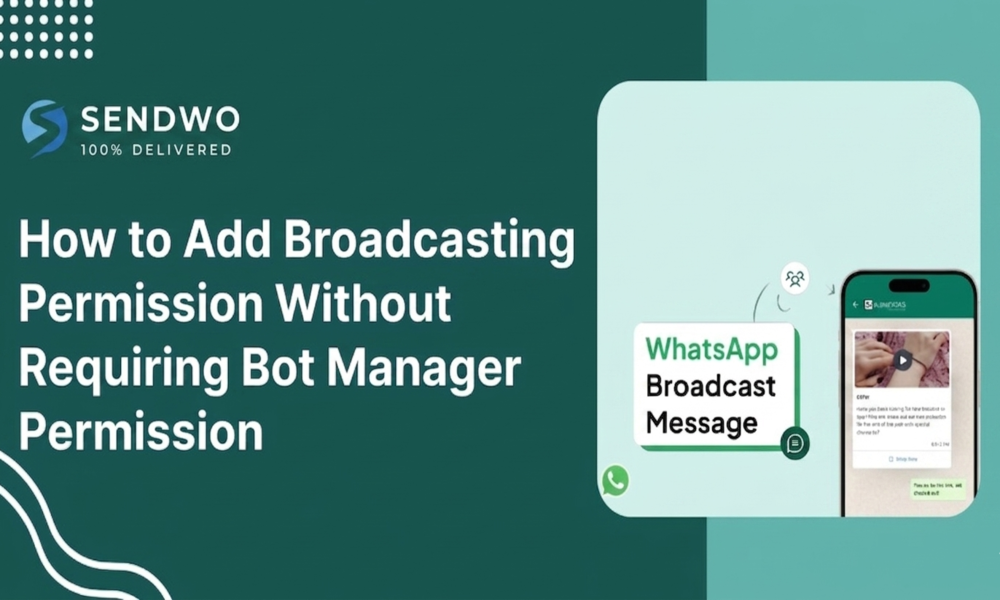
Learn how to Add Broadcasting Permissionin WhatsApp Business API or tools like SendWo without needing Bot Manager admin access.
If you searched for “How to add Broadsting permission without requiring Bot Manager permission”, you are really trying to solve a very practical WhatsApp operations problem: give a team member access to run campaigns without giving them control over templates, bot flows, or other automation assets. But inside SendWo, day-to-day access control is still organized around Team Roles, Team Members, and separate feature modules such as Broadcast and Bot Manager. That means the cleanest SendWo setup is still a role-based one: let campaign operators handle broadcasts; let bot admins handle templates and automation.
The fix in SendWo: create a custom Team Role, enable only Add Broadcasting Permission access you want, leave Bot Manager turned off, assign that role to the team member, and restrict the user to the right allowed WhatsApp bot(s). If that user needs to send an Anytime broadcast, make sure a separate admin has already created and received approval for the required message template.. Let see How to Add Broadcasting Permission Without Requiring Bot Manager Permission.
1. Why this permission split matters
- Good Add Broadcasting Permission design is not just about tidiness. It is about speed, privacy, and damage control. SendWo’s own positioning around its shared team inbox emphasizes that multiple agents can work on the same number with different levels of access and control for better privacy. That is exactly why broadcast-only access is useful for marketing teams, franchise teams, agencies, and internal operators who need to launch approved campaigns but should not be able to edit templates, change flows, or reconfigure bot behavior.
- There is also a security principle behind this. NIST defines least privilege as restricting a user to the minimum access needed to complete assigned tasks. Applied to SendWo, that means a campaign operator should have campaign tools, while the automation owner keeps the sensitive controls inside Bot Manager. For growing teams, that separation reduces mistakes, protects live flows, and makes accountability much clearer when something changes.
2. Add Broadcasting Permission and Bot Manager access really mean in SendWo
Broadcast access
- SendWo’s WhatsApp Add Broadcasting Permission documentation shows that the Broadcasting area is where users create campaigns, choose the campaign type, include or exclude label IDs, schedule sends, and track broadcast progress. It also distinguishes between 24 hours mode and Anytime mode. In other words, this is the campaign execution layer. If someone’s job is to launch a promotion, send an update, or schedule a template-based campaign, the Broadcast module is where that operational work happens.
Bot Manager access
- Bot Manager is different. In SendWo’s documentation structure, Message Templates, Sequences, Action Buttons, and Chat Widgets all live under the Bot Manager area. SendWo’s template docs also make clear that message templates are pre-approved formats used for compliant messaging, especially outside the normal support window. So Bot Manager is not “just another send screen.” It is much closer to an asset-building and automation administration layer.
One subtle but important extra permission
- Here is the nuance many teams miss: if your user needs to create or manage audience labels, that is not a Bot Manager task either. SendWo’s docs place labels in Subscriber Manager, and Add Broadcasting Permission page uses those labels for targeting through Include label IDs and Exclude label IDs. So if your marketer needs segment control, the extra permission to think about is often Subscriber Manager, not Bot Manager.
3. The clean SendWo setup
Here is the documented role-based workflow that best matches the search intent behind this keyword.
- Open Dashboard → Management → Team Role and create a new role. SendWo instructs admins to go to the Team Role section, click Create, name the role, and toggle on only the permissions the team should receive.
- Enable the Broadcast-related permission and leave Bot Manager disabled. SendWo’s module structure shows Broadcast and Bot Manager as separate areas, which is why this separation is the intended role design. If the operator only needs campaign sending, scheduling, and monitoring, there is no documented reason to bundle that with bot-building access.
- Create the user in Dashboard → Management → Team. In the Team Member flow, SendWo asks you to enter user information and assign the team role, along with allowed WhatsApp bots, allowed Telegram bots, and allowed ecommerce stores. That means you can give a user broadcast duties and still limit them to the exact WhatsApp account they are supposed to operate.
- Decide whether the user also needs Subscriber Manager. If the person only sends to existing segments, Broadcast access may be enough. If they also need to create, edit, or maintain labels used for targeting, add Subscriber Manager access as a separate permission instead of handing over Bot Manager access by default.
- Test the role with the right campaign type. In SendWo, a 24 hours campaign targets active subscribers and allows freer message composition, while Anytime campaigns require selecting an approved message template and can be scheduled. That is the easiest way to confirm whether your broadcast-only user has exactly the scope they need.
The most practical takeaway is simple: Broadcast access is for sending; Bot Manager is for building. In SendWo’s documented module layout, those are not the same job.
4. When Bot Manager still belongs in the workflow
You can absolutely separate broadcast execution from bot administration, but there are cases where someone on the team still needs Bot Manager.
The biggest one is template creation and maintenance. WhatsApp’s Business Messaging Policy says businesses may only initiate conversations using an approved Message Template, and outside the 24-hour customer service window, businesses may only send messages through approved templates. SendWo’s Broadcast docs mirror that rule by stating that Anytime broadcasts can only use an approved template, and its template tutorials show those templates being created and managed in the Bot Manager area.
That means the clean operational model is:
- Template admin creates and maintains templates in Bot Manager.
- Broadcast operator selects already-approved templates inside Broadcast/Add Broadcasting Permission.
- Audience manager optionally handles labels in Subscriber Manager.
That division is an inference from SendWo’s module split, but it is a strong one because the docs place template creation in Bot Manager, label management in Subscriber Manager, and campaign execution in Add Broadcasting Permission.
A real-world example makes this easier to picture. Imagine a retail brand with one automation lead and two campaign coordinators. The automation lead builds the welcome flow, owns the templates, and monitors approvals. The campaign coordinators just need to launch Friday offers and seasonal reminders. In that setup, giving both coordinators Bot Manager access creates unnecessary risk. Giving them Broadcast access only, plus the correct WhatsApp bot assignment, is the cleaner model. The docs support that separation of duties.
Turn this learning into your next WhatsApp campaign.
Start with Sendwo’s free plan, explore WhatsApp broadcasts, automation, AI chatbot flows, and upgrade only when your business needs more power.
5. Problems that make broadcast-only access fail
- The user cannot see or use the correct WhatsApp number. In SendWo’s Team Member form, allowed account scope matters. If the right allowed WhatsApp bot is not assigned, the role may look correct on paper while still failing in practice. Always check the Team Member record, not just the Team Role.
- The user can send in 24-hour mode but fails in Anytime mode. This usually points to a template issue, not a Bot Manager issue. SendWo requires an approved template for Anytime broadcasts, and WhatsApp policy requires approved templates outside the 24-hour window. If no approved template exists, or if approval is still pending, the campaign will stall.
- The user can broadcast but cannot build the segment. That usually means you separated Broadcast from Bot Manager correctly, but forgot that labels live in Subscriber Manager. If your operator needs to create or edit labels before sending, give the relevant Subscriber Manager permission rather than overcompensating with Bot Manager.
- The campaign is operationally ready but still risky from a policy standpoint. WhatsApp policy is explicit: you may only contact people who gave you their mobile number and opted in, and you must honor opt-outs. So even a perfectly configured SendWo role will not protect you from quality problems if the audience itself is non-compliant. Permissions help with governance; they do not replace opt-in discipline.
6. The access model that scales for real teams
If you want a setup that grows without turning your workspace into a permission mess, use a three-role model. This is a best-practice recommendation based on SendWo’s module split and least-privilege principles.
Broadcast Operator
- Use this role for sending campaigns, scheduling, selecting approved templates, and checking campaign progress. Give Broadcast access, assign the correct allowed WhatsApp bot(s), and keep Bot Manager off.
Audience Manager
- Use this role for labels, subscriber cleanup, and targeting hygiene. Layer in Subscriber Manager if the person needs to build or refine segments.
Automation Admin
- Use this role for templates, bot flows, sequences, widgets, and deeper automation controls inside Bot Manager. This is the role that should own creation, edits, and approval-related workflows for reusable assets.
That model maps cleanly to SendWo’s UI, respects least privilege, and reduces the odds that a campaign sender accidentally edits something structural. It also fits SendWo’s shared-team positioning, where different agents can work on the same WhatsApp number with different levels of access and control.
If you want the fastest path to implementation, start with one role named Broadcast Operator, assign it to a single test user, limit that user to one WhatsApp bot, and validate both 24 hours and Anytime campaigns. Once that works, roll the model out to the rest of your team. SendWo markets a free plan, shared team access, and official WhatsApp API-based Add Broadcasting Permission, which makes it a practical environment for testing this access structure before scaling it company-wide.
FAQ
1. Can I give a user broadcast-only access in SendWo?
Yes. In SendWo’s documented role system, you create a custom Team Role, toggle only the permissions you want, and then assign that role to a Team Member. Because Broadcast and Bot Manager appear as separate modules in the docs, the intended setup is to give campaign operators Broadcast access without automatically giving them Bot Manager access.
2. Why can a user send a 24-hour campaign but not an Anytime campaign?
Because SendWo treats those as different messaging conditions. A 24 hours campaign targets active subscribers and allows freer messaging, while an Anytime campaign requires an approved message template. WhatsApp policy also requires approved templates outside the 24-hour service window.
3. Do I need Bot Manager permission to use templates that already exist?
Not necessarily to create or administer them. Based on SendWo’s documented module split, a separate admin can manage templates in Bot Manager while a broadcast operator uses approved templates during campaign execution in the Broadcast module. If you still cannot see the template in practice, check the role configuration, the allowed WhatsApp bot assignment, and the template’s approval status first.
4. What permission should I add if the user needs to manage labels too?
Usually Subscriber Manager, not Bot Manager. SendWo’s docs place label management in Subscriber Manager, and Add Broadcasting Permission uses those labels for campaign targeting through include/exclude label fields.
5. Can I restrict a broadcast user to only one WhatsApp number?
Yes. In the Team Member creation flow, SendWo allows admins to choose allowed WhatsApp bots for that user. That is one of the most important controls when you want safe, account-specific campaign access.
Aditi Kamini
Aditi, a content marketer at SendWo, is a passionate writer and marketing enthusiast. She excels in driving revenue campaigns, building client relationships, and mastering content creation, SEO, customer service, and project management.