How Does WhatsApp Work? 5 Powerful Secrets
Discover how Does WhatsApp Work with this ultimate guide to its powerful messaging magic! Unlock seamless chats, secure end-to-end encryption
 By Aditi Kamini
Published: January 15, 2026
Updated: March 26, 2026
11 min read
By Aditi Kamini
Published: January 15, 2026
Updated: March 26, 2026
11 min read
Discover how Does WhatsApp Work with this ultimate guide to its powerful messaging magic! Unlock seamless chats, secure end-to-end encryption
Imagine chatting with a friend on the other side of the world instantly – that’s the magic of WhatsApp, the mobile app used by over 3 billion people worldwide (as of 2025). WhatsApp lets you text, send photos/videos, and make voice or video calls for free by using your smartphone’s internet connection instead of costly SMS or phone minutes. In fact, WhatsApp “uses your internet connection to send encrypted messages, pictures and calls to others… so you can chat with people for free”.
The app’s core appeal is not only its cost (no per-message fees) but its robust security: since 2016 every WhatsApp chat and call is secured with end-to-end encryption (the open-source Signal Protocol). That means only you and your recipient can read the messages – not even WhatsApp or Meta can decrypt your chats.
In this guide, we’ll explore how Does WhatsApp Work under the hood: from basic setup and features to its scalable architecture and privacy model. We’ll cover how messages travel through WhatsApp’s system, how calls are made, and even how businesses can tap into WhatsApp via official APIs. Strap in to learn the tech and tricks behind WhatsApp’s seamless chats!
1. How Does WhatsApp Work?
WhatsApp works by connecting your phone (or device) to WhatsApp’s servers and to your contacts via the internet. Here’s a high-level breakdown:
- Phone-based identity: WhatsApp uses your phone number as your unique ID. When you first set it up, you register with a valid mobile number and verify it via SMS or call. Your WhatsApp contact list is automatically synced to your phone’s address book.
- Internet connectivity: Instead of SMS, WhatsApp sends all your messages and media over the internet (Wi-Fi or mobile data). As noted, it “uses your internet connection to send encrypted messages, pictures and calls”. This is why WhatsApp is essentially free – you just need data, not text credits.
- Persistent connection: Once you open WhatsApp, it maintains a constant TCP connection to WhatsApp’s servers. Your device stays “logged in” (even in the background) so you receive messages instantly. This single, long-lived connection means you don’t have to reconnect every time you send a new message.
- Custom protocol: WhatsApp uses a proprietary messaging protocol (based on XMPP) called FunXMPP. It compresses data heavily before sending. For example, a simple “hello” text might usually be a ~180-byte XML packet, but WhatsApp shrinks it to only ~20 bytes. This efficiency means how Does WhatsApp Work well even on slow 2G networks – “a user in rural India on 2G experiences the same quick delivery as someone on 5G”.
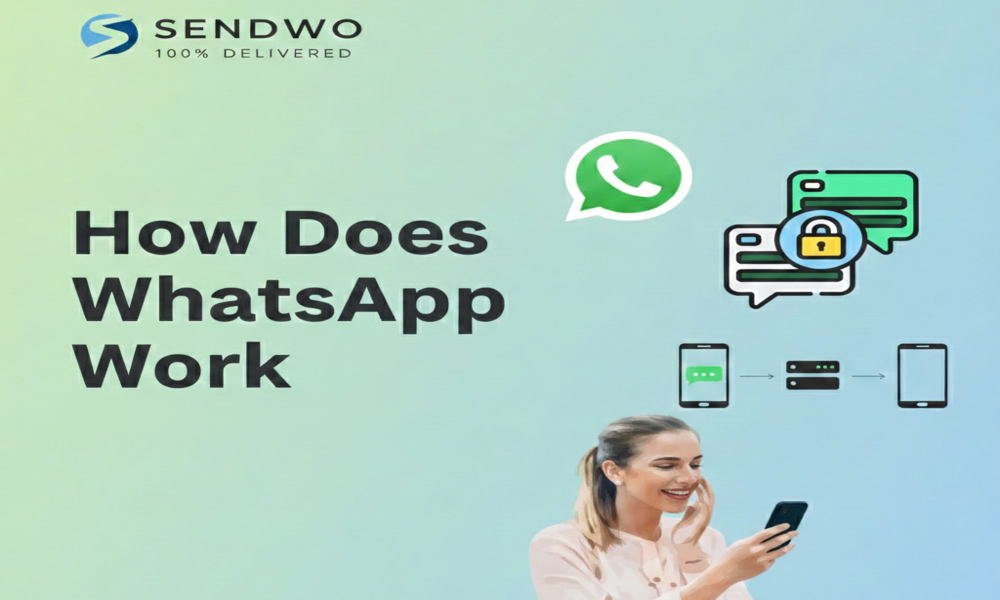
- Message flow: When you send a message, your phone encrypts it with the recipient’s key (Signal Protocol) and sends it to WhatsApp’s server. The server then forwards it to your friend’s device (via their open connection). If the friend is offline, the server holds the encrypted message in a queue until they come online. You’ll see one check mark (✓) when WhatsApp’s server receives it, and a second ✓ when the friend’s phone gets it. Once delivered, if encryption is confirmed, the ticks turn blue (read).
- Multi-device: Today you can also link companion devices (like a PC or second phone) to your account. WhatsApp’s web/desktop clients mirror your phone’s chats. Originally your phone had to stay connected, but recent updates allow stand-alone apps that no longer require the primary phone to be online (companion mode).
In practice, all of the above is invisible. You just type a message or tap to call, and how Does WhatsApp Work complex backend takes care of the rest. It silently encrypts, routes, and delivers the data, giving the feel of real-time chat.
2. Key Features of WhatsApp
WhatsApp offers a rich set of communication features that make it more than just text messaging:
- Instant Messaging: Send text chats, voice notes, photos, videos, documents, contacts, and live locations to individuals or groups. All media is sent over data, so sharing large files is easy and free.
- Voice & Video Calls: Make one-on-one or group voice and video calls anywhere in the world at no charge (beyond data usage). WhatsApp uses Voice-over-IP (VoIP) technology to carry call data. Like messages, all calls are end-to-end encrypted.
- Group Chats: Create groups of up to 1,024 people to coordinate with friends, family, or teams. Group admins can add/remove members and control certain settings.
- Status Updates: Post “Status” photos or short videos (like Instagram/Snapchat stories) that disappear after 24 hours.
- Channels & Broadcasts: Follow public channels for announcements, or use broadcast lists to send a message to many contacts at once (each recipient sees it individually).
Security & Privacy:
- End-to-End Encryption: Every chat and call uses the Signal Protocol by default, so content is private.
- Advanced Privacy Controls: Features like Disappearing Messages (auto-delete after a time), View Once photos/videos, and Chat Lock add layers of privacy. In 2025 WhatsApp introduced “Advanced Chat Privacy”, letting users block outsiders (even group members) from forwarding or exporting their chats and media.
- Two-Step Verification: An optional PIN that adds a second layer when registering your number on a new device.
- Cross-Platform: Available on multiple operating systems. The web and desktop apps mirror your phone’s account. New multi-device support means you can use WhatsApp on several devices simultaneously without constantly tethering to your phone.
- WhatsApp Business: A separate app and API for businesses. Small businesses use the free WhatsApp Business app to chat with customers. Larger companies use the official WhatsApp Business API to automate messages (e.g. shipping updates, notifications) and run chatbots. Over 50 million businesses worldwide engage customers via WhatsApp. For example, SendWo offers a free WhatsApp marketing platform powered by the official Business API, letting companies send bulk messages, manage chats, and even deploy AI chatbots on WhatsApp.
Each feature uses how Does WhatsApp Work core messaging infrastructure. Under the hood, your chats, calls, and media all go through WhatsApp’s encrypted channels. For you, the experience is simple: open the app, tap a contact, and start chatting. how Does WhatsApp Work handles the rest automatically.
3. WhatsApp Architecture & Data Flow
While WhatsApp’s consumer experience is straightforward, the technology behind it is a marvel of scalability and efficiency. Here are some key points about its architecture:
- Erlang Servers: WhatsApp’s backend runs on Erlang/OTP – a telecom-grade platform designed for massive concurrency. This allows a single server to handle millions of simultaneous connections. Each user connection is a tiny “process” in Erlang’s VM, so a server can manage millions of users at once.
- Distributed Database (Mnesia): WhatsApp uses a distributed in-memory database to track who is online and where to route messages. This means finding and delivering your friend’s messages takes microseconds. If your friend is offline, the message is stored in the server’s queue for them.
- Message Routing: When you send “Hello” in chat, your phone encodes it via FunXMPP and streams it to the server in real time. The server looks up the recipient’s connection and forwards it. This handoff is extremely fast – from milliseconds to a few hundred ms globally.
- Group Messages: For group chats, WhatsApp leverages parallel delivery. You send one encrypted message to WhatsApp, which then fan-outs to each group member’s device individually. This is why sending one message to 100 people still feels very fast.
- Media & Documents: Photos, videos, and files are similarly encrypted and sent over data. WhatsApp optimizes these transfers (sometimes using separate servers or connections) so you can share media quickly even on mobile.
- Checks & Acknowledgments: After delivery, the recipient’s phone sends back an acknowledgement. This is how the check marks update. One check (✓) means “sent to server,” two checks (✓✓) mean “delivered to device,” and blue checks mean “read” (if recipient has read receipts on).
Uptime and Scale: WhatsApp’s engineers design for extreme reliability. The system processes hundreds of billions of messages and calls daily while aiming for near-perfect uptime. They accomplish this with clustering (servers in multiple regions), automated failover, and continuous monitoring. In practical terms, WhatsApp is usually available even if you reboot your phone or lose connection momentarily.
All this complexity is hidden. As a user, you rarely notice network delays or reconnections. That’s the goal: make it work as if you’re directly “wired” to your contacts, even though in reality your data is pinging across oceans and bouncing off multiple servers in milliseconds.
Turn this learning into your next WhatsApp campaign.
Start with Sendwo’s free plan, explore WhatsApp broadcasts, automation, AI chatbot flows, and upgrade only when your business needs more power.
4. Security and Privacy
Privacy is a fundamental pillar of how Does WhatsApp Work design. Some highlights:
- End-to-End Encryption (E2EE): By default, all messages and calls on WhatsApp are protected end-to-end. This means when you send a chat, your phone encrypts it with a unique key, and only the recipient’s device has the matching key to decrypt it. WhatsApp (or any eavesdropper) sees only ciphertext. Meta/WhatsApp cannot read your messages. This encryption covers everything – one-on-one chats, group chats, voice notes, even backups (if enabled).
- Signal Protocol: WhatsApp’s encryption is based on the Signal Protocol – an open-source, forward-secure cryptographic scheme. In 2016, WhatsApp completed integration with Signal, so now every message benefits from advanced cryptography. Users can even verify security code (numerical fingerprints) to ensure no MITM tampering.
- Disappearing Messages: You can enable messages to vanish after 24 hours, 7 days, or a custom time. Each new message in that chat auto-deletes after the set period. (Recipients can still screenshot, so use with discretion.)
- View-Once Media: Photos or videos sent as “View Once” disappear as soon as the recipient views them. This is handy for sensitive pics or documents.
- Chat Lock & Face/Touch ID: You can lock individual chats behind a fingerprint or Face ID on your phone, so prying eyes can’t open certain conversations.
- Advanced Chat Privacy: Recently, WhatsApp added new settings to prevent group members (and outsiders) from exporting your chat or media for external use. For example, admins can block others from forwarding messages outside WhatsApp or from uploading them to AI services.
- Two-Step Verification: This optional PIN protects your account when registering your number on a new device. It adds an extra layer beyond just SMS verification.
All these measures mean your communications stay private and under your control. As the official blog puts it, personal messages and calls are “protected by end-to-end encryption so that only the sender and recipient can see” them.
Importantly, how Does WhatsApp Work cannot read your encrypted chats. The keys live only on users’ devices. Even WhatsApp’s own servers never see plaintext. This is why WhatsApp emphasizes that it “cannot access message contents, nor can government agencies or hackers who might intercept the data”. In short, WhatsApp is as secure as apps like Signal or iMessage in terms of encryption.
5. WhatsApp Web and Multi-Device
WhatsApp isn’t limited to your phone. You can also use it on computers:
- WhatsApp Web/Desktop: Go to web.whatsapp.com (or open the desktop app) and you’ll see a QR code. Scan it with WhatsApp on your phone (Settings → Linked devices). This “pairs” your phone with the computer. Now your browser mirrors your WhatsApp chats – all your conversations appear on the big screen. (Behind the scenes, the computer app fetches and sends data through your phone’s account.) As WhatsApp’s blog explains, the web client is “simply an extension of your phone”.
- Phone connection: Note that WhatsApp Web still needs your phone to be online. If your phone loses internet, WhatsApp Web will disconnect. (Later multi-device updates have reduced this reliance, but the first-gen WhatsApp Web required it.)
- Companion Mode (Multi-Device): As of recent updates, you can link up to four devices to one WhatsApp number without needing the main phone to be online. This includes additional phones in “Companion Mode” (iOS and Android). Each companion device gets its own independent connection to WhatsApp’s servers, so you can chat from multiple devices seamlessly.
- WhatsApp Desktop App: The Windows and Mac desktop applications work similarly to WhatsApp Web but as a standalone program. They offer notifications and tighter OS integration. But again, setup is via scanning a QR code and linking to your phone.
In practice, WhatsApp Web/Desktop makes it easy to chat from your computer, with the familiar interface of WhatsApp. It’s perfect for typing with a full keyboard or for showing photos on a larger screen, all while your phone handles the network work.
Conclusion
- how Does WhatsApp Work power comes from its clever combination of simple user experience and sophisticated backend. Under the hood, it’s a massively scaled system with encryption at every layer, yet for users it just feels like pressing “Send” and chatting.
- Whether you’re using it for personal chats or as a business tool, understanding how it works can help you leverage it better. For businesses in particular, how Does WhatsApp Work is now a marketing channel – and tools like SendWo make it easy. SendWo offers a free WhatsApp marketing platform built on the official WhatsApp Business API. With SendWo you can automate broadcasts, run WhatsApp chatbots, and manage customer conversations from one dashboard. Companies are already seeing huge engagement: for instance, “33% of their customers delight in the convenience” of WhatsApp communication.
- Ready to harness how Does WhatsApp Work for your goals? Try SendWo’s WhatsApp solution today – broadcast to thousands of users, engage customers in real time, and grow your reach using the trusted how Does WhatsApp Work platform. Just sign up, connect your WhatsApp number, and start automating messages and chatflows. Your customers are waiting to hear from you on WhatsApp!
Get started with SendWo’s free WhatsApp tools now and supercharge your communication. ?
FAQs
1. How does WhatsApp use encryption to protect my messages?
End-to-end encryption scrambles messages with keys only sender/receiver have—WhatsApp servers see only encrypted data. No one else can read them.
2. Can I use WhatsApp without internet?
No, it requires Wi-Fi/mobile data. Messages queue on servers (one ✓) and deliver on reconnect (two ✓✓).
3.How do I use WhatsApp on computer (Web)?
Visit web.whatsapp.com > Scan QR via phone Settings > Linked Devices. Phone must stay online to mirror chats.
4. Is WhatsApp really free?
Yes—free download/use for messages/calls. Only standard data charges apply, no per-message fees.
5. What do check marks mean?
✓: Sent to server. ✓✓: Delivered. Blue ✓✓: Read (if receipts enabled). Updates via encrypted confirmations.
Aditi Kamini
Aditi, a content marketer at SendWo, is a passionate writer and marketing enthusiast. She excels in driving revenue campaigns, building client relationships, and mastering content creation, SEO, customer service, and project management.