How to Improve Deliverability in WhatsApp Bulk Messaging
Boost WhatsApp bulk message deliverability with best practices on consent, content, timing, segmentation, and compliance for higher engagement.
 By Aditi Kamini
Published: August 18, 2025
Updated: September 1, 2025
20 min read
By Aditi Kamini
Published: August 18, 2025
Updated: September 1, 2025
20 min read
Boost WhatsApp bulk message deliverability with best practices on consent, content, timing, segmentation, and compliance for higher engagement.
WhatsApp has become a powerhouse for business communication, boasting nearly 3 billion users worldwide and exceptionally high engagement. In fact, WhatsApp messages enjoy about a 98% open rate, compared to only ~20% for email. This means almost every message you send on WhatsApp is seen by the recipient.
Such potential comes with a catch: if bulk messaging is done incorrectly, your deliverability can suffer – or worse, your number could be banned.
Meta (WhatsApp’s parent) is serious about curbing spam and misuse; for example, over 8.4 million WhatsApp accounts in India were banned in just one month (August 2024) for policy violations like spamming and bulk unsolicited messaging. In other words, poor practices can kill your reach, derail your marketing, and even get your account shut down.
Deliverability in WhatsApp bulk messaging refers to your messages actually reaching the intended audience without being blocked, filtered out, or ignored. High deliverability means your messages land in customers’ WhatsApp chats (and not as a single grey tick or not at all) and are welcomed rather than reported. Improving this deliverability is crucial to leverage WhatsApp’s real-time engagement (95% of WhatsApp messages are read within 3 minutes) while staying compliant with WhatsApp’s rules.
(Quick fact: Personalized, relevant messaging isn’t just safer – it’s more effective. Businesses using WhatsApp see conversion rates of 45-60%, far higher than typical email campaigns. Deliverability and engagement go hand-in-hand!)
In this comprehensive guide, we’ll explore how to improve deliverability in WhatsApp bulk messaging. You’ll learn proven strategies – from using the WhatsApp Business API to crafting quality content – that ensure your bulk messages reach your audience safely, effectively, and at scale. We’ll also cover the latest WhatsApp policy updates (like new message limits and restrictions) and answer frequently asked questions. By the end, you’ll have a complete roadmap to run WhatsApp marketing campaigns that get seen and drive results, without getting banned. Let’s dive in!
Understanding WhatsApp Bulk Messaging Deliverability
WhatsApp bulk messaging refers to sending a message (or a set of messages) to a large number of users at once, for example, a promotion to thousands of customers. Deliverability refers to the likelihood that messages will be delivered to recipients’ WhatsApp inboxes without being filtered out by WhatsApp or ignored due to being flagged as spam. Unlike email, where “deliverability” often concerns spam folders, on WhatsApp it’s about avoiding bans, blocks, or policies that prevent your message from showing up at all.
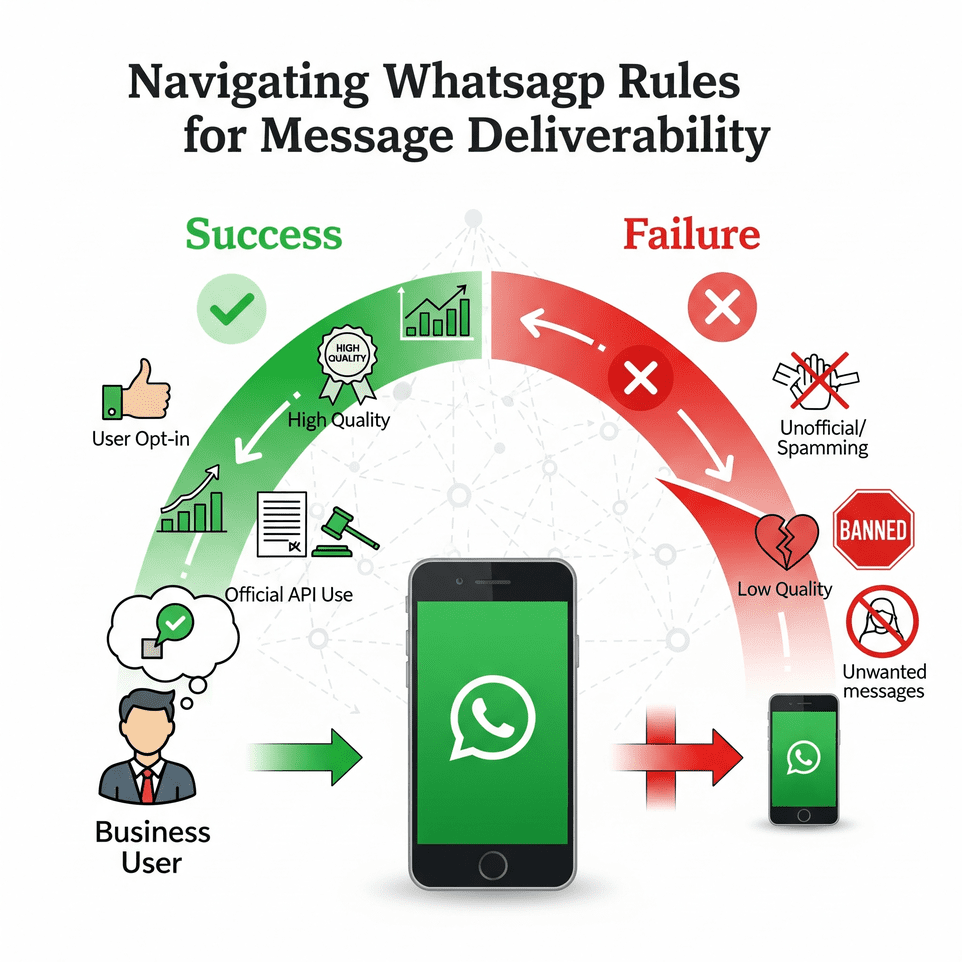
Several unique factors affect WhatsApp deliverability
1. User Opt-In and Trust
WhatsApp is a highly personal channel. If users haven’t consented (opted in) to receive your messages, they might report or block you immediately. WhatsApp monitors user feedback closely; a spike in blocks or “report spam” actions will hurt your number’s reputation and can lead to delivery restrictions or bans.
✅In short, messaging people who aren’t expecting to hear from you is a sure recipe for deliverability problems.
2. Platform Policies and Anti-Spam Measures
WhatsApp has strict policies to maintain a good user experience. Unsolicited bulk messages, use of unauthorized apps, or sending harmful content are all violations of WhatsApp’s terms. The platform uses both algorithms and user reports to identify spam or abuse. If you send too many messages too quickly from a regular account, or use tools that automate sends in non-compliant ways, WhatsApp will likely flag it.
Deliverability can drop as your messages get throttled – or stop entirely if your number is banned. Simply put, WhatsApp will favour businesses that play by the rules and penalize those who don’t.
3. WhatsApp Business Account Quality Rating
For those using the WhatsApp Business API or WhatsApp Business Platform, WhatsApp assigns a Quality Rating to your phone number (High, Medium, or Low quality). This rating reflects recent user feedback on your messages (blocks, reports, read rates, etc.). If your quality rating dips to Low (red), WhatsApp will flag your number and may impose sending limits. A flagged or restricted status means you cannot send further bulk notifications until quality improves, directly hurting deliverability.
On the other hand, maintaining a High (green) quality rating keeps your deliverability strong and even allows you to scale to larger messaging tiers.
4. Official vs. Unofficial Sending Methods
There’s a right way and a wrong way to send bulk WhatsApp messages. The right way is using WhatsApp-approved methods – either the WhatsApp Business App’s broadcast feature for small lists or the WhatsApp Business API for large-scale messaging.
The wrong way is using unauthorized third-party apps, scripts, or “WhatsApp bomber” tools that blast messages. Using unofficial methods might seem to work briefly, but WhatsApp’s systems often detect them. Accounts using unauthorized tools risk immediate bans, meaning zero deliverability because your messages (and account) are shut down. In contrast, using the official channels (app or API) ensures WhatsApp knows you’re abiding by their rules, which significantly safeguards your deliverability.
5. Recipient Experience and Relevance
Even if you have permission to message customers, how you message them affects deliverability. If your bulk messages are irrelevant, overly promotional, or too frequent, users might ignore them or delete them, or worse, complain.
WhatsApp’s new policies even include frequency capping per user to reduce overload. For instance, WhatsApp has introduced a limit on the number of marketing messages a user can receive from all businesses in a given time frame. If a user has hit the limit (say, they’ve already received 5 marketing blasts that day), any further messages – including yours – will simply not be delivered. This means brands are now effectively competing for limited slots in a customer’s daily WhatsApp marketing messages.
✅The takeaway: you must make your messages valuable and engaging to be among those that actually get through to the user.
6. Regional and Template Restrictions
“Deliverability” also depends on where your audience is and what type of message you send. Recent updates show this clearly: as of April 1, 2025, Meta disallows WhatsApp marketing messages to any U.S. (+1) numbers. Promotional or broadcast templates categorized as marketing will be blocked for U.S. recipients, no matter how good your content is. Only transactional or customer service messages are allowed through to U.S. WhatsApp users. So if your bulk campaign includes U.S. phone numbers, marketing content will not deliver at all.
Additionally, WhatsApp requires business-initiated messages outside the 24-hour customer service window to use approved message templates. If you try to send a non-template message to a user you haven’t chatted with recently, it won’t deliver. And if your template content is overly spammy or gets negative feedback, WhatsApp can reclassify or reject templates, hurting future deliverability. Always ensure you use the correct template type (e.g., mark it as transactional vs promotional appropriately) to avoid unnecessary filtering.
Next, we’ll explore how to put this knowledge into practice and overcome the challenges – so your WhatsApp campaigns reach every customer’s chat as intended.
Common Challenges in WhatsApp Bulk Messaging (and How to Overcome Them)
Before jumping into the solutions, it’s important to recognize the key challenges that often hurt WhatsApp message deliverability. Knowing these pitfalls will you avoid them proactively:
1. Account Bans for Policy Violations
WhatsApp frequently bans accounts for spammy or non-compliant activity, such as sending unsolicited promotions, misleading content, or using unofficial apps.
Solution:
- Use the official WhatsApp Business App or API.
- Gain user consent and follow WhatsApp's Business & Commerce policies.
- Work with an official Business Solution Provider (BSP) for compliance guidance.
- High volumes are fine if rules are followed – bans come from misuse, not scale.
2. Messages Not Delivering (Single Tick)
A single gray tick means undelivered. Beyond offline recipients, bulk sends can fail because:
- Broadcast lists only deliver to users who saved your number.
- Message templates were unapproved or daily sending tiers exceeded.
- User-level caps caused your message to be dropped.
Solution:
- For broadcasts, only target contacts who saved your number; for broader reach, use the Business API.
- Monitor template status, account tiers, and quality ratings.
- Send earlier in the day to avoid exceeding a recipient’s daily cap.
3. High Block or Spam-Report Rates
Excessive blocks or complaints lower your quality score, hurting deliverability and brand trust.
Solution:
- Prioritize relevance and personalization.
- Segment audiences for targeted campaigns.
- Avoid excessive or pushy promotions.
- Always provide an opt-out (e.g., “Reply STOP to unsubscribe”).
- Focus on customer value – satisfied users rarely block senders.
4. Content or Template Rejections
API-based outbound messages require WhatsApp-approved templates. Poorly written, overly promotional, or misleading templates risk rejection or misclassification.
Turn this learning into your next WhatsApp campaign.
Start with Sendwo’s free plan, explore WhatsApp broadcasts, automation, AI chatbot flows, and upgrade only when your business needs more power.
Solution:
- Follow template guidelines (no clickbait formatting, no misleading tone).
- Keep messages clear, conversational, and useful.
- Test on small groups and monitor feedback.
- Avoid editing approved templates with disallowed content.
5. New Policy Changes
WhatsApp updates policies often, such as introducing user-level frequency caps or regional restrictions (e.g., marketing messages currently blocked for U.S. users).
Solution:
- Stay updated via WhatsApp’s official announcements or BSP alerts.
- Focus on personalization and engagement to stay competitive when caps apply.
- Adjust regional strategies: use WhatsApp for transactional updates in the U.S., and rely on email/SMS or other Meta channels for marketing.
Why You Should Use the WhatsApp Business API for Bulk Messaging
One of the cornerstones of high deliverability (and successful WhatsApp marketing in general) is using the WhatsApp Business API. If you’re serious about bulk messaging, relying on manual sending or using the basic WhatsApp app is not only inefficient – it also comes with limitations that can hurt deliverability.
WhatsApp Business App vs WhatsApp Business API: The regular WhatsApp Business App (available on mobile) is great for small businesses interacting with dozens of customers. It even has a Broadcast Lists feature that lets you send a message to up to 256 contacts at once. However, as noted, those contacts must have your number saved or they won’t receive the broadcast. This is a built-in anti-spam safeguard.
If you have, say, 1000 customers, you’d have to split them into 4 lists, and even then, delivery is only guaranteed to those who saved you. There’s also no automation in the app – every message or list sent is manual, personalization is minimal, and you risk getting blocked if you send too many broadcasts that people don’t expect (even via the app, users can report spam). In short, the app is fine for small, organic outreach, but it struggles for large-scale campaigns.
By contrast, the WhatsApp Business API (also known as the WhatsApp Business Platform) is designed for bulk messaging at scale. Through the API (accessed via official providers known as Business Solution Providers or BSPs), you can send messages to thousands or even millions of users reliably. There’s no 256-recipient cap – instead, you have messaging tier limits based on quality.
New API-enabled numbers start at Tier 1 (1,000 unique recipients per 24 hours), and can climb to Tier 2 (10k/day), Tier 3 (100k/day) and beyond as your quality remains high. This tiered ramp-up is effectively a built-in “warm-up” mechanism. And crucially, with the API, recipients do not need to save your number to get your messages. As long as you obtained their consent and have their number, you can reach them. This dramatically improves deliverability for marketing use-cases like reaching new leads or customers who haven’t chatted with you yet.
Other deliverability benefits of the API include
- Compliance & Trust
- WhatsApp requires verification and template approval, ensuring you follow rules.
- Traffic through the API is recognized as legitimate, avoiding stealth bans.
- Message Templates & Insights
- Outbound messages (outside 24h) require approved templates, reducing spam risks.
- Dashboards provide quality ratings, delivery reports, opt-out data, helping you monitor and improve campaigns.
- Automation & Personalization
- API integrates with CRM systems for tailored campaigns.
- Enables event-driven messages (e.g., order updates, cart reminders).
- Dynamic fields allow messages like “Hi {name}, your {product} is now 20% off.” → higher engagement, better deliverability.
- Scalability & Multi-Number Support
- Businesses can manage multiple WhatsApp numbers within one account, balancing large-scale messaging (e.g., 10 Tier-3 numbers = 1M+ contacts/day).
Overall, the WhatsApp Business API is the foundation for reliable bulk messaging. By migrating to the API (or starting with it outright), you put yourself on the “approved highway” for WhatsApp communication. You won’t need to worry about weird limits or getting banned just for being successful in messaging your customers.
Of course, the API does come with some costs (WhatsApp charges per conversation, and BSPs may have platform fees), and there’s an initial setup/verification process. But the ROI is worth it, considering the massive engagement WhatsApp provides. Later in this article we’ll provide a call-to-action on how you can get started with the API easily.
Next, let’s get into the best practices that will improve your deliverability regardless of channel (app or API) – though you’ll see many of these are much easier to implement if you are using the API and an automation platform.
Best Practices to Improve WhatsApp Bulk Message Deliverability
Improving deliverability isn’t a mystery – it comes down to following a set of best practices consistently. Below are the most important strategies, each building on the others. Adopt these, and you’ll find your WhatsApp campaigns not only deliver to more people, but also drive better engagement and results.
1. Always Obtain Clear Opt-In Consent from Users
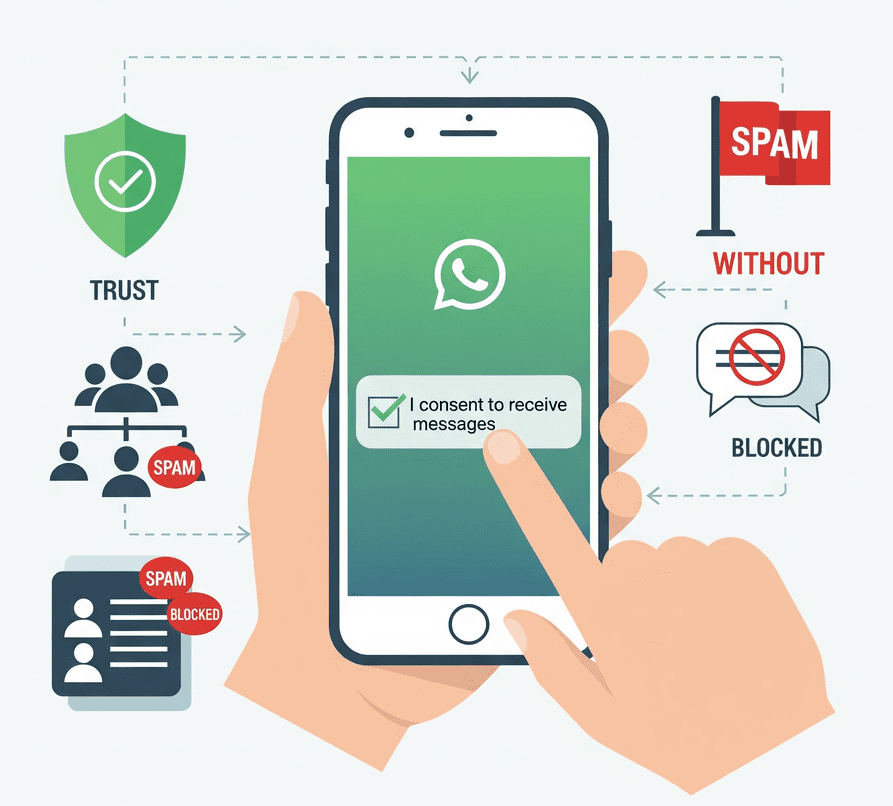
- Only message users who consented: WhatsApp requires businesses to message only those who gave explicit permission—such as selecting a WhatsApp opt-in checkbox during signup, checkout, or in-store forms, or texting a keyword like “START.”
- Maintain proof of consent: Keep detailed records of how, when, and where each user opted in. If challenged, you can verify compliance.
- Regularly clean your lists: Remove inactive contacts (numbers not on WhatsApp) and promptly honor opt-out requests. A smaller, more engaged list is better than a large, uninterested one.
- Reconfirm periodically: If users haven’t engaged for a long time, reconfirm consent or remind them why they’re receiving messages.
2. Use Official Tools and Avoid Unofficial Hacks
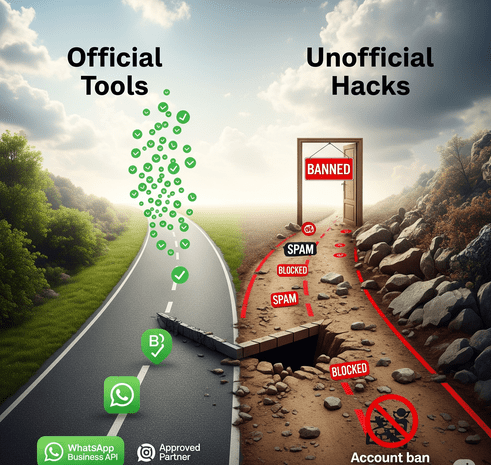
- Stick to the official Business App or API: Use the Business App for manual, small-scale outreach; the Business API for scalable, automated campaigns.
- Do not use unauthorized third-party mods/plugins: Unofficial methods (like Chrome extensions or GBWhatsApp) violate WhatsApp terms and lead to bans. Official BSPs (Twilio, 360dialog, WATI, SendWo, etc.) guarantee compliance and provide support.
- Start small if not on the API: Manual broadcasts should be spaced out, targeting contacts who have saved your number.
3. Segment Your Audience and Personalize Your Messages
- Divide users by meaningful criteria: Purchase history, engagement level, location, interests.
- Match content to audience: New sign-ups might get a welcome offer; loyal customers get exclusive rewards. Avoid irrelevant promotions that risk opt-outs or complaint.
- Personalize bulk messages: Use names, reference specific activity, or tailor offers. API platforms make personalization scalable, e.g., “Hi {name}, your order is ready!”
Actionable tips for personalization: Use the customer’s name in the greeting. Mention context (“Thanks for your last purchase of X, we have a related offer you’ll love”). Segment by behaviour – e.g., send a different message to those who clicked the last campaign vs. those who didn’t (for the latter, you might try a different angle to re-engage them). If you have location info, promote store events or services available in their area. The key is making the recipient feel like the message was crafted for them.
Modern WhatsApp marketing software makes this easy with merge fields and conditional messaging. It may require a bit more setup than a one-size-fits-all blast, but the payoff is huge in both deliverability and conversion. As you personalize and segment, you’ll likely see metrics improve across the board – higher read rates, higher replies, and minimal negative feedback.
4. Send Valuable Content (Quality Over Quantity)
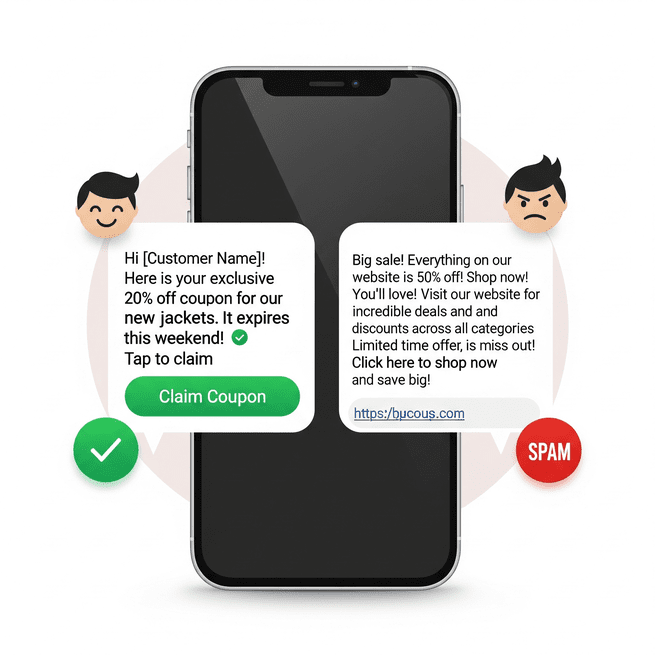
- Transactional messages: Timely, clear updates (shipping, appointments, OTPs) are highly valued and generally welcomed.
- Exclusive promotions: Frame deals as special for WhatsApp subscribers (“Early access,” “VIP offer”).
- Conversational tone: Use friendly, human language—WhatsApp users expect chat-like, not formal, messages.
- Rich media: High-quality images/videos grab attention, boost conversion, and legitimize campaigns.
- Actionable and concise: Short, scan-friendly messages with clear calls-to-action (“Tap to claim discount,” “Reply for info”).
Focusing on quality over quantity also means don’t spam with too many messages. It’s better to send one highly valuable message a week than three mediocre ones per day. Overloading users will lead to fatigue and opt-outs, hurting your long-term deliverability. In light of the new per-user limits, it’s wise to save your WhatsApp messages for when they matter most. Make each campaign count so that if a user only sees a handful of brand messages a day, yours is one they actually appreciate.
When your content consistently delivers value, users begin to trust your messages – they might even look forward to them. This positive relationship is the ultimate deliverability boost: WhatsApp will have no reason to restrict you, and your audience will stay engaged rather than tuning you out.
5. Mind Your Sending Frequency and Timing
- Limit sends: 1–2 bulk marketing messages per week is optimal; more risks fatigue and opt-outs.
- Stagger large campaigns: Avoid delivery avalanches, break sends into batches to mimic natural traffic, and leverage BSP dashboards with send scheduling and frequency controls.
- Send at ideal hours: Respect time zones and avoid early morning/late night sends. Target campaign windows when users are active (e.g., 10 AM–6 PM local time).
- Consider day of week: Engagement may peak on weekends for B2C, weekdays for B2B—monitor and adapt.
6. Warm Up New Phone Numbers and Gradually Increase Volume
- Ramp up message volume: Start with small sends (50–100/day) and increase only as positive feedback is received.
- With API, WhatsApp automatically tiers numbers; do not attempt to “game” this process by mass-creating numbers.
- Monitor feedback closely: Pause scaling if you encounter warnings, blocks, or complaints.
In summary, think of warming up as building a reputation gradually. Just like an email domain builds sender reputation over time, your WhatsApp number builds a reputation. A slow and steady start leads to a strong finish (i.e., high deliverability when you do reach big volumes). Patience in the early stage will pay off with a robust channel that can reliably hit all your customers’ inboxes when it counts.
7. Monitor Your WhatsApp Metrics and Adjust Quickly
You can implement all the best practices above, but you also need to continuously monitor how your WhatsApp campaigns are performing. Deliverability isn’t a set-and-forget thing – it’s an ongoing process of tuning and responding to feedback.
Key metrics and signals to watch:
- Delivery rates: Check for undelivered messages (single ticks); investigate contacts, timing, or cap issues.
- Read rates & engagement: Track blue ticks, replies, clicks for content effectiveness and engagement.
- Opt-outs and blocks: Remove opt-outs immediately; analyze campaigns with high block rates for relevance.
- Quality Rating: When using API, watch Green/Yellow/Red status, pausing aggressive or poorly-performing campaigns quickly.
- WhatsApp warnings: Do not ignore warning banners; act immediately to refine lists, slow sends, or change messaging approach.
- Platform dashboards: Leverage BSP analytics for campaign insights, template issues, and audience breakdowns.
The mantra here is be proactive. Don’t wait for a serious issue (like a ban or a dramatic drop in delivery) to take action. By keeping an eye on the health of your WhatsApp campaigns, you can catch trends early. For example, suppose you notice each successive campaign is getting slightly fewer reads and a couple more opt-outs – that could indicate fatigue; maybe scale back frequency or refresh your content approach before it escalates to complaints.
Also, when WhatsApp introduces a new rule or feature (like the per-user cap or the US ban on marketing messages), monitor how it affects your metrics. You might observe that after the cap rule, your delivery to heavy WhatsApp users in India went down if your messages were less engaging. If so, double down on engaging content for that segment.
Finally, treat monitoring as a learning loop. WhatsApp marketing is still relatively new for many businesses, and user behaviours can change. Perhaps you’ll find your customers love receiving a quick tip of the week via WhatsApp and your engagement soars – that’s a sign to keep doing it. Or you might find no one clicks videos but they respond to voice notes – who knows! Every audience is different. Use your metrics to discover what your customers prefer, and lean into that. The happier your audience, the better your deliverability and outcomes.
8. Provide an Easy Opt-Out (Respect the User’s Choice)
- Always provide opt-out instructions: “Reply STOP to unsubscribe.”
- Automate opt-out handling, and confirm action taken (“You’ve been unsubscribed”).
- Never re-add opted out numbers unless they opt-in again.
- Opt-outs help avoid worse outcomes (blocks/reports).
In summary, empower the user. WhatsApp marketing should be permission-based from start to finish. If the user’s preferences change and they no longer want to hear from you on WhatsApp, graciously let them go. It’s the right thing to do and it keeps your deliverability ecosystem healthy.
9. Stay Updated on WhatsApp Policies and Regulations
- Track policy changes and feature updates: Such as frequency caps, U.S. marketing restrictions, template guidelines.
- Comply with local regulations: GDPR, TRAI, or similar laws require explicit consent and user rights.
- Adapt strategy as user sentiment shifts: Monitor tolerance for message frequency and content relevance.
- Consider alternate channels: WhatsApp Channels/Newsletters can be effective for large anonymous broadcasts as the feature matures.
10. Encourage Interactive Conversations
- Design bulk messages to invite replies: Two-way interactions open the 24-hour session window for follow-ups outside template rules.
- Engage with users promptly: Respond to queries within 24 hours to maintain engagement and boost deliverability.
- Conversational engagement is favoured: More interactions = less likelihood of being flagged as spam.
Conclusion
Improving your WhatsApp bulk messaging deliverability isn’t just a technical tweak – it’s a fundamental strategy for successful WhatsApp marketing. When your messages consistently reach the intended audience and resonate with them, you unlock the true power of WhatsApp as a channel: immediate engagement, high visibility, and interactive communication that can drive conversions at a rate other platforms hardly match.
Let’s quickly recap the journey to better deliverability:
- Start with consent and compliance: Always message opted-in users and stick to WhatsApp’s official tools and rules. This forms the safe foundation for all your campaigns.
- Focus on quality and relevance: Every message should offer value – whether it’s useful info, a great deal, or a personal touch that makes the user smile. Quality content gets read and acted upon, which in turn keeps your account in WhatsApp’s good graces.
- Be mindful of user experience: Segment your audience, personalize the content, and don’t over-message. Treat your customers’ attention as a privilege. When users feel respected, they’ll welcome your messages instead of pushing them away.
- Monitor and adapt: Keep an eye on how users respond. Use those blue ticks, replies, and even opt-outs as feedback to continuously refine your approach. If something’s not working (or new rules come in), pivot and try new tactics. You now have plenty of best practices in your toolkit to test out.
- Leverage the WhatsApp Business API for scale: If you’re ready to ramp up, the API is your best friend. It ensures deliverability at scale and provides the infrastructure to implement all the above points efficiently – from template messaging to tracking quality.
Ultimately, high deliverability means your messages land where they should – in your customer’s chat, building a relationship. Low deliverability, on the other hand, means wasted effort and missed opportunities. By following the guidance in this blog, you’re stacking the odds in your favour that your WhatsApp campaigns will land successfully every time.
Always put these tips into practice. Whether you’re launching your first WhatsApp campaign or optimizing an existing one, take a moment to apply what you’ve learned. Maybe start by auditing your contact list for proper opt-ins, or drafting a more personalized message template, or reaching out to sign up for a WhatsApp API provider if you haven’t yet. Small steps can make a big difference. For example, simply adding an opt-out line or the customer’s name in your next bulk message can improve its reception markedly.
If you’re serious about WhatsApp as a marketing channel, consider taking the next step and explore the WhatsApp Business API solutions and SendWo is one such one stop solution that fits your needs. Having an official platform will not only boost deliverability but also save you time with automation and insights.
Ready to supercharge your WhatsApp outreach? Start implementing these deliverability strategies today. Your audience will notice the difference – more relevant messages – and you’ll notice the results in higher read rates, better customer interactions, and ultimately, more conversions. In the world of WhatsApp marketing, deliverability is king. Master it, and you’ll stay ahead of the competition.
Your customers are just a message away – let’s make sure it’s a message they’ll appreciate and act on.
Happy (and successful) WhatsApp messaging!
1. How many WhatsApp messages can I send without getting banned?
Regular WhatsApp accounts have no official limits but sending unsolicited messages, even a few dozen, can cause bans. For WhatsApp Business API, new numbers start with a 1,000-message daily limit (Tier 1) and can scale to 10,000 or more as quality improves. Always send messages only to opted-in users, start with small volumes, and prioritize relevant content to avoid bans.
2. Is bulk messaging on WhatsApp legal and allowed?
Yes. Bulk messaging is allowed if you follow WhatsApp’s policies and relevant laws. You must have user consent and send relevant, non-spammy content. Sending unsolicited messages or abusive content violates WhatsApp’s rules and legal regulations like GDPR. Always message only opted-in users to stay legal and avoid penalties.
Aditi Kamini
Aditi, a content marketer at SendWo, is a passionate writer and marketing enthusiast. She excels in driving revenue campaigns, building client relationships, and mastering content creation, SEO, customer service, and project management.