Best Gupshup Alternatives: Pricing, Pros, Cons & Use Cases
Compare the best Gupshup alternatives for WhatsApp, API messaging and support . See verified pricing, setup complexity, pros, cons.
 By Aditi Kamini
Published: April 6, 2025
Updated: May 31, 2026
21 min read
By Aditi Kamini
Published: April 6, 2025
Updated: May 31, 2026
21 min read
Compare the best Gupshup alternatives for WhatsApp, API messaging and support . See verified pricing, setup complexity, pros, cons.
Gupshup is one of the better-known names in enterprise conversational messaging, CPaaS, WhatsApp Business API, RCS, conversational AI, and customer engagement automation. It serves businesses across marketing, commerce, support, sales, customer service, and developer-led messaging infrastructure.
Gupshup is not just a WhatsApp API provider. Its current platform positioning includes autonomous AI agents, Conversation Cloud, enterprise conversational AI, AI Copilot, campaign management, conversation builder, enterprise integrations, RCS messaging, WhatsApp API, and omnichannel customer engagement.
But Gupshup is not the easiest or most predictable fit for every business. A small business owner running WhatsApp campaigns does not evaluate software the same way an enterprise architecture team evaluates CPaaS, AI agents, APIs, webhooks, RCS, compliance, global routing, and system integrations.
That is why this guide compares the best Gupshup alternatives in 2026 across five buyer segments: no-code WhatsApp marketing, developer/API messaging, omnichannel support, enterprise CPaaS, and conversational AI.
If your business wants a simpler WhatsApp Business API platform with a free forever plan, 0% Sendwo markup on official Meta WhatsApp API pricing, AI chatbot automation, live chat, ecommerce workflows, campaign tools, and multichannel messaging across WhatsApp, Instagram, Facebook Messenger, Telegram, and website chat, Sendwo is one of the strongest Gupshup alternatives to compare first.
How We Compared These Gupshup Alternatives
This comparison is written for different types of buyers because Gupshup serves a broad market. Some businesses need a simple WhatsApp marketing dashboard. Some need APIs and developer flexibility. Some need customer support routing. Some need enterprise-grade conversational AI, RCS, CPaaS, and global messaging infrastructure.
We compared each Gupshup alternative based on:
| Criteria | What We Checked |
|---|---|
| WhatsApp marketing fit | Broadcasts, templates, campaign builder, segmentation, shared inbox, chatbot flows, and analytics. |
| Developer/API capability | APIs, webhooks, HTTP integrations, routing, programmable messaging, and backend system integration. |
| Enterprise CPaaS fit | Support for multiple channels, telecom-grade messaging, global scale, RCS, voice, compliance, and enterprise procurement. |
| Conversational AI | AI agents, AI copilots, chatbot automation, LLM support, training, AI replies, and enterprise AI governance. |
| Omnichannel messaging | WhatsApp, Instagram, Facebook Messenger, Telegram, website chat, RCS, SMS, email, voice, and other messaging channels. |
| Pricing clarity | Public software pricing, free plan, WhatsApp API fees, platform fees, usage fees, AI costs, and enterprise pricing complexity. |
| Best-fit buyer | SMB, agency, ecommerce brand, developer team, support team, enterprise, or global messaging team. |
Best Gupshup Alternatives by Buyer Segment
| Buyer Segment | Best-Fit Tools | Why They Fit |
|---|---|---|
| No-code SMB WhatsApp marketing | Sendwo, WATI, AiSensy, Interakt, Gallabox | Best for teams that want WhatsApp campaigns, broadcasts, inboxes, automation, and templates without deep API work. |
| Developer/API messaging | Twilio, Bird, Gupshup, Sendwo API | Best for teams that need programmable messaging, APIs, routing, webhooks, and infrastructure flexibility. |
| Omnichannel support and sales | Sendwo, Respond.io, WATI, DelightChat | Best for teams managing WhatsApp plus social, web chat, email, and other customer conversation channels. |
| Enterprise CPaaS | Gupshup, Infobip, Sinch, Twilio, Bird | Best for large businesses that need global messaging infrastructure, RCS, voice, routing, compliance, and implementation support. |
| Enterprise conversational AI | Gupshup, Infobip, Sinch, enterprise AI platforms | Best for larger businesses that need AI agents, governance, enterprise integrations, and complex automation programs. |
Quick Answer: Best Gupshup Alternative in 2026
Sendwo is the best Gupshup alternative for SMBs, agencies, ecommerce brands, education businesses, healthcare clinics, coaches, consultants, and local businesses that want WhatsApp marketing, AI chatbot automation, live chat, ecommerce workflows, and multichannel messaging without enterprise CPaaS complexity.
Gupshup is stronger for enterprise buyers that need CPaaS infrastructure, conversational AI agents, RCS, voice, enterprise integrations, global messaging scale, and custom implementation. Sendwo is stronger for business teams that want to start faster with WhatsApp campaigns, broadcasts, templates, shared inbox, AI replies, chatbot flows, forms, ecommerce automation, and paid-plan support.
- Choose Sendwo if you want a WhatsApp-first platform with free plan access, 0% API markup, AI chatbot automation, live chat, campaign management, ecommerce catalog, Shopify/WooCommerce workflows, and multichannel expansion.
- Choose Gupshup if you are an enterprise, bank, fintech, telecom, large ecommerce company, or developer-led team that needs CPaaS, RCS, voice, deep APIs, enterprise conversational AI, compliance, and custom rollout support.
WhatsApp Pricing: What Buyers Must Understand First
Before comparing Gupshup alternatives, you need to understand WhatsApp pricing clearly. Most businesses make the mistake of comparing only the vendor’s monthly software fee. That is incomplete.
Your WhatsApp Business API cost usually has two parts:
1. Vendor Platform Fee
This is what you pay to the software provider for features such as:
- WhatsApp dashboard
- Shared inbox
- Campaign builder
- Chatbot builder
- Automation workflows
- APIs
- Integrations
- Analytics
- Team access
- Support
- AI agents
Some vendors offer free plans. Some charge monthly subscription fees. Some charge based on users, contacts, automation usage, AI usage, or message volume. Enterprise platforms usually use custom pricing.
2. WhatsApp / Meta Messaging Fee
This is the official WhatsApp Business Platform fee charged based on delivered messages, message category, and recipient market. Message categories include marketing, utility, authentication, and service.
This matters because older WhatsApp pricing explanations often focused heavily on “conversation-based pricing.” In 2026, comparison pages should avoid outdated wording and explain the newer per-message model clearly.
Gupshup vs Sendwo Pricing: What Buyers Should Compare
Pricing is one of the biggest reasons businesses compare Gupshup alternatives. Gupshup can be suitable for large enterprises, developer-led teams, and high-volume messaging operations, but the pricing model may include multiple layers such as Meta WhatsApp fees, Gupshup fees, wallet deductions, enterprise implementation, media fees, AI features, RCS, and other channel costs.
Sendwo is easier to compare for SMBs and agencies because the software plans are public, the free forever plan is clearly available, and the pricing page states 0% markup on official WhatsApp API pricing. Paid Sendwo users also get dedicated WhatsApp group support for onboarding, templates, campaigns, integrations, migration, and troubleshooting.
| Pricing Layer | What It Means | Sendwo | Gupshup |
|---|---|---|---|
| Software subscription | Monthly/yearly plan for dashboard, users, automation, channels, support, and features | Free forever plan; public paid plans starting from $23/month yearly | Can vary by product, plan, usage, region, and enterprise deal |
| Meta WhatsApp fee | Official WhatsApp Business Platform fee based on message category and recipient market | Separate from Sendwo subscription; 0% Sendwo markup | Separate WhatsApp fee applies; buyers should check current Meta and Gupshup billing setup |
| Vendor/platform fee | Fee charged by the messaging software/API provider | Software plan only; no markup on official Meta API pricing | May depend on product, wallet, channel, contract, region, and implementation model |
| AI cost | AI replies, AI agents, AI copilot, LLM usage, or token consumption | AI tokens included in plans; limits depend on plan | AI agents and enterprise conversational AI may depend on product, contract, and implementation |
| RCS / other channels | Costs for RCS, SMS, voice, or other messaging channels | Not RCS-first; focused on WhatsApp, Instagram, Facebook Messenger, Telegram, and webchat | Relevant if the buyer needs RCS, voice, and broader enterprise messaging |
| Implementation and support | Setup, onboarding, campaign execution, templates, workflows, migration, and troubleshooting | Paid monthly/yearly users get dedicated WhatsApp group support | Enterprise support and implementation depend on sales agreement and use case |
Simple buying rule: choose Sendwo if you want predictable WhatsApp marketing software pricing and 0% Meta API markup. Choose Gupshup if you need enterprise CPaaS, RCS, AI agents, and broader messaging infrastructure — and are ready to evaluate pricing through a more complex enterprise lens.
Sendwo vs Gupshup: Enterprise API, CPaaS, Conversational AI, RCS, and Pricing Comparison
Sendwo and Gupshup are not built for exactly the same buyer. Gupshup is broader and more enterprise-oriented. Sendwo is WhatsApp-first, more practical for SMBs and marketers, and easier for teams that want campaign execution without building a custom messaging infrastructure.
| Comparison Point | Sendwo | Gupshup | Best-Fit Buyer |
|---|---|---|---|
| Primary positioning | WhatsApp-first marketing, automation, AI chatbot, live chat, ecommerce, and multichannel platform | Enterprise conversational AI, CPaaS, messaging infrastructure, WhatsApp API, RCS, and AI agents | Sendwo for SMBs and growth teams; Gupshup for enterprises and developer-led teams |
| Free plan | Free forever plan available for learning, testing, and small WhatsApp marketing use cases | More sales-led, usage-led, or enterprise-led evaluation depending on product and region | Sendwo is easier for early-stage teams that want to start without enterprise procurement. |
| Starting paid plan | Yearly paid plans start from $23/month, with monthly pricing also available | Pricing depends on product, usage, wallet, enterprise plan, region, channel, and implementation needs | Sendwo is easier to compare for SMB software budgeting. |
| WhatsApp API pricing | 0% Sendwo markup on official Meta WhatsApp API pricing | Pricing can include WhatsApp fees, vendor fees, wallet billing, implementation, and channel-specific usage | High-volume buyers should compare Meta fees, platform fees, vendor fees, media fees, and add-on fees carefully. |
| Enterprise API / CPaaS | Developer API, HTTP API, outbound webhooks, integrations, and workflow automation for business use cases | Stronger CPaaS and enterprise messaging infrastructure across channels and systems | Gupshup is stronger for enterprise-grade CPaaS; Sendwo is enough for many SMB/agency WhatsApp workflows. |
| Conversational AI | Sendwo AI, AI replies, AI bot training, chatbot builder, flows, and AI tokens | Autonomous AI agents, AI Copilot, fine-tuned LLMs, enterprise guardrails, and Conversation Cloud | Gupshup is stronger for large enterprise AI agent programs; Sendwo is stronger for practical SMB chatbot automation. |
| RCS support | Not positioned as an RCS-first platform | RCS API and RCS business messaging are part of Gupshup’s broader messaging stack | Gupshup is better if RCS is a major requirement. |
| Omnichannel messaging | WhatsApp, Instagram, Facebook Messenger, Telegram, and website chat on paid plans | Broader enterprise omnichannel messaging including WhatsApp, RCS, voice, and other channels depending on solution | Sendwo is enough for WhatsApp-first SMB omnichannel; Gupshup fits large multichannel enterprises. |
| Campaign execution | Broadcasts, templates, labels, segmentation, drip campaigns, forms, flows, analytics, and live chat | Campaign manager, conversation builder, click-to-chat ads, ROI dashboards, AI agents, and enterprise integrations | Sendwo is more straightforward for marketers; Gupshup is stronger for enterprise orchestration. |
| Support model | Paid monthly/yearly users get WhatsApp group support for onboarding, templates, campaigns, integrations, migration, and troubleshooting | Enterprise sales/support model depending on contract, region, product, and implementation | Sendwo is attractive for SMBs wanting hands-on setup support without enterprise contracts. |
| Best decision | Choose Sendwo for WhatsApp marketing, automation, ecommerce, AI chatbot, and multichannel SMB growth | Choose Gupshup for enterprise CPaaS, RCS, conversational AI, global scale, and developer-led infrastructure | The better choice depends on whether you need a growth platform or an enterprise messaging infrastructure layer. |
Enterprise API and CPaaS Comparison: When Gupshup Is Stronger
Gupshup is stronger than most SMB WhatsApp tools when the buyer needs CPaaS-style infrastructure. This includes APIs, routing, multiple channels, enterprise integration, global messaging, RCS, voice, compliance, and large-scale conversational AI deployments.
If your team has developers, solution architects, compliance teams, procurement teams, and enterprise implementation requirements, Gupshup may be more relevant than a no-code WhatsApp marketing platform.
| Enterprise Requirement | Why Gupshup Fits | When Sendwo Is Still Better |
|---|---|---|
| CPaaS messaging infrastructure | Gupshup is built for broader programmable messaging and enterprise conversational engagement. | Sendwo is better if you only need WhatsApp marketing, campaigns, chatbots, and customer conversations. |
| Deep API-led workflows | Enterprise teams can build custom messaging into products, CRMs, backend systems, and customer journeys. | Sendwo is better if your marketing or support team wants ready-made campaign and automation tools. |
| RCS business messaging | Gupshup has RCS API and RCS business messaging positioning. | Sendwo is better if your channels are WhatsApp, Instagram, Messenger, Telegram, and webchat. |
| Enterprise conversational AI | Gupshup offers Conversation Cloud, AI agents, AI Copilot, LLMs, and enterprise guardrails. | Sendwo is better if you need practical AI replies, chatbot training, and SMB automation. |
| Global enterprise scale | Gupshup positions itself for global brands and high-volume messaging across industries. | Sendwo is better for SMBs, agencies, ecommerce brands, and growing teams that want faster setup. |
Conversational AI Comparison: Gupshup AI Agents vs Sendwo AI
Gupshup has a strong conversational AI story. Its current website talks about autonomous AI agents for sales, marketing, and customer support. Its Conversation Cloud page also highlights AI Copilot, multimodal AI agents, fine-tuned LLMs, and enterprise guardrails.
Sendwo’s AI story is more practical for business users who want AI replies, AI bot training, chatbot automation, live chat assistance, and campaign execution without building a large enterprise AI stack.
| AI Requirement | Sendwo | Gupshup |
|---|---|---|
| AI chatbot for SMBs | AI bot, AI replies, training, and chatbot builder | Can support AI agents, but may be more enterprise-oriented |
| AI customer support | AI replies inside live chat and automation workflows | AI Copilot, support automation, and enterprise AI agents |
| AI sales assistant | Can qualify leads and respond through chatbot workflows | Autonomous AI agents for assisted sales and shopping |
| Enterprise AI governance | Best for simpler business automation | Enterprise guardrails, fine-tuned LLMs, and large-scale AI deployment |
| Best fit | SMBs, ecommerce brands, agencies, and marketers | Enterprises, banks, fintech, retail, healthcare, and large global brands |
In simple terms, choose Sendwo AI if you need useful AI automation inside WhatsApp marketing and live chat. Choose Gupshup if you need an enterprise conversational AI program with broader governance, integrations, and custom implementation.
RCS and Omnichannel Messaging: Where Gupshup Has an Enterprise Edge
Gupshup has an advantage when RCS is part of the buyer’s messaging roadmap. Its RCS API positioning focuses on rich customer communication, RCS business messaging, channel fallback, and interactive customer journeys.
Sendwo is not trying to be an RCS-first CPaaS provider. Its strength is WhatsApp-first growth with expansion into Instagram, Facebook Messenger, Telegram, and website chat. That is often enough for SMBs, agencies, ecommerce brands, education businesses, healthcare clinics, and local service businesses.
| Channel Need | Best Fit | Reason |
|---|---|---|
| WhatsApp marketing and broadcasts | Sendwo | Focused on campaigns, templates, broadcasts, segmentation, and growth workflows |
| WhatsApp + Instagram + Facebook Messenger + Telegram + webchat | Sendwo | Good for WhatsApp-first SMB omnichannel communication |
| RCS business messaging | Gupshup | Stronger RCS positioning and enterprise channel coverage |
| Voice + RCS + WhatsApp + enterprise messaging | Gupshup / Infobip / Sinch / Bird | Better for CPaaS and infrastructure-led communication stacks |
| Simple live chat, AI replies, and customer support | Sendwo | Better for business users who want a practical dashboard instead of enterprise implementation |
Best Gupshup Alternatives for No-Code SMB WhatsApp Marketing
This segment is for small businesses, agencies, ecommerce brands, education businesses, local service providers, real estate teams, and marketers who want to run WhatsApp campaigns without building everything through APIs.
These platforms are usually better if your team wants:
- Broadcast campaigns
- WhatsApp templates
- Contact upload and segmentation
- Shared inbox
- Basic chatbot flows
- Drip campaigns
- Lead capture
- Campaign analytics
- Faster onboarding
1. Sendwo
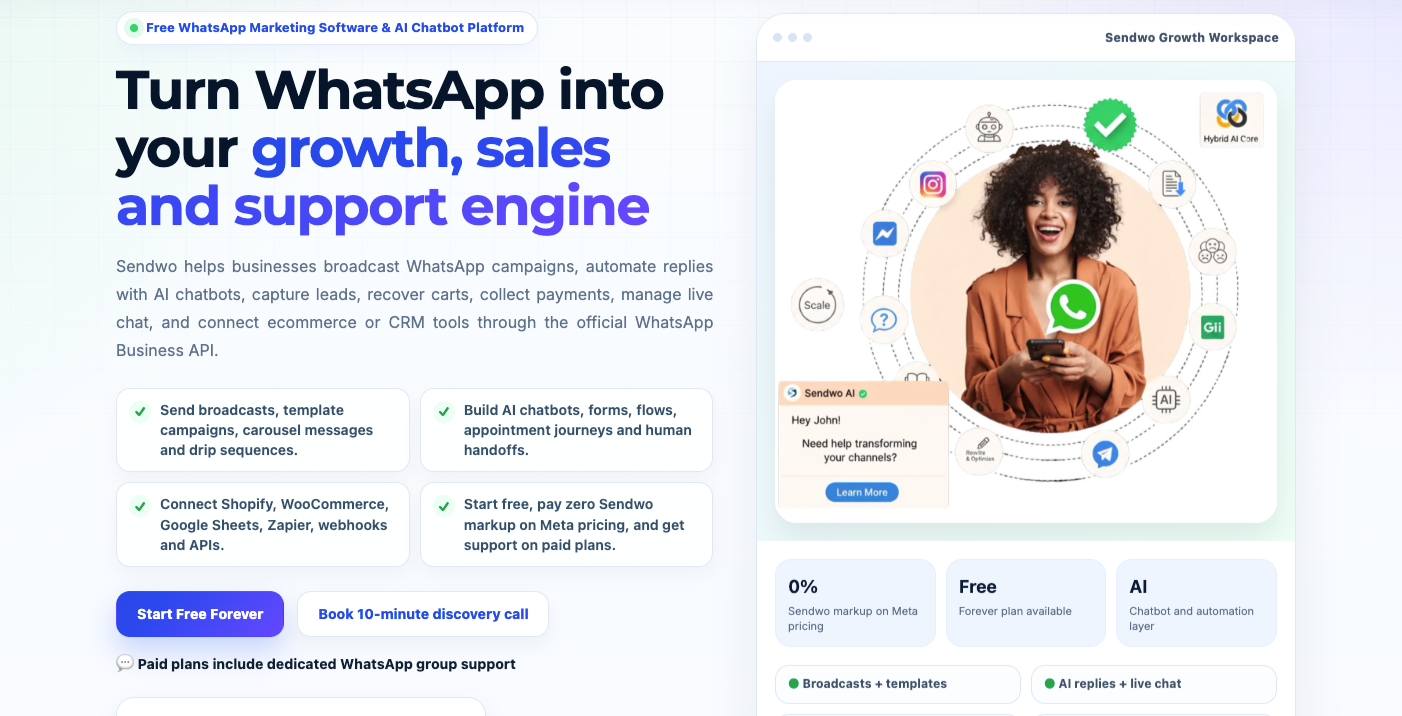
Best for: SMBs, agencies, ecommerce brands, education businesses, healthcare clinics, real estate teams, local businesses, coaches, consultants, and WhatsApp-first teams that want simpler execution than Gupshup.
Channels: WhatsApp and webchat on the free plan; WhatsApp, Instagram, Facebook Messenger, Telegram, and website chat on paid plans.
Price: Sendwo has a free forever plan. Yearly paid pricing starts from $23/month for Starter, $47/month for Pro, and $67/month for Enterprise. Businesses should always check the latest Sendwo pricing page before buying.
Sendwo is the strongest Gupshup alternative for businesses that want practical WhatsApp marketing software, AI chatbot automation, live chat, campaign management, ecommerce workflows, and multichannel messaging without enterprise CPaaS complexity.
Sendwo helps businesses run WhatsApp broadcast campaigns, build a WhatsApp chatbot, manage customer conversations through a shared team inbox, automate replies using Sendwo AI, and connect workflows through Shopify, WooCommerce, Google Sheets, APIs, webhooks, forms, flows, and ecommerce catalog features.
Why Sendwo is a strong Gupshup alternative
Gupshup is powerful, but it may be more platform than a small business needs. Many teams do not need CPaaS infrastructure, RCS, voice, enterprise AI agents, or custom messaging architecture. They need WhatsApp campaigns, templates, chatbot flows, AI replies, live chat, segmentation, ecommerce automation, and support.
Sendwo is built for that practical execution layer. It gives teams a simpler dashboard, free-plan access, public software pricing, 0% Sendwo markup on official Meta WhatsApp API pricing, and paid-plan WhatsApp group support.
Sendwo pros
- Free forever plan for learning, testing, and small WhatsApp marketing use cases
- 0% Sendwo markup on official Meta WhatsApp API pricing
- WhatsApp broadcasts, templates, segmentation, analytics, and campaign workflows
- AI bot, AI replies, AI training, and chatbot automation
- Live chat and shared inbox for customer conversations
- WhatsApp, Instagram, Facebook Messenger, Telegram, and webchat on paid plans
- Shopify, WooCommerce, ecommerce catalog, forms, flows, API, and webhook workflows
- Dedicated WhatsApp group support on paid monthly/yearly plans
Sendwo cons
- Not an RCS-first CPaaS platform
- Not built for large custom telecom-grade messaging infrastructure
- Enterprise buyers needing deep AI governance, voice, RCS, and global CPaaS may still compare Gupshup, Infobip, Sinch, Twilio, or Bird
Best fit
Choose Sendwo if you want a simpler Gupshup alternative for WhatsApp marketing, AI chatbot automation, live chat, ecommerce campaigns, lead generation, customer support, and multichannel messaging without enterprise implementation complexity.
2. WATI
Best for: SMB sales, support, automation, WhatsApp CRM, and growing customer engagement teams.
Turn this learning into your next WhatsApp campaign.
Start with Sendwo’s free plan, explore WhatsApp broadcasts, automation, AI chatbot flows, and upgrade only when your business needs more power.
WATI is another popular Gupshup alternative for SMBs that want WhatsApp sales, support, automation, and team inbox capabilities. It is generally easier for business teams than a pure developer-first messaging platform.
WATI is useful when your sales, support, or marketing team wants a WhatsApp dashboard, campaigns, chat assignment, automation, and integrations without depending fully on engineering.
WATI pros
- User-friendly for non-developer teams
- Good fit for WhatsApp sales and support workflows
- Shared inbox, campaign tools, chatbot automation, and ecommerce use cases
- Better for business teams than API-only infrastructure
WATI cons
- Pricing can become layered because software subscription and message charges are separate.
- Some advanced automation and integrations may depend on higher plans.
- Exact pricing should be verified on the live pricing page because it may vary by region and billing selection.
3. AiSensy
Best for: India-focused SMBs, D2C brands, education businesses, real estate teams, and lead-generation teams.
AiSensy is a strong India-focused WhatsApp Business API platform for businesses that want campaigns, broadcasts, live chat, chatbot flows, and WhatsApp retargeting.
AiSensy pros
- Clear India-focused positioning
- Easy for non-technical teams
- Good for WhatsApp broadcasts, retargeting, and campaign execution
- Useful for small businesses and growing marketing teams
AiSensy cons
- More WhatsApp-focused than enterprise CPaaS platforms.
- Not as flexible as developer-first API platforms.
- Teams outside India should verify regional pricing and product fit carefully.
4. Interakt
Best for: D2C, ecommerce, WhatsApp sales, Instagram automation, and SMB engagement.
Interakt is a WhatsApp and Instagram automation platform that works well for D2C brands, ecommerce teams, SMBs, and businesses that want sales CRM-style workflows.
Interakt pros
- Strong for WhatsApp and Instagram engagement
- Useful for D2C and commerce workflows
- Good fit for sales CRM-style WhatsApp operations
Interakt cons
- Pricing differs by plan, billing mode, and region.
- Some advanced capabilities are locked behind higher tiers.
- Not ideal if your primary need is developer-first CPaaS infrastructure.
5. Gallabox
Best for: WhatsApp chatbots, flows, forms, automation, and sales team workflows.
Gallabox is a WhatsApp automation platform for teams that want chatbots, broadcasts, shared inbox, WhatsApp forms, workflows, integrations, and sales automation. It is a good Gupshup alternative if your business needs automation depth but does not need enterprise CPaaS infrastructure.
Gallabox pros
- Strong WhatsApp chatbot and automation features
- Useful forms, flows, shared inbox, and integrations
- Good fit for automation-heavy SMB and mid-market teams
Gallabox cons
- Entry pricing may be higher than simpler SMB WhatsApp tools.
- Not as infrastructure-led as enterprise CPaaS platforms.
Best Gupshup Alternatives for Developer/API Messaging
This segment is for developer-led companies, SaaS products, marketplaces, fintech apps, logistics teams, and product teams that want to embed messaging into their software stack.
These teams usually care about APIs, SDKs, webhooks, routing, message logs, scalability, compliance, and technical control.
6. Twilio
Best for: Developer-first messaging, custom communication workflows, and programmable WhatsApp API use cases.
Twilio is one of the strongest alternatives when the buyer wants API-first messaging infrastructure. It is not built mainly as a no-code WhatsApp marketing dashboard. It is better for engineering teams that want to build custom messaging workflows.
Twilio pros
- Strong developer ecosystem
- Flexible APIs for custom communication workflows
- Useful for product-led and SaaS teams
- Good for teams with in-house developers
Twilio cons
- Requires technical implementation.
- Not ideal for non-technical marketers who want ready-made campaigns, templates, shared inbox, and chatbot builder.
7. Bird
Best for: Enterprise messaging, global communication workflows, and API-led customer engagement.
Bird is more relevant when the business wants broader communication infrastructure instead of only WhatsApp marketing. It can be compared with Gupshup for API-first and enterprise messaging use cases.
Bird pros
- Strong global messaging infrastructure positioning
- Relevant for enterprise and developer-led teams
- Useful for multichannel communication workflows
Bird cons
- May be too technical or heavy for a small business that only needs WhatsApp campaigns.
- Pricing and implementation may require deeper evaluation.
Best Gupshup Alternatives for Omnichannel Support and Sales
This segment is for teams that manage WhatsApp plus other channels, such as Instagram, Facebook Messenger, website chat, email, SMS, and support inbox workflows.
8. Respond.io
Best for: Larger teams that need omnichannel messaging, workflows, AI agents, reporting, routing, and lifecycle management.
Respond.io is a broader customer conversation platform, not just a WhatsApp tool. It works well for teams that need structured customer conversations across multiple messaging channels.
Respond.io pros
- Strong omnichannel messaging platform
- Useful for automation, routing, lifecycle workflows, and reports
- Good for larger teams with complex sales and support operations
Respond.io cons
- May be more expensive or complex than needed for small teams.
- Businesses focused only on WhatsApp marketing may prefer Sendwo or other WhatsApp-first tools.
9. DelightChat
Best for: Ecommerce customer support, Shopify/D2C support teams, and WhatsApp plus helpdesk-style workflows.
DelightChat is more support-led than pure WhatsApp marketing platforms. It is useful for ecommerce teams that want to combine customer support, WhatsApp marketing, Shopify context, live chat, email, Instagram, and Facebook conversations.
DelightChat pros
- Strong support inbox for ecommerce brands
- Useful for Shopify-led customer service workflows
- Combines support and retention communication
DelightChat cons
- May not be the best fit if your primary need is API-led CPaaS.
- Less relevant for non-ecommerce businesses.
Best Gupshup Alternatives for Enterprise CPaaS and Conversational AI
This segment is for large enterprises, banks, fintech companies, telecom teams, airlines, healthcare groups, logistics companies, and global brands that need messaging infrastructure beyond basic WhatsApp campaigns.
10. Infobip
Best for: Enterprise CPaaS, global communication, omnichannel messaging, and large-scale customer engagement.
Infobip is a strong Gupshup alternative for enterprise buyers that need SMS, WhatsApp, RCS, voice, email, push, and broader customer engagement infrastructure. It is better suited for large teams than SMBs looking for a simple WhatsApp marketing dashboard.
Infobip pros
- Strong global CPaaS positioning
- Relevant for enterprises and global brands
- Supports broad channel coverage and enterprise workflows
Infobip cons
- May be too complex for small businesses.
- Pricing and implementation usually require enterprise evaluation.
11. Sinch
Best for: Enterprise messaging, CPaaS, SMS, voice, RCS, WhatsApp, and global customer communications.
Sinch is another enterprise-grade Gupshup alternative. It is relevant when businesses need global messaging infrastructure, telecom-grade scale, voice, RCS, and API-driven customer communication.
Sinch pros
- Strong CPaaS and global messaging infrastructure
- Useful for enterprises with large communication volumes
- Relevant for SMS, voice, RCS, WhatsApp, and multichannel workflows
Sinch cons
- Not ideal for small teams that want a ready-made WhatsApp campaign dashboard.
- Enterprise buying process can be heavier than SMB tools.
When Should You Choose Gupshup Instead of Sendwo?
This comparison should be honest. Gupshup is not weak. It is simply built for a different type of buyer.
Choose Gupshup instead of Sendwo if your business needs:
- Enterprise CPaaS infrastructure
- RCS business messaging
- Voice, multimodal, or telecom-grade messaging workflows
- Custom enterprise conversational AI agents
- Fine-tuned LLMs and AI governance
- Complex banking, fintech, airline, telecom, healthcare, or enterprise integrations
- Global messaging architecture across multiple markets and channels
- Developer-led implementation with procurement and enterprise support
Choose Sendwo instead if your business mainly needs WhatsApp marketing, broadcasts, templates, shared inbox, AI replies, chatbot flows, ecommerce automation, lead generation, campaign analytics, and support without buying a heavy enterprise CPaaS stack.
Which Gupshup Alternative Should You Choose?
| Use Case | Best Choice | Why |
|---|---|---|
| Best overall SMB Gupshup alternative | Sendwo | Free plan, 0% API markup, WhatsApp marketing, AI, live chat, ecommerce, and multichannel support |
| Best for no-code WhatsApp marketing | Sendwo / WATI / AiSensy | Good for campaigns, templates, shared inbox, and SMB marketing workflows |
| Best for developer API messaging | Twilio / Bird / Gupshup | Better for API-led custom messaging infrastructure |
| Best for omnichannel support | Respond.io / Sendwo / DelightChat | Useful for teams handling customer conversations across multiple channels |
| Best for enterprise CPaaS | Gupshup / Infobip / Sinch / Twilio / Bird | Better for RCS, voice, global routing, compliance, and enterprise integrations |
| Best for conversational AI | Gupshup for enterprise AI; Sendwo for SMB AI automation | Choose based on whether you need enterprise AI agents or practical AI replies and chatbot automation |
| Best for RCS | Gupshup / Infobip / Sinch | Better if RCS is a central communication channel |
Final Verdict
Gupshup is a strong enterprise conversational messaging platform. It makes sense for businesses that need CPaaS infrastructure, RCS, voice, enterprise APIs, autonomous AI agents, AI Copilot, fine-tuned LLMs, enterprise guardrails, and global messaging scale.
But if your business does not need enterprise CPaaS complexity, Sendwo is the stronger first choice to evaluate. It gives SMBs, agencies, ecommerce brands, education businesses, healthcare clinics, real estate teams, and service businesses a practical WhatsApp-first platform for campaigns, AI chatbot automation, live chat, ecommerce workflows, forms, flows, APIs, webhooks, and multichannel messaging.
Choose Sendwo if your priority is WhatsApp marketing execution, transparent pricing, 0% Sendwo markup on official Meta WhatsApp API pricing, paid-plan support, and a faster path to launch. Choose Gupshup if your priority is enterprise-grade CPaaS, RCS, voice, AI agents, and custom messaging infrastructure.
Best next step: create a free Sendwo account, test the dashboard, compare your WhatsApp campaign needs, and decide whether you need Starter, Pro, or Enterprise support.
Start free with Sendwo, compare pricing, or book a 10-minute discovery call.
FAQs
1. What is the best Gupshup alternative?
Sendwo is the best Gupshup alternative for SMBs, agencies, ecommerce brands, marketers, and WhatsApp-first businesses that want campaigns, AI chatbot automation, live chat, ecommerce workflows, multichannel messaging, 0% API markup, and paid-plan support without enterprise CPaaS complexity.
2. Is Sendwo better than Gupshup?
Sendwo is better for SMBs, agencies, ecommerce brands, and marketers that want WhatsApp marketing, AI chatbot automation, live chat, campaign tools, ecommerce workflows, multichannel messaging, 0% Sendwo markup on official Meta WhatsApp API pricing, and paid-plan support. Gupshup is better for enterprises that need CPaaS, RCS, conversational AI agents, voice, global messaging, and custom implementation.
3. Which Gupshup alternative is best for SMB WhatsApp marketing?
Sendwo is one of the best Gupshup alternatives for SMB WhatsApp marketing because it offers a free forever plan, WhatsApp broadcasts, templates, shared inbox, AI chatbot features, ecommerce workflows, and dedicated WhatsApp group support on paid plans.
4. Which Gupshup alternative is best for enterprise CPaaS?
For enterprise CPaaS, compare Infobip, Sinch, Twilio, Bird, and Gupshup itself. These platforms are better suited for API-led messaging, RCS, voice, global routing, enterprise integrations, and custom messaging infrastructure.
5. Which Gupshup alternative is best for conversational AI?
For enterprise conversational AI, Gupshup, Infobip, Sinch, and large CPaaS platforms are relevant. For SMB-friendly AI chatbot automation inside WhatsApp marketing and live chat, Sendwo is a strong choice.
6. Does Sendwo support CPaaS?
Sendwo is not positioned as a full enterprise CPaaS platform like Gupshup, Twilio, Infobip, or Sinch. Sendwo is better understood as a WhatsApp-first marketing, automation, AI chatbot, live chat, ecommerce, and multichannel business messaging platform with APIs and webhooks for integrations.
7. Does Sendwo support RCS?
No. Sendwo is not positioned as an RCS platform. If RCS is a major requirement, compare Gupshup, Infobip, Sinch, Bird, or similar enterprise messaging providers. If your priority is WhatsApp, Instagram, Facebook Messenger, Telegram, and website chat, Sendwo is more relevant.
8. Is Gupshup pricing transparent?
Gupshup pricing can depend on product, channel, region, message volume, implementation model, wallet billing, enterprise contract, and add-ons. Buyers should verify the latest Gupshup pricing directly before purchase.
9. Does Sendwo charge markup on WhatsApp API pricing?
No. Sendwo states that it charges 0% markup on official Meta WhatsApp API pricing. Businesses pay for Sendwo’s software plan separately, while official WhatsApp API charges remain separate.
10. Which is better for WhatsApp marketing: Sendwo or Gupshup?
For no-code WhatsApp marketing, Sendwo is usually the better fit because it focuses on campaigns, templates, broadcasts, segmentation, shared inbox, AI replies, chatbot flows, ecommerce workflows, and paid-plan support. Gupshup is better when WhatsApp is part of a larger enterprise messaging, RCS, CPaaS, or conversational AI infrastructure project.
11. Which Gupshup alternative is best for ecommerce?
Sendwo is a strong Gupshup alternative for ecommerce businesses because it supports Shopify, WooCommerce, ecommerce catalog, WhatsApp broadcasts, AI replies, live chat, forms, flows, and automation workflows.
12. Can I migrate from Gupshup to Sendwo?
Yes, but migration should be planned carefully. Before switching, check your WhatsApp number, WABA ownership, approved templates, contacts, tags, custom fields, chatbot flows, API integrations, ecommerce workflows, and campaign history. You can review the migrate to Sendwo page before moving.
Aditi Kamini
Aditi, a content marketer at SendWo, is a passionate writer and marketing enthusiast. She excels in driving revenue campaigns, building client relationships, and mastering content creation, SEO, customer service, and project management.