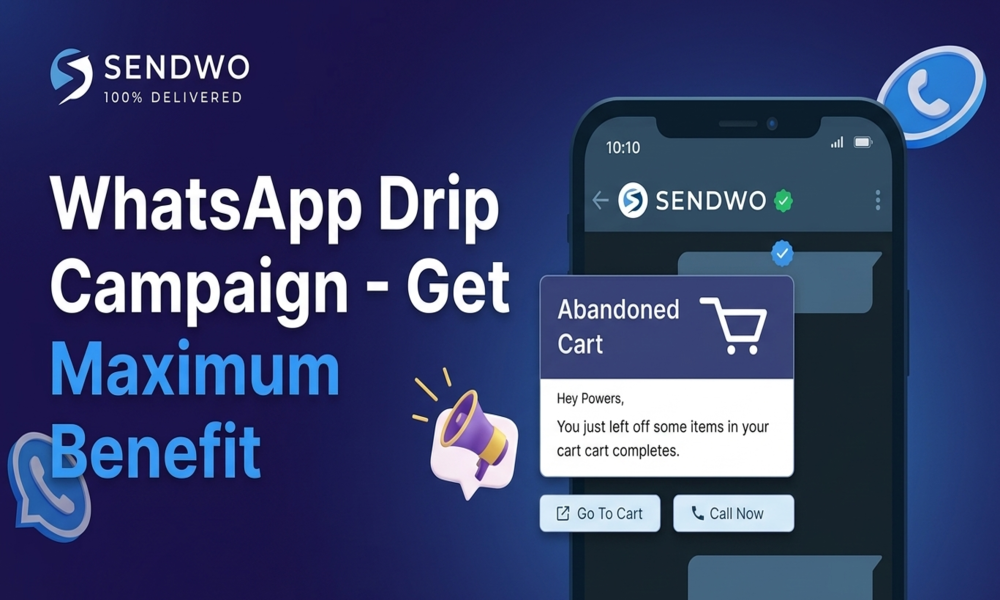
WhatsApp Drip Campaign - Get Maximum Benefit
Most businesses either forget to follow up or send one generic message that feels pushy, out of context, and easy to ignore. A strong WhatsApp drip campaign does the exact opposite. It delivers the right message in the right order, at the right moment, so that the customer keeps moving instead of stalling. That is […]
 By Aditi Kamini
Published: May 11, 2026
10 min read
By Aditi Kamini
Published: May 11, 2026
10 min read
Most businesses either forget to follow up or send one generic message that feels pushy, out of context, and easy to ignore. A strong WhatsApp drip campaign does the exact opposite. It delivers the right message in the right order, at the right moment, so that the customer keeps moving instead of stalling. That is […]
Most businesses either forget to follow up or send one generic message that feels pushy, out of context, and easy to ignore. A strong WhatsApp drip campaign does the exact opposite. It delivers the right message in the right order, at the right moment, so that the customer keeps moving instead of stalling. That is the real secret behind getting maximum benefit from a WhatsApp Drip Campaign. It should not feel like automation. It should feel like a useful conversation that happens to be automated.That is also more important now than ever.
1. Why WhatsApp drip campaigns outperform one-off follow-ups
A one-time blast can create awareness. A drip campaign creates momentum.
- That is the difference. A single message asks for attention once. A drip sequence builds context over time. Official WhatsApp marketing documentation shows that the channel is meant for more than announcements. Businesses can use it to share new products or services, nurture leads, and follow up on click-to-chat ad conversations. Utility messaging extends that lifecycle by supporting opt-in confirmations, opt-out confirmations, and order updates. When you combine those two ideas, you get a full-funnel customer journey instead of a disconnected broadcast strategy.
- There is also a strong attention advantage. In one 2025 SMB benchmark, average WhatsApp message open rates were reported at 96% and average click-through rate at 26%. A separate 2026 email report said average email open rates reached 26.6% in 2024. Benchmarks vary by industry, list quality, and offer strength, so these are not universal guarantees. But directionally, they help explain why WhatsApp drip campaigns often feel more immediate and more responsive than email-based nurture flows.
- The platform itself also rewards quality over brute-force volume. Official onboarding guidance says businesses start with limited messaging capacity, then scale upward by maintaining high-quality interactions. The same guidance describes scaling from 1,000 to 10,000 to 100,000 messages per day and eventually unlimited, while also warning that low-quality ratings can reduce limits or contribute to account blocks. That means a well-built drip campaign is not just better for conversions. It is also better for long-term deliverability and scale.
The takeaway is simple: if your WhatsApp strategy still relies on random blasts, you are leaving money, engagement, and message quality on the table.
2. The expected, timely, relevant framework for WhatsApp automation
If you want a WhatsApp drip campaign to perform well, build it around the platform’s own quality standard: expected, timely, and relevant.
Expected means consent, clarity, and no surprises
- Read together, the latest policy pages and best-practices documents point to a practical rule: you still need valid prior consent, but that consent does not always have to be a WhatsApp-only checkbox. What matters is that the person has opted in before you message them, your business name is clear, the kinds of messages are clear, and local legal requirements are respected. Official guidance also recommends making promotional consent explicit rather than burying it inside broader transactional permissions.
This is where many campaigns fail before they even start. A business gets a phone number from a form, assumes it can start pushing offers, and then wonders why block rates rise. A better approach is to set expectations upfront:
- what the subscriber will receive,
- how often they will hear from you,
- what kind of value they will get,
- and how they can opt out.
Official policy also requires that opt-out requests be respected whether they happen on or off WhatsApp. If someone wants out, they need to be removed from the communication flow.
Timely means trigger-based, not calendar-based spam
Timing is not just about the hour you send. It is about whether the message makes sense right now.
- Official policy says that outside the 24-hour customer service window, business-initiated messages must use approved message templates. Inside that 24-hour window, automation is allowed, but businesses must still provide prompt, clear escalation paths such as a human agent handoff, phone, email, a website support option, or a support form. That means your drip campaign should never become a bot-only dead end.
- The platform also discourages repetitive promos. Official template guidance notes per-user marketing template limits, and says that when a user responds to a marketing message, a new 24-hour customer service window opens. Importantly, marketing messages sent within that window do not count toward that per-user marketing limit. From a strategy standpoint, that is a huge clue: build your sequence to invite replies early, because replies create context and reduce pressure on outbound volume.
- Official marketing-message best practices also say to line messages up with seasonal or business moments, avoid times when users may be offline, monitor how many marketing conversations a customer receives per day and per week, avoid excessive promotional frequency, and apply cool-downs when customers stop engaging.
Relevant means segmentation and personalization
A generic sequence is not a drip campaign. It is just scheduled noise.
- Official guidance recommends segmenting your audience based on what they are most likely to be interested in, tailoring the message for each segment, using browsing or purchase context, and combining marketing messages with other message types such as account or order updates. The same guide encourages adding complementary information, upgrades, or related products based on previous behavior.
So if two people joined your list for two different reasons, they should not receive the same sequence.
- A user who clicked a WhatsApp ad asking for pricing needs a different message path than a customer who already bought from you. A customer who abandoned a cart needs a different path than someone who subscribed to receive educational content. Relevance is what turns automation into conversion.
3. How to build a WhatsApp drip campaign that converts
Now let’s turn strategy into execution.
Choose the right trigger before you write a single message
High-performing WhatsApp nurture campaigns are usually tied to a clear trigger. Strong examples include:
- a Click-to-WhatsApp ad,
- a website form opt-in,
- a lead magnet request,
- a quote request,
- an abandoned cart,
- a post-purchase follow-up,
- or a reactivation attempt for an inactive customer.
That lines up directly with official use cases. WhatsApp’s marketing-message documentation points to lead nurturing and follow-up from click-to-chat ads, while utility-message documentation supports opt-in management and order updates.
Imagine a skincare brand running click-to-WhatsApp ads for a free routine guide. The user asks for the guide. That first interaction should not be followed by a random discount blast. It should trigger a sequence that delivers the guide, asks one short qualifying question, recommends the right product type, addresses one common objection, and then offers a next step. That is what a drip sequence is supposed to do: reduce uncertainty one message at a time.
Use a simple high-converting sequence structure
For many businesses, a 5-step WhatsApp drip sequence is the best starting point:
- Message one: Welcome and deliver the thing the user expected.
- Message two: Add value through education, clarification, or one qualifying question.
- Message three: Personalize the next recommendation based on behavior or reply.
- Message four: Present a focused CTA such as booking, checkout, or demo request.
- Message five: Send a reminder, offer light urgency, or transition to a cool-down if the user remains inactive.
That structure works because it mirrors the platform’s own guidance: be expected, timely, relevant, concise, and respectful of overload. It also leaves room for the user to reply, which is exactly what you want if you are trying to turn a sequence into a conversation instead of a one-way blast.
For e-commerce, a different but equally powerful version is utility first, marketing second:
- order confirmation,
- shipping or status update,
- review or feedback request,
- related product suggestion,
- reorder or replenishment reminder.
That approach aligns with official utility messaging use cases for confirmations, updates, cancellations, and post-purchase communication, while still leaving room for relevant marketing follow-up later in the lifecycle.
Write copy for mobile reading, not for brochures
One of the most overlooked parts of WhatsApp campaign optimization is message design.
Official template guidance recommends keeping messages focused and concise, highlighting important information at the start, optimizing the first five lines because longer messages are truncated, using CTA buttons instead of pasting URLs into the text, and refreshing templates every few weeks to prevent creative fatigue. It also suggests testing different media types such as text, image, video, and carousel formats.
Turn this learning into your next WhatsApp campaign.
Start with Sendwo’s free plan, explore WhatsApp broadcasts, automation, AI chatbot flows, and upgrade only when your business needs more power.
That leads to a few practical copy rules:
- One message, one goal.
- One CTA, not three competing asks.
- Lead with the benefit, not the brand intro.
- Use buttons when possible.
- Make media useful even if the user never taps “read more.”
Here is a simple example of the difference:
Weak message:
“Hello from our company. We offer premium skin solutions and would love to tell you more about our products and discounts. Check our site.”
Stronger message:
“Hey Sarah, here’s your dry-skin routine guide. Want the 2-minute morning version or a product recommendation based on your skin concern?”
The second one is shorter, more contextual, more specific, and easier to reply to.
4. How to measure ROI and optimize every sequence
If you are not measuring a WhatsApp drip campaign properly, you are not really optimizing it. You are just sending messages and hoping.
- Official WhatsApp template-insight materials now surface a much stronger measurement layer than many marketers realize. Available metrics include messages sent, messages delivered, message or template read rate, quick-reply button clicks, CTA website button clicks, top block reasons, and cost metrics, although some availability varies by geography and account type. A separate enterprise guide recommends going further by tracking conversion rate, uplift in sessions, purchases, retention, and customer lifetime value.
That means you should evaluate a drip campaign on two levels:
Message-level performance
- delivery,
- read rate,
- click-through rate,
- quick replies,
- CTA engagement,
- block reasons.
Business-level performance
- leads qualified,
- demos booked,
- carts recovered,
- orders placed,
- repeat purchases,
- revenue per sequence,
- retention impact.
Because official pricing is now per delivered template message, trimming even one weak message from a large sequence can improve ROI immediately. Cost control in WhatsApp automation is no longer just about reducing platform fees. It is about eliminating low-value steps.
A weekly optimization loop that actually works
A practical optimization rhythm should look like this:
- If read rates are weak, rewrite the first five lines.
- If clicks are weak, simplify the CTA and test buttons instead of raw links.
- If users stop engaging, apply a cool-down instead of forcing more sends.
- If block reasons rise, revisit opt-in quality and segment accuracy.
- If one segment responds better than another, split the sequence and personalize harder.
- A/B test timing, creative, and campaign strategy.
Those actions are directly supported by official best-practices guidance on timing, frequency, quality, template design, and testing agendas.
5. Common mistakes that hurt WhatsApp drip campaign performance
The fastest way to lose the benefit of a WhatsApp drip campaign is to treat it like a mass-promotion channel.
The most common mistakes are predictable:
- collecting phone numbers without setting messaging expectations,
- sending promotional messages too often,
- using the same sequence for every audience,
- stuffing messages with multiple competing CTAs,
- relying on automation without a clear human escalation path,
- ignoring quality signals,
- and forgetting current platform constraints such as U.S. marketing-message delivery restrictions.
Official documentation explicitly warns against poor opt-in hygiene, excessive promotional frequency, multiple competing CTAs, and bot-only support experiences without escalation paths. It also connects low-quality messaging with reduced limits and account risks.
A good rule is this:
If your sequence feels like a campaign calendar, it is probably too brand-centered.
If it feels like a customer journey, you are much closer.
FAQ
1. What is a WhatsApp drip campaign?
A WhatsApp drip campaign is a planned sequence of messages sent over time based on a trigger, a customer action, or a lifecycle stage. In practice, it often combines marketing messages for awareness and nurturing with utility messages for confirmations, updates, and transactional follow-up.
2. Do I need a WhatsApp-specific opt-in checkbox?
Not necessarily, based on how the latest official materials are written. The practical takeaway is that you still need prior opt-in or lawful consent before messaging, but the guidance suggests it does not always need to be a WhatsApp-only checkbox. What remains essential is that your business name, message types, and customer expectations are clear, and that promotional consent is handled explicitly and legally.
3. Do I need approved message templates for a drip campaign?
Yes, for business-initiated messaging outside the 24-hour customer service window. Official policy says you may reply without a template only within 24 hours of the user’s last message. Outside that window, approved templates are required.
4. How many messages should be in a WhatsApp drip campaign?
There is no official fixed number. Official best practices focus on requested cadence, avoiding overload, and using cool-downs when customers stop engaging. For most businesses, starting with 3 to 5 messages is sensible, then expanding only if your read rate, reply rate, and conversion data support it.
5. What is the best time to send WhatsApp drip messages?
The best time is usually tied to a customer moment, not just a clock time. Official guidance recommends aligning messages with seasonal or business moments, considering when users may be offline, and monitoring daily and weekly frequency to avoid fatigue.
Aditi Kamini
Aditi, a content marketer at SendWo, is a passionate writer and marketing enthusiast. She excels in driving revenue campaigns, building client relationships, and mastering content creation, SEO, customer service, and project management.