WhatsApp Team Inbox: Complete Guide to Multi-Agent Chat Management
Scale your customer support with a shared WhatsApp Team Inbox that lets multiple agents collaborate, assign chats, and track performance.
 By Aditi Kamini
Published: May 19, 2026
15 min read
By Aditi Kamini
Published: May 19, 2026
15 min read
Scale your customer support with a shared WhatsApp Team Inbox that lets multiple agents collaborate, assign chats, and track performance.
Imagine dozens of customers messaging your business on WhatsApp at once – questions, orders, support requests – all vying for a response. With 3.2 billion global WhatsApp users and over 175 million business conversations every day, this scenario is common. Fortunately, a WhatsApp team inbox can turn this chaos into organized collaboration. It centralizes all customer chats into one shared platform, so multiple agents can seamlessly manage conversations under a single business number. This “shared inbox” approach ensures no message is missed and every customer gets a fast, professional reply – a must in an era when WhatsApp messages boast an open rate near 98%.
1. What is a WhatsApp Team Inbox?
- A WhatsApp team inbox is a centralized messaging dashboard powered by the WhatsApp Business API. Unlike the standard WhatsApp Business App (which is meant for solo use or very small teams), a team inbox is built for collaboration. It lets multiple agents log into the same WhatsApp business number. All incoming messages funnel into this shared space, where any authorized team member can view, assign, and respond. In practice, customers continue chatting with “your company” through one official number – they see no agents – while behind the scenes, your agents coordinate and share the workload.
- This is a critical difference from the regular app. The WhatsApp Business App, even with its multi-device mode, limits you to 4 additional linked devices. That means at most 5 people can use it, and it lacks true collaboration features: there’s no assignment, tag-based routing, or comprehensive analytics. By contrast, a team inbox (via the API) removes those limits. You can have unlimited agents working simultaneously, all in one place. It's the difference between “passing the phone” among coworkers and giving each team member their own seat at a unified support console.
- Key Point: A WhatsApp team inbox is like a shared mailbox. It lets your whole support or sales team manage chats together, ensuring faster responses and consistent service. By using the API, you bypass broadcast limits (256 contacts on the App) and device caps, enabling true teamwork.
2. How a Multi-Agent WhatsApp Inbox Works
A team inbox changes the workflow of customer messaging. Here’s a typical flow:
- Customer Message: A user texts your WhatsApp business number. Immediately, the conversation appears in the team dashboard.
- Chat Triage: The system can auto-label or tag incoming chats (e.g. “sales”, “support”, “VIP”) based on keywords or prior data. Intelligent routing rules assign the chat to the right agent or queue.
- Agent Assignment: An available agent picks up the chat. Agents see customer profiles, past messages, and tags – so they know context before replying. If needed, agents can add internal notes or transfer the chat to a more qualified colleague.
- Responding (Bot or Human): Frequently, a chatbot or FAQ automation handles simple queries instantly. When the issue is complex, the conversation is handed off to a human agent seamlessly, with the full chat history intact.
- Collaboration: At any time, managers or teammates can jump in. Agents can see chat statuses (active, awaiting response, etc.) and use internal chat to consult experts without leaving the platform.
- Analytics & Wrap-Up: Once the chat ends, it’s logged. Managers view metrics like response time, resolution rate, and CSAT scores for each agent. Tag and conversation data can feed into your CRM for follow-ups and analysis.
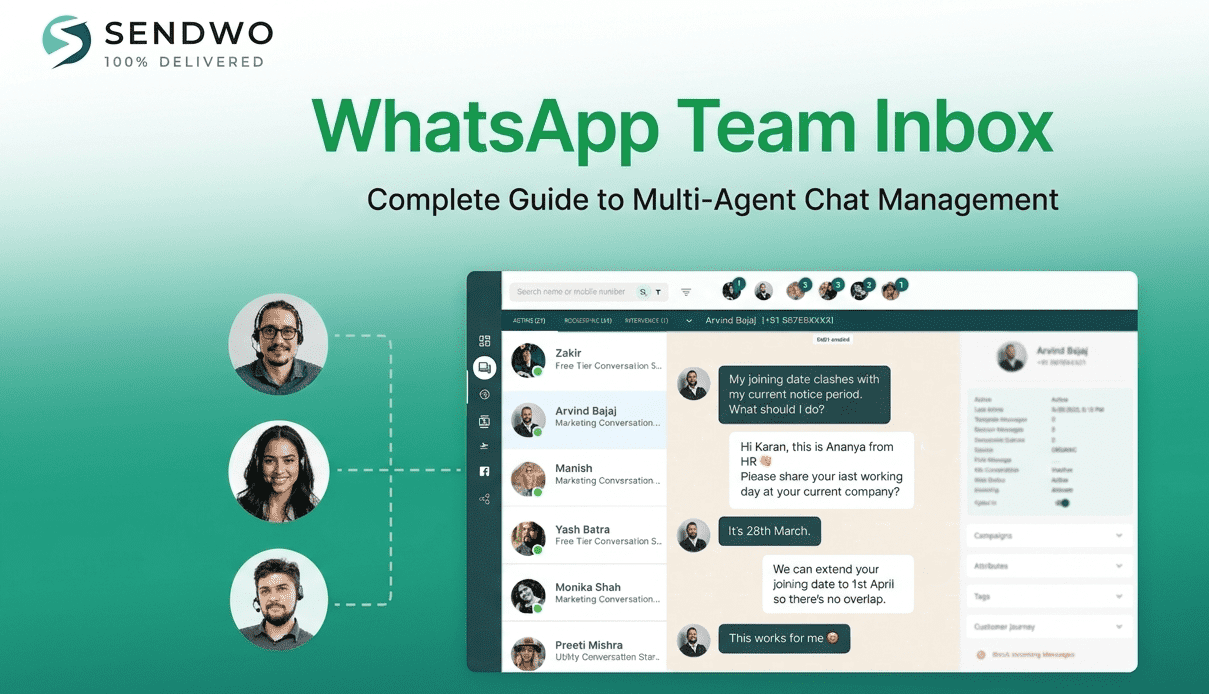
This smooth flow is possible because a team inbox provides features beyond a simple messaging app. For example, platforms like SendWo and other providers offer three-pane dashboards (queues, chat list, conversation view), smart assignment rules, and built-in CRMs. One example UI (pictured above) shows columns like “Active,” “Requesting,” and “Intervened” which help agents prioritize and coordinate on chats. According to industry reports, businesses that implement multi-agent chat with routing automation see dramatic results. For instance, one analysis notes that a single agent’s average first response time (over 15 minutes) can drop below 2 minutes when five agents share the load. In short, more agents + smarter systems = faster, higher-quality support.
3. Key Features of a Team Inbox Platform
A robust multi-agent WhatsApp solution (like SendWo) includes:
- Centralized Dashboard: All chats (inbound messages and ongoing conversations) appear in one unified inbox. Agents don’t switch phones or accounts. From this view, they can see unread messages, pending conversations, and customer details.
- Role-Based Access & Permissions: Agents, supervisors, and admins each have different rights. For example, managers may reassign any chat, while agents only handle ones assigned to them. SendWo lets you “assign multiple agents on the same number with different levels of access and control”, ensuring privacy and accountability.
- Intelligent Chat Routing: Use tags, keywords, or AI to route chats automatically. For example, Spanish-language queries can auto-assign to a Spanish-speaking agent. E-commerce queries go to sales; support tickets to the tech team. This smart assignment means no customer waits due to confusion about whose job it is to respond.
- Internal Collaboration Tools: Agents can add private notes to a chat (visible only to staff), or @-mention colleagues inside the system. Shared templates and quick replies help maintain consistency. Avoid “cross-talking” by seeing which chats colleagues are handling – no two agents answer the same message.
- Chatbot and Automation Integration: A team inbox often integrates with bots. When a chat starts, an automated FAQ bot can greet the customer, gather basic info (name, order number, issue type), and even solve simple requests. Only when needed does it escalate to a live agent, handing off all collected context. SendWo, for example, lets you “assign chat via AI to human on [the] shared team inbox”, blending automation with human care.
- Built-In CRM & Profiles: Each chat can link to a customer profile in your system. Agents see contact history, tags (e.g. “High Value” or “Prospect”), and conversation logs. This turns your WhatsApp Team Inbox into a mini-CRM, so agents have full context and customers don’t repeat themselves.
- Analytics & Reporting: Track KPIs like average response time, chat volume, resolution rate, and agent activity. Dashboards help managers spot trends or bottlenecks. For example, team inbox platforms often show “First Response Time” and “Chats Closed” per agent, enabling data-driven optimization.
Each of these features works together to make multi-agent chat management possible. Without them, a group of people messaging customers would quickly become chaotic. With a proper team inbox, however, your WhatsApp channel scales seamlessly even as your customer base and support team grow.
4. Why Multi-Agent WhatsApp Support Matters
Businesses are adopting WhatsApp Team Inbox at record pace – and for good reason. The advantages are both strategic and measurable:
- 24/7 Coverage & Scalability: With multiple agents, you can staff the channel in shifts around the clock. Customers in any time zone get a real person whenever they reach out. Plus, WhatsApp Team Inbox has no practical limit on concurrent chats or agents. You could handle hundreds of chats simultaneously if needed, which is impossible on a solo business app.
- Faster Response Times: Responding quickly on messaging drives satisfaction and sales. Because agents share the load, no single person has to juggle every query. Industry data shows that messaging agents can handle 4–5 chats at once on average. By contrast, a voice call ties up one agent. Faster handling also means fewer missed leads; a prompt reply often wins a sale.
- Improved Collaboration: Shared access means no “knowledge silos.” If one agent is out, others see that conversation and can cover for them. Agents can escalate issues or consult specialists internally without leaving the chat, providing a smoother customer experience. This teamwork leads to higher first contact resolution and happier customers.
- Cost Efficiency: Messaging is cheaper than phone calls. One study found that allowing agents to work on multiple chats cut support costs significantly. WhatsApp team inboxes also integrate chatbots, automating routine Q&As (store hours, tracking updates, etc.) so human agents focus only on complex cases. Bird.ai reports an e-commerce brand shifted 25% of inbound calls to WhatsApp, slashing call center load.
- Higher Customer Satisfaction: Customers love quick messaging. Since 80% of WhatsApp messages are read within 5 minutes, prompt chat support meets customer expectations. The streamlined, personal nature of chat leads to better NPS and repeat business. In fact, studies show messaging customers have a higher purchase intent: one research cited a 31% signup increase when live chat was present.
- Actionable Data: Every chat becomes data. Tag customers by issue, measure how many chats end in a sale vs. a support ticket, and see peak inquiry times. Dashboards reveal inefficiencies – e.g., if one agent is overloaded or one query type takes too long. This insight lets you optimize staffing, bot responses, and workflows.
- Unified Brand Experience: Keeping all conversations on one number (and linked to your brand profile) builds customer trust. They aren’t left confused by bouncing between random managers or failing to reach a human. A team inbox preserves continuity and branding – regardless of which agent replies.
In summary, a multi-agent WhatsApp Team Inbox isn’t just a luxury – it’s fast becoming a necessity for any business serious about customer engagement. The gains in responsiveness, teamwork, and insights directly translate into better customer outcomes and often pay for themselves many times over.
5. How SendWo Powers Your Multi-Agent Inbox
SendWo offers a complete WhatsApp API platform built for teams. Its Shared Team Inbox is designed exactly for multi-agent chat management. For example, SendWo lets you “assign multiple agents on the same number with different levels of access and control”. This means you can add all your support reps to one WhatsApp account, controlling who sees which chats or customer data.
Key SendWo inbox features include:
- Multi-Agent Support: Add unlimited team members to your WhatsApp account. Agents log in via web or app, see all incoming messages, and can take ownership of chats.
- Role Management: Define roles like Agent, Manager, Admin. Managers can view and audit all conversations, whereas Agents only handle chats assigned to them. This mirrors what leading CRM platforms do.
- Live Chat & AI: Agents get a real-time chat dashboard. Coupled with SendWo’s AI chatbot builder, initial customer inquiries can be auto-answered. The platform even allows “chatbot-to-human handoff” – e.g. when the bot can’t answer, it “transfers the conversation to a human on [the] shared team inbox”.
- Broadcast & CRM Tools: Beyond chatting, SendWo includes list-based broadcasting, message templates, and contact labeling. Agents can tag conversations (e.g. “Order Query,” “VIP Customer”) and search chat history. Over 50 million businesses use WhatsApp Business for marketing; SendWo brings those campaign tools and CRM segmentation alongside the team inbox.
- Analytics: Built-in reports let you monitor team performance. Track KPIs like average response time (usually 60–90 seconds on WhatsApp) and conversation volume per agent. These insights mirror the benefits of dedicated support software, right within your messaging tool.
By combining all of these, SendWo acts as a one-stop WhatsApp CRM. The advantages are clear: agents no longer struggle with separate devices or missed messages. Instead, your team works from a powerful shared inbox, boosting efficiency and customer satisfaction.
Turn this learning into your next WhatsApp campaign.
Start with Sendwo’s free plan, explore WhatsApp broadcasts, automation, AI chatbot flows, and upgrade only when your business needs more power.
6. Best Practices for Multi-Agent Chat Management
Implementing a team inbox is not just about technology, but also about smart processes. Here are some proven tips:
- Define Clear Roles & Workflows: Establish who does what. For instance, have dedicated “first-responder” agents to greet new chats and tag them, then route to specialists as needed. Assign Managers to oversee queues. Use SendWo’s permissions to enforce these roles.
- Set Response SLAs: Customers expect rapid replies on messaging. Aim to respond within 1–2 minutes on WhatsApp chat. Use tools (automated greetings if an agent is delayed) so nobody sees a blank wall. Bird.ai advises keeping asynchronous channels as instant as possible; if an agent can handle 4–5 chats at once, try to use that bandwidth without compromising quality.
- Use Tags & Categories: Create consistent tags (e.g. “Order”, “Complaint”, “Billing”). When a new chat arrives, the first agent should label it. These tags help in routing and reporting. For example, VIP customers can get a “Priority” tag, ensuring only senior staff handle them. In SendWo, tags and attributes function like a mini-CRM.
- Employ Chatbots for FAQs: Free your agents to focus on complex issues by automating the routine. Common questions (e.g. “What are your hours?”) can be answered instantly by a bot. A Zendesk study cited by Bird found automating FAQs tripled agent productivity in one case. Design your bot to collect key info (name, order ID) before passing to a human.
- Train Your Team: Make sure agents know how to use the team inbox features. They should practice assigning chats, leaving internal notes, and escalating properly. Regularly review conversation transcripts as a team to learn from tough cases.
- Monitor & Optimize: Use reporting dashboards daily. If you see chats piling up at certain hours, add shifts then. If one topic causes long delays, improve your bot flow for that topic. Continuous improvement is the key.
- Maintain Brand Voice: With multiple agents, consistency is vital. Use approved message templates and quick replies to keep tone uniform. SendWo’s template manager helps here by storing canned responses.
- Ensure Data Security: Remember, all WhatsApp messages are end-to-end encrypted on the platform. A good team inbox (and SendWo) will also offer audit logs and compliance measures. Make sure your setup complies with privacy laws (e.g. GDPR) when storing chat data.
By treating your WhatsApp Team Inbox as a core support channel – with SLAs, training, and analysis – you maximize its impact. A well-managed team inbox not only resolves customer issues faster, but builds loyalty.
Real-World Use Cases
Many industries are seeing big wins from multi-agent WhatsApp support:
- E-commerce & Retail: An online retailer uses WhatsApp to handle order inquiries, returns, and recommendations. When sales spike (e.g. Black Friday), dozens of agents jump on chats. A chatbot answers basic order status questions instantly, while human agents handle size exchanges or complaints. The result: 25% higher customer satisfaction and a 40% cut in support costs.
- Technical Support (SaaS/Tech): A software company lets users report bugs or ask for help via WhatsApp. Agents triage by software module or urgency. Simple password resets are automated; complex bugs get escalated to engineers. Tagging chat topics gives product teams data on common issues, improving the software itself.
- Healthcare & Services: A clinic uses WhatsApp for appointment scheduling and follow-ups. A patient texts to book an appointment; a chatbot collects their name and preferred time, then notifies a staff member to confirm. For ongoing care, doctors and nurses collaborate on patient chats (one patient = one chat), ensuring continuous, secure communication.
- Sales & Lead Gen: For many B2B companies, WhatsApp has become a prime channel for new leads. Chat ads or website links open a WhatsApp chat, which an automated flow qualifies. Sales reps then take over promising leads. Agents can even tag chats with deal stages or move them into a CRM pipeline automatically. This reduces lead dropout and speeds up the sales cycle.
- Travel & Hospitality: A travel agency handles booking inquiries, itinerary changes, and customer support via WhatsApp. During travel disruptions (flights delayed or cancelled), they notify affected customers instantly through the team inbox, automatically sending new itineraries or hotel vouchers in the chat. Agents remain reachable 24/7 for travelers in different time zones.
These examples show the versatility of a WhatsApp Team Inbox. Any scenario where customers want fast, personal responses – from banking to real estate – can benefit. The common thread is that multi-agent WhatsApp support turns a high-volume, multi-topic channel into a coordinated, data-driven process.
7. Set Up Your WhatsApp Team Inbox
Ready to implement a multi-agent system? Follow these steps:
- Obtain a WhatsApp Business API Account: You’ll need a verified business (often a Facebook Business Manager account) and an approved phone number. Work with an official WhatsApp Business Solution Provider (BSP) like SendWo. They’ll handle the API setup so you can focus on using the system rather than dealing with Facebook’s developer details.
- Choose Your Platform: Pick a team inbox tool that meets your needs. Key criteria: unlimited agents, chatbot integration, role permissions, analytics, and integrations (CRM, CMS). SendWo is one such platform that offers all these features with official API support.
- Onboard Your Team: Add your agents to the platform. Assign roles (Agent vs. Manager) and set permissions. In SendWo, you can restrict who sees which labels or templates. Provide training on the dashboard: how to claim a chat, apply a tag, or escalate an issue.
- Define Workflows: Set up chat assignment rules and tags. For example, create rules that route messages containing “order” to your sales queue, and “refund” to support. Configure your chatbot greetings: perhaps an automated “Hi, I’m Alex. How can I help you today?” and logic trees for FAQ. Document these processes in a simple team guide.
- Test and Refine: Before going live, simulate loads. Have teammates send test messages to the number. Ensure chats correctly fall into queues and reach the right agent. Test fallback scenarios (e.g. if no agent is available, send an auto-reply with next steps). Review and adjust.
- Monitor and Iterate: Once live, keep an eye on the analytics. If average response time is rising, consider adding agents or improving your autoresponses. Regularly collect feedback from agents (is anything confusing?) and customers (are they getting timely help?). Use this to continuously optimize the system.
Throughout, remember that continuous improvement is key. A WhatsApp team inbox is a dynamic tool – as your business grows or changes, your workflows will too.
FAQs
1. What is a WhatsApp team inbox vs. a shared inbox?
A WhatsApp Team Inbox generally implies advanced multi-agent features: smart chat routing, analytics, and roles. A shared WhatsApp Team Inbox (like WhatsApp app with linked devices) only means multiple users see the same chats. It lacks automatic assignment or detailed reporting. In practice, for small teams a shared inbox suffices, but any growing business needs the full multi-agent system with routing, automation, and tracking.
2. How many agents can use one WhatsApp Business number?
With the WhatsApp Business API, there is no hard limit on agents. Official platforms support unlimited team members on one number. (In contrast, the free Business App multi-device feature caps at 5 devices.) The only constraints are your platform and subscription.
3. How many chats can be handled simultaneously?
Effectively unlimited. Team inbox software can handle thousands of concurrent chats, limited only by how many agents you have. Even a small team can manage dozens of active chats at the same time: surveys show a typical agent handles 2–3 chats at once, with 22% of agents juggling 4–5 conversations simultaneously. The key is having enough agents so no one is overwhelmed.
4. What’s the difference between WhatsApp Business App and API for teams?
The Business App (free) is meant for solo or tiny teams. It allows up to 5 linked devices and basic functions. The API (used by SendWo) is a fully-fledged platform: unlimited users, templates for broadcast, chatbot integrations, and deep analytics. In short, use the Business App if you have <5 people and low volume; use the API if you need true multi-agent support and scale.
5. Can I automate responses in a team inbox?
Yes. The WhatsApp Business API supports automation. In SendWo and similar platforms, you can build chatbots (no-code flows or AI) that answer FAQs or route customers before a human replies. Automations can send instant greetings, collect information, and escalate to a live agent seamlessly. This speeds up service – Bird.ai notes that companies using FAQ bots saw huge productivity gains.
Aditi Kamini
Aditi, a content marketer at SendWo, is a passionate writer and marketing enthusiast. She excels in driving revenue campaigns, building client relationships, and mastering content creation, SEO, customer service, and project management.