Click to WhatsApp Ads Strategies to Maximize Sales - Easy Guide
Drive more sales with high‑converting Click to WhatsApp Ads Strategies using for targeting, messaging, and automation that turn social traffic.
 By Aditi Kamini
Published: May 12, 2026
11 min read
By Aditi Kamini
Published: May 12, 2026
11 min read
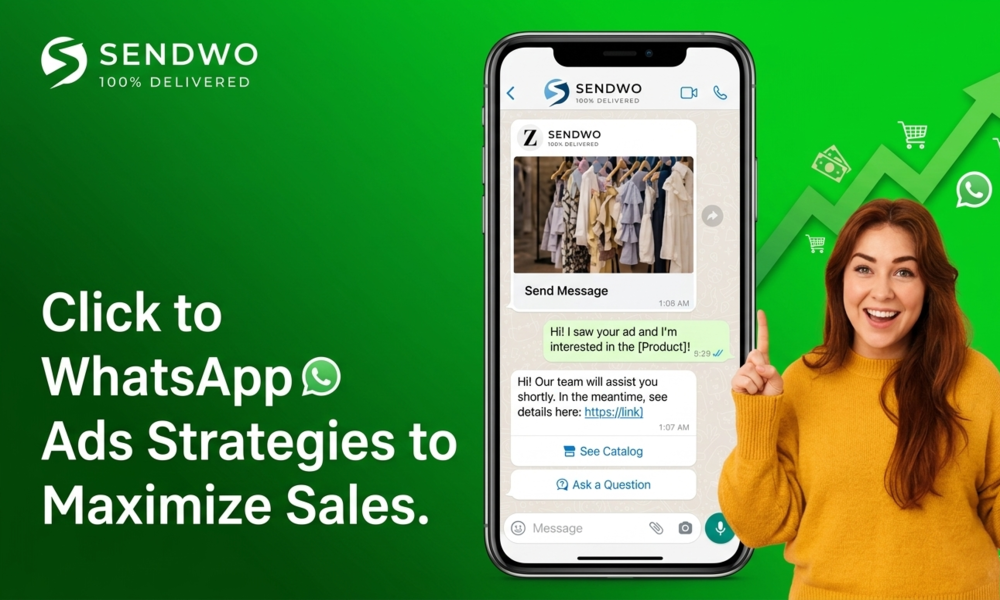
Drive more sales with high‑converting Click to WhatsApp Ads Strategies using for targeting, messaging, and automation that turn social traffic.
A buyer sees your ad, taps, lands on a page, waits, scrolls, gets distracted, and disappears. Click to WhatsApp Ads Strategies fix that by collapsing the gap between interest and action. Instead of sending people into a colder, slower fuWhatsappnnel, you send them straight into a conversation.Official guidance from WhatsApp for Business positions ads that click to WhatsApp as a channel for lead generation, product consideration, repeat purchase, and direct sales, not just top-of-funnel engagement.Let see Click to WhatsApp Ads Strategies to Maximize Sales.
1. Why Click to WhatsApp Ads Strategies are different
- Click to WhatsApp Ads Strategies work because they are built for how people actually buy today: fast, mobile-first, conversation-led, and low-friction. The official WhatsApp for Business guide says these ads can appear across feeds, stories, and marketplace placements, and can support shoppers at all funnel stages, from discovery to repeat purchase. It also highlights three practical outcomes marketers use them for most often: lead generation, product consideration, and sales.
- Customer expectations make this even more important. One major customer research report found that 65% of customers expect companies to adapt to their changing needs and preferences, while 81% expect faster, more tailored service as technology improves. Another industry report says 67% of consumers now expect more personalized service when AI can use prior interactions, and separate consumer research found that 59% of shoppers prefer gathering information themselves rather than speaking to a human immediately. In plain English: people want answers fast, but they also want those answers to feel relevant.
- That is exactly where Click to WhatsApp Ads Strategies win. They turn an ad into the opening line of a real sales conversation. And because the ad platform now supports more centralized campaign management, richer measurement, flows, business AI support, and even calling options for larger businesses, the channel is becoming more operationally mature, not less.
2. Click to WhatsApp Ads Strategies that win more sales
Here are the ten strategies that separate average click-to-WhatsApp campaigns from high-converting WhatsApp sales funnels.
Lead with an offer that belongs in chat
The biggest mistake brands make is writing an ad that belongs on a website, then sending traffic into a chat.
A click-to-WhatsApp ad performs best when the promise can be fulfilled inside a conversation. Official WhatsApp guidance frames these ads around generating and qualifying leads, helping buyers consider products, and closing sales. It also explicitly recommends that brands follow through on the ad’s promise quickly after the chat starts.
That means your CTA should sound like this:
- Get a custom quote on WhatsApp
- Check stock and delivery in one message
- Find the right plan for your budget
- Book your appointment instantly
- See the best product for your needs
And not like this:
- Contact us
- Learn more
- Message us
- Hi
A good click-to-WhatsApp ad is not vague. It is specific, useful, and easy to complete in chat.
Practical example: if you sell skincare, do not run an ad that says “Shop our full range.” Run one that says, “Tell us your skin concern and get a recommended routine on WhatsApp.” That feels personal, useful, and immediate.
Choose the objective that matches the sale
A lot of advertisers lose money because they optimize for the wrong event.
Official help documentation shows that click-to-WhatsApp campaigns can be used with Awareness, Traffic, Engagement, Leads, or Sales setups, and pre-filled message functionality is available for Traffic, Engagement, Leads, and Sales. The right choice depends on what happens after the click. If the real goal is qualification, use a lead-focused setup. If you can pass downstream purchase signals, optimize for sales. Official Meta case studies show why this matters: one lead optimization test reduced cost per lead by 12%, while another purchase optimization test delivered 3.9 times more purchases with 79% lower cost versus the brand’s usual conversation-focused approach.
A simple rule works well:
- Awareness if you are educating a cold market
- Traffic or Engagement if you are driving conversations at scale
- Leads if you need structured qualification
- Sales if you can measure purchases or high-value downstream events
If your team keeps saying, “We got a lot of chats, but not many sales,” the issue may not be the ad creative. It may be the optimization event.
Write the first message before the customer does
The blank chat box kills momentum.
Official ads guidance says you can customize pre-filled customer messages in Ads Manager so the opening line matches the ad objective and offer. That seems small, but it is a major conversion lever because it removes the friction of making the buyer think of what to type first.
Your pre-filled message should do one of three things:
- state the product intent
- state the buying problem
- state the desired outcome
Examples:
- I want a quote for this product
- Can you help me pick the right package?
- I want to book a demo
- Is this item available in my city?
- I saw the ad and want the offer
This small shift improves conversion quality because the first message becomes structured buying intent instead of random small talk.
Qualify instantly with a guided welcome path
The best campaigns do not make the customer wait for the second step. They deliver it instantly.
Official developer guidance says a click-to-WhatsApp campaign can connect to a Welcome Message Sequence that includes text, a prefilled message, and buttons. Official WhatsApp guidance also recommends using a 24/7 chatbot to ask predefined questions, handle common product queries, and route more complex questions to a live agent.
A high-converting welcome path usually looks like this:
- Pricing
- Product recommendation
- Delivery and stock
- Book a demo
- Talk to a human
This matters because the first minute of the conversation decides whether a buyer stays or disappears.
If you are running Click to WhatsApp Ads Strategies without a guided first response, you are paying for curiosity and hoping it magically turns into purchase intent. A welcome path turns that curiosity into usable sales data.
Replace long forms with WhatsApp Flows
When your offer needs more than one answer, use a structured flow instead of a messy back-and-forth.
Official help documentation says WhatsApp Flows let you add a structured form to ads that click to WhatsApp, and related guidance explains that businesses can use flows to build customized forms and collect information directly inside the chat. One official case study attributed a 60% decrease in time spent qualifying leads and a 31% lower cost per qualified lead to WhatsApp Flows connected to Click to WhatsApp Ads Strategies.
Flows are especially powerful for:
- insurance quotes
- real estate inquiries
- education admissions
- clinic bookings
- financing or loan screening
- high-consideration ecommerce
Imagine a dental clinic running an ad that says, “Check appointment availability on WhatsApp.” A flow can capture treatment type, preferred date, city, and urgency before a staff member even joins the chat. That cuts lead handling time, keeps the customer engaged, and makes the handoff cleaner.
If your current chat feels like filling a form manually, use a flow.
Segment by intent, not just demographics
Demographic targeting still matters. But for Click to WhatsApp Ads Strategies, intent segmentation matters more.
Customers increasingly expect relevance. Research shows people want faster, more tailored service, more adaptive experiences, and more personalization in businesses’ communications. Official WhatsApp guidance also recommends adjusting your targeting and messaging by funnel stage and collecting zero-party data that shoppers deliberately share with your brand during conversations, such as preferences, sizes, or use case details.
Turn this learning into your next WhatsApp campaign.
Start with Sendwo’s free plan, explore WhatsApp broadcasts, automation, AI chatbot flows, and upgrade only when your business needs more power.
So stop thinking only in terms of:
- age
- gender
- location
Start building around:
- cold vs warm traffic
- first-time vs repeat buyers
- high-intent vs browsing behavior
- product category interest
- cart abandoners vs active buyers
- price-sensitive vs premium shoppers
A strong segmentation framework might look like this:
- Cold audience ad: “Need help choosing the right product?”
- Warm audience ad: “Still comparing options? Get personalized advice on WhatsApp.”
- Cart abandoner ad: “Still interested? Ask us anything before you checkout.”
- Repeat buyer ad: “Reorder your last favorite in one message.”
That is how you make a WhatsApp ad feel less like advertising and more like assistance.
Follow up while the conversation is still warm
The click is not the campaign. The click is the opening.
Meta’s WhatsApp Business messaging documentation says that when a user messages or calls your business, a 24-hour customer service window starts. It also says all messages are free for 72 hours when sent inside an open free entry point window, and that if you do not respond within 24 hours in the relevant scenario, that free entry point conversation is not opened and you will need a template to message later. Service messages are free-form during an active customer service window. Meta also introduced integrated campaigns that combine ads with marketing messages in Ads Manager for re-engagement.
That means speed is not just a customer experience issue. It is a sales issue and, in some cases, a cost issue.
A smart follow-up rhythm looks like this:
- within minutes: answer the initial intent
- within the first hour: handle objections and offer proof
- within the day: send the quote, recommendation, or booking prompt
- before the window cools: ask for next-step commitment or opt-in
This is especially important for higher-ticket or comparison-heavy offers. Buyers rarely need more hype. They need faster clarity.
Blend automation with human takeover
Automation should qualify. Humans should close.
Official WhatsApp guidance recommends 24/7 chatbot support because slow replies cause people to abandon the chat, and it highlights use cases like answering basic questions, sharing resources, recommending products, and routing complex issues to agents. On its own product pages, SendWo says its live chat workflow includes team collaboration, follow-up notifications, AI-powered response automation, shared conversation visibility, and a unified inbox view for ongoing support and upsell workflows.
The best-performing structure usually looks like this:
- Bot handles the first layer
- greeting
- qualification
- FAQs
- product suggestions
Agent handles the buying layer
- objections
- customization
- urgency
- payment close
- upsell
This hybrid model works because it preserves speed without sacrificing trust.
A buyer asking, “What’s your price?” should not wait fifteen minutes for a human. But a buyer asking, “Which plan is right for my team of twelve?” should not be trapped in a dead-end bot loop either.
Measure revenue, not vanity metrics
The wrong metric will make a decent click-to-WhatsApp campaign look great, and a great one look average.
Official business messaging measurement documentation says analytics can include link tracking, while template analytics can show metrics like sent, delivered, read, clicked, and cost. The platform also exposes a unique ctwa_clid identifier for click-to-WhatsApp ad clicks, and the automatic events webhook can notify businesses when a purchase or lead event is detected in a chat started through a click-to-WhatsApp ad. Conversions API for Business Messaging also supports retrieval of the click-to-WhatsApp click ID for measurement and optimization.
So do not stop at:
- CTR
- CPC
- message volume
Track these instead:
- cost per conversation
- cost per qualified lead
- qualified lead rate
- quote rate
- booking rate
- purchase rate
- revenue per conversation
- time to first response
- follow-up completion rate
A campaign with lower CTR but higher qualified lead rate is often the better campaign. A campaign with fewer chats but better purchase rate is often the scalable one.
If you are not tying chats to revenue, you are optimizing blind.
Diversify creatives and placements
Click-to-WhatsApp performance is rarely unlocked by one perfect ad. It is usually unlocked by creative variety.
A July 2025 company update said businesses can now manage WhatsApp and other major social-app marketing campaigns more centrally in Ads Manager, using the same creative, flows, and budgets while the platform’s AI systems optimize across placements. Separate Meta business guidance on creative diversification says performance improves when marketers upload multiple creatives with different themes and messages so AI systems have more options to test and optimize. One official case study tied to Reels ads that clicked to WhatsApp reported a 35% increase in revenue and an 84% lower cost per lead.
Instead of making one ad and hoping it wins, build a small creative matrix:
- one pain-point creative
- one benefit-led creative
- one testimonial-style creative
- one urgency-driven creative
- one offer-led creative
- one educational creative
Then vary format too:
- short video
- talking-head promo
- carousel
- static image
- UGC-style clip
- story-style ad
The algorithm cannot optimize options you never give it.
3. Mistakes that quietly drain ad budget
Most click-to-WhatsApp campaigns do not fail dramatically. They fail quietly.
They get clicks, start some chats, generate a few leads, and still never scale because the core system is weak. Those weak spots usually run directly against official best practices around ad promise, response speed, opt-ins, measurement, and conversation windows.
Watch for these mistakes:
- A vague CTA with no clear promise
“Message us” is not a reason to click. - No pre-filled message
You are forcing the buyer to do work before the conversation even starts. - No welcome path
Every click should land in a cleaner, guided experience. - Asking too many questions before giving value
Give the recommendation, quote range, or next step early. - Slow first response
Delay destroys intent and weakens your opportunity to convert inside the active window. - Optimizing for cheap chats instead of qualified demand
High message volume can still produce poor sales. - No opt-in and no long-term nurture plan
Official guidance stresses opt-ins and zero-party data if you want to stay connected beyond the first conversation.
FAQs
1. Are Click to WhatsApp Ads Strategies effective for small businesses?
Yes, ideal for conversation-driven sales like quotes, appointments, or demos. Meta's Ads Manager updates make it scalable for all sizes.
2. Which campaign objective is best for Click to WhatsApp Ads Strategies?
Match to your goal: Leads for qualification, Sales for conversions, Traffic/Engagement for chat volume. Case studies show big lifts with alignment.
3. How much do Click to WhatsApp Ads Strategies cost?
Varies by auction, audience, creative, and optimization. Messages free for 72 hours (open window) or 24 hours (service); templates needed outside.
4. Can I automate the first reply without hurting conversions?
Yes, with helpful, fast bots, pre-fills, or Flows. Best as hybrid: auto for basics, human for complex sales.
5. How do I collect opt-ins for future WhatsApp marketing?
Ask in active chats within 72 hours. Get zero-party data for relevant follow-ups, per WhatsApp rules.
Aditi Kamini
Aditi, a content marketer at SendWo, is a passionate writer and marketing enthusiast. She excels in driving revenue campaigns, building client relationships, and mastering content creation, SEO, customer service, and project management.