How to Build an AI Shopping Assistant on WhatsApp - Easy Guide
Build an AI Shopping Assistant on WhatsApp with SendWo to automate product recommendations, cart recovery, order updates, and support.
 By Aditi Kamini
Published: April 30, 2026
14 min read
By Aditi Kamini
Published: April 30, 2026
14 min read
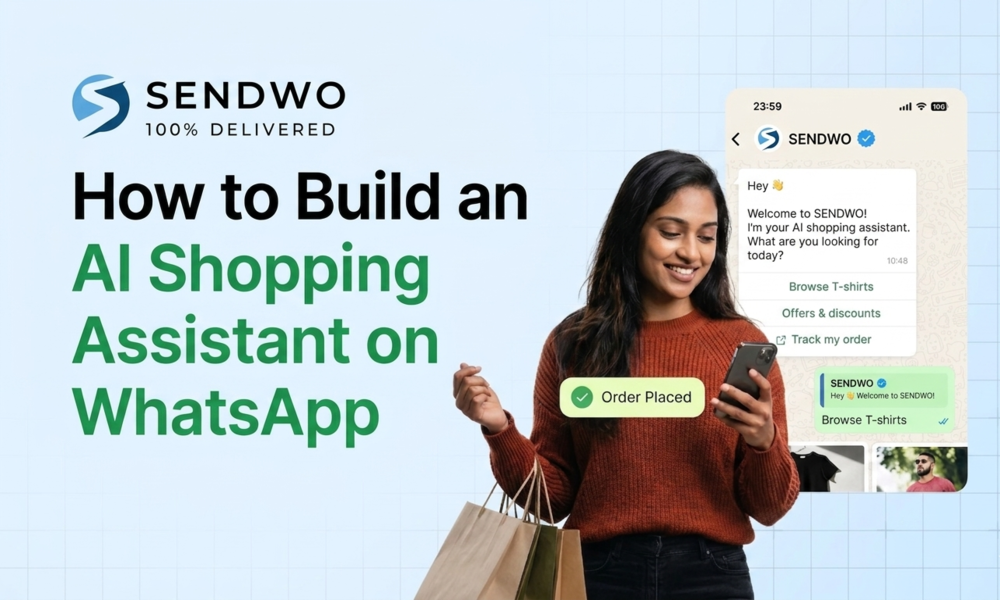
Build an AI Shopping Assistant on WhatsApp with SendWo to automate product recommendations, cart recovery, order updates, and support.
Imagine turning WhatsApp – the world’s most popular chat app – into your 24/7 online store. An AI shopping assistant on WhatsApp acts like a personal shopper in your customer’s pocket, recommending products, answering questions, and even handling checkouts via chat. With over 3 billion users on WhatsApp globally and open rates above 90%, this conversational channel unlocks sales opportunities impossible on email or traditional chatbots. In this guide, we’ll show you step-by-step how to build your own WhatsApp AI shopping assistant using SendWo’s platform. We’ll cover the technology, business benefits, practical examples, and FAQs – so you can create a AI Shopping Assistant on WhatsApp bot that feels human, drives conversions, and delights your customers.
1. Why Use WhatsApp for Your AI Shopping Assistant?
WhatsApp is more than just a messaging app – it’s a global engagement platform for commerce. Some key reasons businesses use WhatsApp chatbots for e-commerce are:
- Massive Reach: WhatsApp has 3+ billion users worldwide, from Brazil to India to Europe. Over 200 million businesses already use WhatsApp Business to chat with customers. Reaching customers on an app they check daily gives your bot instant attention.
- High Engagement: WhatsApp messages see open rates of 90–98% (versus ~20% for email). This means product offers, cart reminders, and support replies sent via WhatsApp are almost guaranteed to be seen. In fact, WhatsApp-based catalogs are viewed by 40+ million people each month.
- Rich Commerce Features: WhatsApp’s Commerce Manager lets you create a product catalog with images, descriptions, prices and direct “Add to Cart” links. Customers can browse your catalog, add items to a cart, and even pay right in chat. For example, after tapping a WhatsApp catalog link, users add products and complete checkout via a secure link – all inside
- WhatsApp.Personalization & AI: Modern AI chatbots use Natural Language Processing (NLP) to understand shopper intent (“I want red sneakers under $100”) and recommend products accordingly. By learning from past interactions, an AI assistant can tailor suggestions to each shopper’s tastes. Gartner predicts AI-powered personalization will drive 25% of e-commerce revenue by 2026.
- 24/7 Support & Sales: Unlike human agents, an AI bot never sleeps. It can answer FAQs, guide product discovery, and recover abandoned carts any time of day. This increases conversions and customer satisfaction – stores using WhatsApp automation often see cart recovery rates of 15–25% (versus just 3–5% with email).These advantages make WhatsApp an ideal platform for conversational commerce. Whether you sell fashion, electronics, groceries or services, a WhatsApp AI assistant meets customers on their preferred channel and turns chat into sales.
2. What Is an AI Shopping Assistant on WhatsApp?
An AI Shopping Assistant on WhatsApp (or shopping agent) is a smart chatbot that helps customers buy products through natural conversation. Unlike basic chatbots that follow fixed scripts,AI Shopping Assistant on WhatsApp use machine learning and language models to understand context and intent. They don’t just respond to keywords – they “remember” past messages and tailor suggestions on the fly.
- Conversational Recommendations: The assistant asks clarifying questions (“Who is this gift for?”, “What’s your size?”) and interprets answers to find the right products. It can suggest exactly what the user needs (e.g. “Here are three red running shoes under $100”), rather than showing generic menus. It dynamically combines filters (price, style, color) with past behavior to present only relevant items.
- Real-Time Upsells: During chat, the AI can cross-sell by bundling complementary items. For example, after a user adds a camera to cart, the assistant might suggest memory cards or tripods frequently bought together. It can also offer limited-time discounts or promotions directly in chat.
- Order Tracking & Support: Post-purchase, the WhatsApp assistant can send order confirmations, shipping updates, or handle return requests – just like a human rep. Because it’s an AI system, it seamlessly passes complex queries (like a refund issue) to a live agent while keeping the conversation context intact.
- Multilingual, Human-Like Dialogue: Modern LLM-driven bots can chat naturally in multiple languages. For instance, a WhatsApp assistant in India might switch between English, Hindi or Tamil based on user preference. They understand intent across languages, not just word-for-word translation. This multilingual ability broadens reach and makes AI Shopping Assistant on WhatsApp feel local and personal.
- Multilingual Support: In diverse markets, AI Shopping Assistant on WhatsApp can chat in customers’ preferred languages and dialects. For example, the image above shows a WhatsApp assistant greeting a user in Hindi and Tamil, making the AI Shopping Assistant on WhatsApp experience seamless for different audiences. By preserving context in each language, your bot feels like a natural extension of your brand everywhere.
In short, an AI shopping assistant on WhatsApp behaves like a virtual personal shopper: it can discover customer needs, answer questions instantly, recommend products, and guide them through checkout – all through normal text conversation or voice. This turns every WhatsApp chat into a potential sale.
3. Key Benefits of a WhatsApp AI Shopping Assistant
Building an AI-powered WhatsApp bot for your store offers tangible business wins. Here are some of the biggest advantages:
- Personalized Product Recommendations: AI analyzes user data (browsing history, past purchases, preferences) to suggest exactly the products customers want. This relevance dramatically boosts conversion rates and average order value (AOV). (Studies show personalized suggestions increase AOV by ~20–30%.) For example, after a customer buys running shoes, the bot might proactively recommend high-rated socks or fitness accessories.
- Abandoned Cart Recovery: When a shopper leaves without buying, the bot can automatically send a friendly reminder via WhatsApp (with a link to their cart). These gentle nudges are highly effective – stores see 15–25% of abandoned carts recovered on WhatsApp(vs only 3–5% with email). The image below illustrates a cart reminder message. By timing these messages (e.g. after 30 minutes of inactivity) and even offering a small coupon, you recapture potentially lost revenue.
- Abandoned Cart Reminder: Shoppers who left items in their cart get an automated WhatsApp message like “? Hey! You left some items in your cart – complete your order now while we hold them for you.” This friendly nudge (possibly with a discount) can recover 15–25% of lost sales, far outperforming email reminders.
- 24/7 Instant Support: Your WhatsApp AI bot never sleeps. It can instantly answer common queries (size guides, return policy, payment issues) any hour of day. This round-the-clock service cuts support costs and reduces cart abandonment – customers don’t drop out waiting hours for a response. In practice, brands see 50% or more reduction in support tickets after deploying chatbots.
- Higher Engagement & Conversions: Conversational commerce on WhatsApp often generates 6× more engagement than email campaigns. Because messages feel one-to-one, customers click and interact more. For example, broadcast campaigns with Click-to-WhatsApp ads can flow directly into conversations with your AI assistant, turning ad impressions into active buyers.
- Cost Efficiency: Automating routine tasks with AI lets your team focus on high-value work. Chatbots scale to serve thousands of chats simultaneously without extra headcount. In one case, a bank cut costs 10× and boosted NPS by 19% after WhatsApp integration. Automated assistants also reduce costs of missed sales and support overhead.
- Rich Media & Branding: WhatsApp supports images, videos, and carousels. Your bot can send product pictures, explainer videos, or image carousels in chat. Using rich media and your brand voice makes interactions engaging. For instance, a fashion bot might show outfit photos or a “shop by image” feature where customers send a photo and the AI finds similar items.
- Trusted by Leading Brands: Global companies are already seeing impressive results. Unilever’s AI WhatsApp chatbot campaign drove 138% higher sales, and Nivea hit 207% of its campaign reach target. These successes show that a well-designed WhatsApp assistant can significantly boost marketing ROI and customer loyalty.
Overall, a AI Shopping Assistant on WhatsApp streamlines the buying journey – from discovery to delivery – inside the app customers already love. By reducing friction and personalizing every chat, it converts more prospects into repeat buyers.
4. Core Components and Architecture
Building an AI Shopping Assistant on WhatsApp involves combining several technologies and tools. Here’s how the pieces fit together:
- WhatsApp Business Cloud API & SendWo (BSP): Your bot uses the official WhatsApp Business API (hosted in Meta’s cloud) to send and receive messages. Because Meta restricts access, you work with a Business Solution Provider (BSP) like SendWo. SendWo handles the API connection, phone verification, and compliance. Through SendWo’s dashboard you connect your WhatsApp number, configure webhooks, and manage templates. Once connected, messages from users are forwarded to SendWo’s servers for processing.
- Product Catalog & Commerce Integration: To allow AI Shopping Assistant on WhatsApp in chat, you’ll set up a product catalog. Using Facebook Commerce Manager, upload your inventory (images, descriptions, prices) and link it to your WhatsApp account. SendWo then synchronizes this catalog. Behind the scenes, SendWo can fetch products (e.g. via API from Shopify/WooCommerce) and let customers browse or add to cart right in chat. When the customer checks out, the catalog delivers a safe checkout link. This end-to-end flow – from catalog sync to payment – happens within WhatsApp.
- Chatbot Flow Engine: SendWo’s no-code flow builder lets you design conversation paths with a drag-and-drop editor. You create message blocks, quick-reply buttons, and rules (e.g. “If user says ‘help’, reply with FAQs”). Triggers can be keywords or user actions. For example, a button “View Catalog” can send the entire product list, while “Contact Support” might connect to a human agent. Workflows can also branch based on user input (yes/no, multi-choice, etc.) to guide the chat. This is where you define all the structured flows (like a product finder quiz or menu navigation).
- AI/NLP Integration: For open-ended or complex queries, integrate an AI engine. SendWo supports OpenAI (ChatGPT) integration or custom NLP models. Typically, you add a fallback step in your flow: if no rule matches the user’s message, send it to ChatGPT (via SendWo’s AI block). The AI model is given context (like your catalog details and conversation history) and generates a human-like response recommending products. For instance, the bot might send ChatGPT a prompt: “Customer says: ‘I need a gift for my teenage daughter, likes tech and games.’ Recommend 3 products from our kids’ gadgets category.” The model replies with suggestions, which SendWo relays as a chat message.
- Webhook & API Calls: In many cases, you’ll connect external systems. SendWo’s HTTP API integration lets you fetch data on the fly. For example, when a user asks “Is this in stock?”, the bot can use a webhook to your inventory API to get real-time stock info. Or it can pull order status from your store. This keeps the conversation dynamic. The flow builder can trigger these webhooks automatically and insert returned data into replies.
- Live Agent Handoff: Some queries may need a human touch (e.g. a complaint or a unique request). SendWo provides a Live Chat inbox where support agents can take over. When handing off, the system passes the full chat history and customer profile to the human agent. The bot can be paused for that user so only the person handles responses. This hybrid model (AI first, then human) ensures customers always get an answer.
In summary, the architecture looks like this:
User Chat ⇄ WhatsApp API ⇄ SendWo Bot Engine (Flows + AI) ⇄ Product Catalog / External APIs / Human Agents
Turn this learning into your next WhatsApp campaign.
Start with Sendwo’s free plan, explore WhatsApp broadcasts, automation, AI chatbot flows, and upgrade only when your business needs more power.
Behind the scenes, modern LLMs (GPT-4.5, Claude, etc.) power the “brain” of the assistant, parsing requests and generating replies. Combined with SendWo’s flow logic and product integrations, you get a seamless shopper experience.
5. Step-by-Step: Building Your AI Shopping Assistant on WhatsApp
Ready to start? Here’s a high-level roadmap to create your assistant:
- Set Up WhatsApp Business Account: On Facebook for Developers, create a new Business App and add the WhatsApp product. Obtain a WhatsApp Business API key and number. Use SendWo’s Connect Account guides to link your API credentials. This involves generating a callback URL and verify token, then subscribing to message webhooks (as shown in SendWo’s docs).
- Create and Sync Your Catalog: In Facebook’s Commerce Manager, create an eCommerce catalog and add your products (images, prices, links). Once filled, go to WhatsApp Manager > Catalog and connect it. Back in SendWo, go to Catalog Sync in the dashboard and pull in your catalog. Now your products are linked to WhatsApp. (SendWo can also integrate with Shopify or WooCommerce to auto-import products.)
- Design Your Chat Flows: In SendWo’s Bot Manager, build the conversational flow. Start with welcome messages and menus. For example:
- Greet new subscribers (“Hi ? Welcome to [Brand Name]! How can I help you today?”).
- Offer quick replies/buttons (“Browse Catalog”, “Track Order”, “Contact Support”).
- Create keyword triggers (e.g. if user types “shoes”, show shoe catalog).
- Add FAQ sections: “What are your shipping times?” or “Return policy”.
- Use variables (like {name}) to personalize.
- Configure an AI fallback node: any unrecognized query should jump to the AI integration (OpenAI) node, which will formulate a custom answer.
- Integrate AI (OpenAI/ChatGPT): In SendWo’s AI integration settings, link your OpenAI API key. In the flow builder, set up a step that calls the AI model. Craft a system prompt that gives context (e.g. your store name, product types) so the AI responds on-brand. For example: “You are the virtual shopping assistant for [Brand]. A customer asks: '{customer message}'. Provide a friendly, concise answer with up to 3 product suggestions from our catalog.” Test this by chatting and refining the prompt. SendWo will handle sending the user’s message to the model and returning the response in chat.
- Implement Webhooks for Dynamic Data: If you have an external backend (like an order database), set up webhooks. For instance, when the bot asks, “Do you want to check your order status?”, you can trigger a webhook to your system with the customer ID. The response (e.g. “Your order #12345 ships tomorrow”) can be sent back in the bot’s reply. SendWo’s External HTTP API block makes this straightforward.
- Test Extensively: Before going live, simulate conversations. Check that AI Shopping Assistant on WhatsApp responses are accurate and appropriate. Ensure quick replies and buttons work. Test language variations. Have teammates pretend to be customers: ask tricky questions and see if the handoff to human agent flows correctly.
- Launch & Monitor: Once testing is done, flip your WhatsApp to Live Mode. Share your WhatsApp number via website, ads, and social media (“Chat with us on WhatsApp!”). Monitor analytics in SendWo: track metrics like conversations per day, resolution rate, conversion (e.g. cart checkouts). Use these insights to tweak flows, update AI prompts, or refine your catalog.
By following these steps with SendWo’s platform, even non-developers can deploy a sophisticated AI assistant. (For advanced users, you could also build parts with code via SendWo’s APIs – for example, calling GPT or performing custom logic in a middleware server before returning data to SendWo.)
6. Best Practices and Tips
To make your WhatsApp shopping assistant effective and user-friendly, keep these best practices in mind:
- Write Natural, Concise Messages: People read short chat messages. Keep replies to 1–2 sentences and use a friendly tone. Use emojis and images to make messages visual (WhatsApp supports inline images and carousels). For example, send a product photo with a caption, rather than a long text description.
- Use Quick Replies and Menus: Offer buttons and menus for common actions. This guides the user instead of forcing them to type everything. For instance, after a greeting, show buttons like “Browse New Arrivals” or “Get 10% Coupon”. Buttons improve conversion because they’re easy taps.
- Prioritize High-Value Conversations: Use AI for discovery and recommendations, but script common flows. Program FAQs (shipping time, returns) so the bot can answer quickly. Reserve the AI fallback for queries that truly need understanding. This optimizes costs and ensures accuracy.
- Personalize Context: The assistant should use known info (like user’s name or last order). For returning users, you might say, “Welcome back, Alex! Would you like more cat food or try our new gadget sale?”. Personal touches (pronouns, preferences) build trust.
- Respect Privacy and Compliance: Only message users who have opted in. Use WhatsApp’s approved templates for any outbound notifications (shipping updates, etc.) outside the 24-hour window. Provide an easy opt-out (Reply “STOP”) to comply with policies.
- Monitor and Iterate: Track key metrics (see “People Also Ask” below) such as conversion rate, cart recovery, AI response accuracy and user satisfaction. Regularly review chat logs: fix misunderstood questions by improving the AI prompt or adding rules. Continuously train your bot with new product info and customer feedback.
- Language and Localization: If serving multiple regions, localize product names and currency. Test the assistant in each language it will use. Modern AI keeps intent intact across languages
- , but you should still ensure product info (descriptions, measurements) is translated.
- Balance Promotions with Help: Don’t push sales too hard. Ensure the bot also genuinely helps (answering questions, solving problems). A helpful tone builds loyalty; even when suggesting products, do it in a helpful way (“This backpack has great reviews and matches what you asked!”).
By designing a thoughtful conversational flow and constantly refining it, your AI assistant will feel like a real salesperson. Remember: effective conversation design limits choices to a few relevant options at each step
and blends support with sales naturally.
FAQs
1. What is an AI shopping assistant on WhatsApp?
It's a virtual salesperson powered by LLMs like GPT-4. The chatbot chats naturally, answers product questions, suggests items, and completes purchases. Unlike menus, it personalizes recommendations like an always-on store clerk.
2. What are the main benefits?
It boosts engagement and sales with 90%+ open rates, 24/7 support, 15-25% abandoned cart recovery, and upsells. This cuts support workload and doubles/triples conversions for big brands.
3. Do I need coding skills?
No—use no-code platforms like SendWo for drag-and-drop flows and ChatGPT integration. Basic WhatsApp/API setup is needed, but guides and support make it easy for small businesses.
4. How do I integrate products and inventory?
SendWo offers one-click sync with Shopify, WooCommerce, or Facebook Commerce Manager. The bot searches catalogs, shows carousels, handles carts, and auto-updates stock/prices.
5. Can it handle post-purchase support?
Yes—it tracks orders, shipping, and returns in-chat. Complex issues hand off to humans with full context for faster resolutions.
Aditi Kamini
Aditi, a content marketer at SendWo, is a passionate writer and marketing enthusiast. She excels in driving revenue campaigns, building client relationships, and mastering content creation, SEO, customer service, and project management.