How to Build a High-Converting WhatsApp Lead Generation Funnel
If you are wondering how to build a high-converting WhatsApp lead generation funnel, the short answer is this: bring traffic into chat, qualify fast, personalize the journey, automate the routine, and hand off high-intent WhatsApp Lead Generation Funnel to humans at the right moment. That approach makes sense because WhatsApp is already one of the […]
 By Aditi Kamini
Published: May 15, 2026
14 min read
By Aditi Kamini
Published: May 15, 2026
14 min read
If you are wondering how to build a high-converting WhatsApp lead generation funnel, the short answer is this: bring traffic into chat, qualify fast, personalize the journey, automate the routine, and hand off high-intent WhatsApp Lead Generation Funnel to humans at the right moment. That approach makes sense because WhatsApp is already one of the […]
If you are wondering how to build a high-converting WhatsApp lead generation funnel, the short answer is this: bring traffic into chat, qualify fast, personalize the journey, automate the routine, and hand off high-intent WhatsApp Lead Generation Funnel to humans at the right moment. That approach makes sense because WhatsApp is already one of the world’s biggest communication channels. WhatsApp says more than 3 billion people in over 180 countries use the app, and WhatsApp Business says more than 175 million people message a business account every day. DataReportal adds that 93.6% of online adults use chat apps each month, while HubSpot reports that 63% of consumers prefer finding information about brands and products on mobile devices.
1. Why WhatsApp lead generation is converting better
- The biggest reason WhatsApp performs so well is simple: it matches user behavior. People already open chat apps every day, and they already prefer mobile-first, low-friction communication. A WhatsApp Lead Generation Funnel built around conversational messaging feels lighter than a traditional website-first flow because it meets prospects in the interface they already use, instead of forcing them through tabs, forms, and delayed callbacks.
- The second reason is reduced friction. Meta’s ads that click to WhatsApp can run across Facebook and Instagram placements such as News Feed, Stories, and Marketplace, which means you can move people from attention to conversation in one tap. If you want more context before the chat starts, Meta also supports website-to-WhatsApp ads, where users visit a website first and then choose WhatsApp as an additional contact method. For offline or organic traffic, WhatsApp supports QR codes and click-to-chat links with pre-filled messages, so a flyer, landing page, LinkedIn post, or email can all become funnel entry points.
- The third reason is that WhatsApp now supports structured in-chat experiences, not just free-text conversations. Meta’s WhatsApp Flows are designed to let businesses build streamlined interactions inside chat, and Meta says Flows can help businesses acquire new customers, create signups for newsletters, events, and promotions, and improve conversions by keeping users inside WhatsApp. Meta also says WhatsApp Flows on ads that click to WhatsApp can add a structured form directly to Facebook and Instagram ads that open a WhatsApp conversation.
- The channel is also getting stronger from a measurement standpoint. In 2025, Meta said the WhatsApp Updates tab was being used by 1.5 billion people daily, expanding discovery surfaces inside the app. For advertisers using advanced business messaging, Meta’s Marketing Messages API for WhatsApp now supports click-event tracking, added offsite conversion metrics in April 2026, and began rolling out an optional max-price control for marketing message delivery in beta in May 2026. That makes WhatsApp more measurable, more optimizable, and more attractive as a performance channel than it was even a year ago.
2. What a high-converting WhatsApp funnel actually looks like
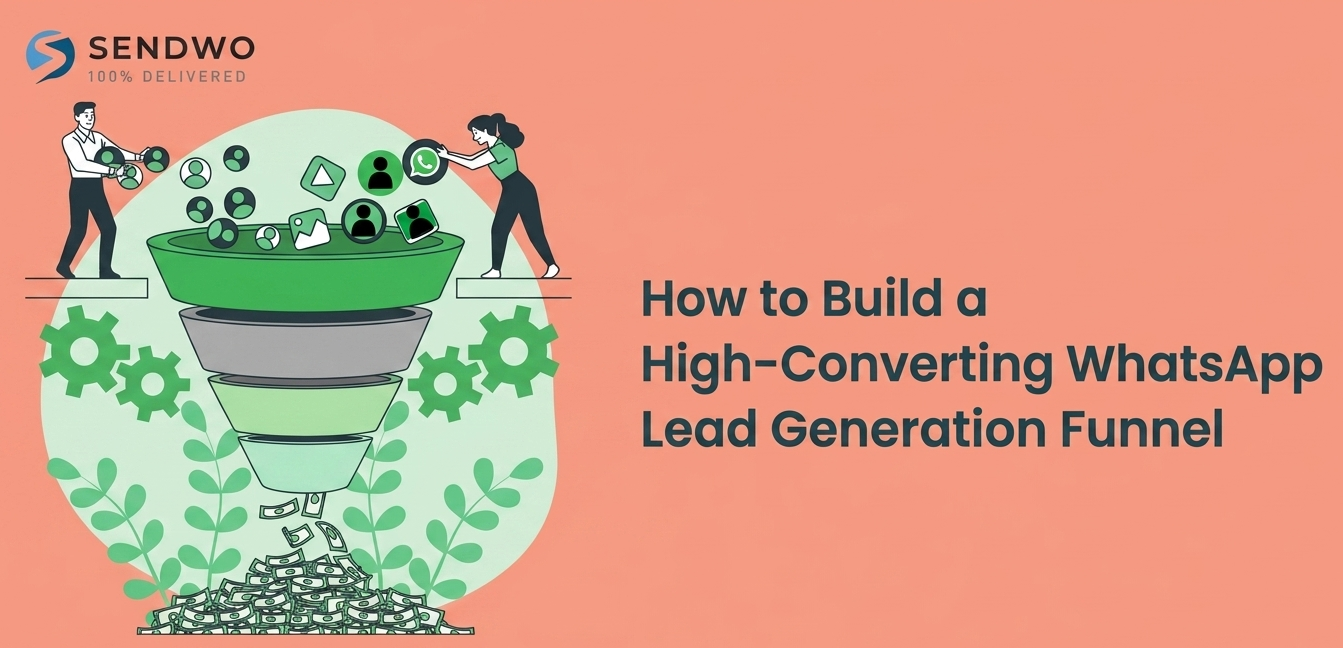
A high-converting WhatsApp sales funnel is not just “send people to chat and hope for the best.” It is a deliberately designed journey that moves a prospect through entry, context, qualification, routing, follow-up, and conversion. Meta’s own WhatsApp Business Platform positioning emphasizes WhatsApp Lead Generation Funnel generation, conversational commerce, engagement marketing, and full-funnel interactions, which is exactly how you should think about the channel. In practice, the funnel usually looks like this: Traffic source → First message → Qualification → Next best action → Nurture → Conversion
- That simple flow can begin with click-to-WhatsApp ads, website-to-WhatsApp ads, QR codes, or short links. The first message can come from a welcome message sequence, a pre-filled message, or a simple automated greeting. Qualification can happen through reply buttons, list messages, or a WhatsApp Flow. The next best action might be a calendar link, quote request, product list, catalog, payment link, or human handoff. Follow-up then happens through service, utility, or marketing messaging depending on where the lead sits in the journey and whether the user has opted in.
- The best part is that this works across industries. A clinic can use it to book consultations. A D2C brand can use it for product discovery and abandoned cart recovery. A SaaS company can use it for demo requests and qualification. A real estate business can use it for location, budget, and timeline screening before a sales rep ever joins the chat. That is why WhatsApp is increasingly becoming a WhatsApp Lead Generation Funnel, sales funnel, and customer engagement funnel at the same time.
- If you are building for SendWo, this is where the platform angle matters: the goal is not to create a complicated automation system. The goal is to make the experience feel fast, helpful, and human, while SendWo handles the repetitive parts in the background.
3. How to build the funnel with SendWo
- Start with the right infrastructure. WhatsApp itself separates the WhatsApp Business App from the WhatsApp Business Platform: the app is aimed at smaller businesses managing conversations manually, while the platform is for businesses that need programmatic access, richer integrations, and the ability to reach customers at scale. SendWo’s onboarding guide says it uses Meta’s official Cloud API integration, and SendWo’s core platform includes bulk broadcasting, AI chatbot automation, button templates, carousel messages, transactional notifications, payment collection, and integrations such as Shopify and WooCommerce.
- Next, choose the right entry points based on user intent. For cold traffic, click-to-WhatsApp ads are often the fastest option because they move users directly from attention to conversation. For warmer traffic that needs more product context, website-to-WhatsApp ads can work better. For owned and offline channels, add QR codes, click-to-chat links, and pre-filled messages on landing pages, blog posts, brochures, webinars, event booths, and email signatures. The trick is to create a separate message path for each source, so the first message feels context-aware instead of generic.
- Then build the opening experience carefully, because the first 30 seconds of chat decide whether people continue or disappear. Meta’s welcome message sequences for click-to-WhatsApp ads can include text, pre-filled messages, and structured experiences. Meta also supports reply buttons with up to three predefined replies and list messages with up to ten options. Use those tools aggressively. The more typing you remove, the higher your chances of getting the next action.
A simple opening flow for SendWo might look like this:
Welcome message:
Hi ? Thanks for messaging SendWo. Want help with WhatsApp API setup, chatbot automation, pricing, or a live demo?
Quick choices:
Book a demo | See pricing | Talk to support
Qualification message:
Got it. Which best describes your business?
D2C brand / SaaS / Agency / Education / Healthcare / Real estate / Local business
- That structure works because it feels like assistance, not interrogation. Once the WhatsApp Lead Generation Funnel responds, qualify with the minimum data needed to make a smart routing decision. This is where WhatsApp Flows and SendWo’s bot builder become powerful. Meta says WhatsApp Flows are built to create streamlined signups and lead capture experiences inside chat, and SendWo’s no-code chatbot builder lets you set keyword triggers, build flows with a drag-and-drop interface, use variables like {{name}}, and connect lead capture to Google Sheets or CRM workflows. SendWo’s Google Sheets integrations can automatically write user inputs into a spreadsheet in real time, and its HTTP API integration can push data into tools like WordPress, Shopify, Zoho CRM, Google Sheets, or custom systems without code.
- A practical rule here is to ask only what helps you route or personalize the next step. For most businesses, that means things like need, budget range, timeline, location, team size, or product interest. Everything else can come later. Meta’s recent case studies make that point indirectly: structured qualification inside WhatsApp works because it shortens the path between interest and action, rather than recreating a long web form in chat.
- After qualification, route the lead to the best next action. If the lead is hot, send them to a human immediately. SendWo says its chatbot can transfer to a real human, while its managed-service page highlights multi-step flows, input forms, routing logic, and human handoff when high-value leads arise. If the lead is mid-intent, send a CTA URL button to a calendar, application page, or checkout. Meta’s CTA URL button docs note that URL button messages let businesses map any URL to a button instead of dropping a raw link into chat. If the WhatsApp Lead Generation Funnel needs more context, SendWo’s AI can answer from FAQs, files, website URLs, APIs, or Google Sheets, which makes it useful for pre-sales support before a rep steps in.
- Do not forget compliance while building the nurture layer. Meta’s documentation says that, following the November 2024 WhatsApp Business Messaging Policy update, businesses must obtain opt-in before messaging people on WhatsApp, clearly state the business name, and comply with applicable law. Meta also notes that people can opt in through a business website, in a store, or directly inside WhatsApp. Once contact is established, the 24-hour customer service window matters: Meta says free-form service messages can be sent during that window, while template messages are required outside it. WhatsApp’s business pricing is now based on delivered messages, and rates vary by message category: marketing, utility, authentication, and service.
- That matters operationally. Use service and utility style messaging for things like reminders, confirmations, appointment details, cart nudges, or post-conversion updates. Use marketing messages for segmented promotions, price drops, product recommendations, assisted selling, and re-engagement. SendWo’s broadcasting features support button-based templates, carousel messages, and transactional notifications, which makes it practical to build a nurture sequence without leaving the platform.
- Finally, set up reporting from day one. SendWo’s analytics tutorial says the platform provides visibility into sent, delivered, opened, and missed messages, while Meta’s newer marketing-message tooling supports sends, clicks, conversions, and event-based conversion measurement. That combination gives you a much better funnel view than “someone messaged us.”
4. The conversion levers that move lead quality and sales
- The first lever is optimizing for qualified leads, not just chat volume. Meta’s business help documentation says that ads that click to WhatsApp optimized for leads experienced 24% lower cost per lead on average than ads optimized for conversations. That is a major distinction. A cheap conversation is not the same as a useful lead.
- Meta’s case studies reinforce the same lesson. Nutryfit reported a 12% lower cost per lead from leads-optimized click-to-WhatsApp ads compared with conversation-optimized ads, and its internal comparison showed 3X more qualified leads from WhatsApp than emails. Braip reported a 45% increase in qualified leads and a 30% lower cost per lead after testing leads optimization against its previous approach. Engelife Construtora e Incorporadora reported a 26-point increase in lead qualification rate, a 37% reduction in cost per qualified lead, and a 12-minute reduction in average qualification time using WhatsApp Flows on click-to-WhatsApp ads. Meta notes that success-story results vary, but the directional pattern is clear: structured qualification and lead-focused optimization tend to outperform vague “message us” campaigns.
- The second lever is personalization. SendWo’s chatbot builder supports variables, while its Google Sheets and API integrations let you enrich conversations with product interest, region, lifecycle stage, inventory data, CRM status, or previous interaction history. When users feel the chat understands their intent, the conversation feels like help rather than lead collection. HubSpot’s marketing research also points to the same broader reality: mobile and tailored experiences matter more because today’s buyers expect relevance quickly.
- The third lever is measurement discipline. Meta and Bain’s 2024 report on conversational journeys argues that businesses need a clear “return on conversations” framework, and Meta’s newer WhatsApp measurement stack now offers message, click, and conversion signals. In practice, that means you should track a handful of business-first metrics, not just vanity engagement: cost per qualified WhatsApp Lead Generation Funnel, qualification rate, time to first response, demo-booked rate, show-up rate, CRM progression rate, and revenue per conversation. SendWo’s campaign analytics and Meta’s message/conversion reporting give you the raw data to make those decisions.
- The fourth lever is fast human takeover for high-intent leads. AI is great for routing, FAQs, and repetitive qualification. It is not a license to hide real salespeople from real buyers. SendWo’s own product pages emphasize both AI automation and human transfer, and that is the right architecture: let automation handle the top and middle of the funnel, and let humans handle high-value objections, pricing nuance, negotiation, and final conversion.
5. The mistakes that quietly destroy WhatsApp funnel performance
- The first mistake is sending traffic into an unstructured inbox. If people click an ad and land in a chat with no welcoming context, no buttons, no qualification path, and no obvious next step, you are wasting paid demand. WhatsApp Business Platform is designed for rich, guided, two-way experiences, and WhatsApp Flows exist specifically to streamline tasks in chat. Treating the channel like a random support inbox weakens conversion immediately.
- The second mistake is asking too many questions too early. Just because you can build a five-page form inside a chatbot does not mean you should. The most effective WhatsApp qualification sequences remove friction and get the user to a relevant next action fast. That is one reason recent Meta case studies around Flows and leads optimization consistently point to better qualification efficiency and lower cost per qualified WhatsApp Lead Generation Funnel.
- The third mistake is ignoring opt-in, template, and message-category rules. Meta’s docs are explicit: businesses need opt-in before messaging people on WhatsApp, must identify the business clearly, and need template messages outside the customer service window. SendWo’s fully managed service page also warns that weak funnel design and non-compliant messaging increase the risk of sender issues and bans. If you want a high-converting funnel, compliance is not a legal footnote. It is part of conversion because trust drives response.
- The fourth mistake is measuring only message activity, not business outcomes. Opens, replies, and click-throughs are useful, but they are not the goal. If your team cannot tell which campaign source produced the best-qualified WhatsApp Lead Generation Funnel, which Flow delivered the best demo-booked rate, or which template sequence moved pipeline, you do not have a growth engine yet. You have chat activity. Use SendWo and Meta reporting together so every automation is tied to a real commercial result.
- The fifth mistake is trying to run scale from the wrong setup. WhatsApp’s own product distinction is clear: the small-business app is for lighter, manual conversation management, while the platform is designed for scale, automation, integration, and richer messaging features. If WhatsApp Lead Generation Funnel is becoming strategically important, build on the stack that actually supports growth.
6. Turn this into a SendWo growth engine
If you want to launch a WhatsApp lead generation funnel quickly, keep it simple. Start with one offer, one entry source, one qualification path, and one conversion event. For most businesses, that means something like click-to-WhatsApp ads + qualification flow + demo booking, or website-to-WhatsApp ads + quote flow + human handoff. Add QR codes and short links later for organic and offline capture. Build the first version fast, then improve it with live data.
Turn this learning into your next WhatsApp campaign.
Start with Sendwo’s free plan, explore WhatsApp broadcasts, automation, AI chatbot flows, and upgrade only when your business needs more power.
A practical SendWo rollout looks like this:
- Connect your WhatsApp setup through SendWo’s guided official Cloud API onboarding.
- Build a no-code chatbot flow in SendWo with a welcome message, quick choices, and a short qualification sequence.
- Send captured data into Google Sheets or your CRM in real time.
- Launch a click-to-WhatsApp campaign optimized for leads instead of only conversations.
- Use SendWo broadcasts and templates for reminders, nurture, and reactivation.
- Review message analytics, click/conversion data, and sales outcomes every week.
- WhatsApp itself points businesses toward partners that can help them plan, build, and integrate the channel. For teams that want one stack for chatbot automation, broadcasts, AI replies, Sheets or CRM sync, API workflows, and reporting, SendWo is positioned exactly for that use case. If you want to test the channel yourself, start with SendWo’s no-code setup. If you want the funnel designed and operated for you, SendWo also offers a fully managed service with bot development, campaign management, monthly dashboards, and a roadmap-based approach.
The strongest CTA is this: stop sending high-intent prospects into slow forms and cold follow-up queues. Build a conversational funnel where leads can ask, answer, qualify, and convert in the same place they already use every day. If WhatsApp matters to your pipeline, now is the time to turn it into a real acquisition engine with SendWo.
FAQs
1. What is a WhatsApp lead generation funnel?
A WhatsApp lead generation funnel is a structured conversation journey that moves a prospect from discovery to qualification to conversion inside WhatsApp. It usually starts with an entry point such as a click-to-WhatsApp ad, website-to-WhatsApp ad, QR code, or short link, then uses automation, interactive choices, and follow-up messaging to move the person toward a sale, booking, or qualified handoff.
2. How do I generate leads directly from WhatsApp?
The most effective ways are to use ads that click to WhatsApp, website-to-WhatsApp ads, QR codes, short links with pre-filled messages, and WhatsApp Flows for structured in-chat forms. Once the chat begins, use buttons, lists, Flows, or a chatbot to gather just enough information to route the lead correctly.
3. Do I need opt-in before sending WhatsApp messages to leads?
Yes. Meta’s documentation says that following the November 2024 WhatsApp Business Messaging Policy update, businesses are required to obtain opt-in before messaging people on WhatsApp. Meta also says businesses must clearly state the business name and comply with applicable law.
4. What is the difference between WhatsApp Business App and WhatsApp Business Platform?
WhatsApp’s own product guidance is clear: the Business App is for smaller businesses managing conversations more manually, while the Business Platform is for medium to large businesses that need scale, programmatic access, integrations, richer messaging, and the ability to reach large audiences. If you need automation, CRM sync, structured Flows, and advanced tracking, the platform is the better fit.
5. Can I automate WhatsApp Lead Generation Funnel qualification without coding?
Yes. SendWo’s chatbot builder is designed as a no-code drag-and-drop tool, and SendWo says businesses can create multiple flows for lead capture, demo booking, and support from the same dashboard. SendWo also supports Google Sheets integration, real-time user input capture, and HTTP API integrations with external tools such as CRMs and commerce platforms.
Aditi Kamini
Aditi, a content marketer at SendWo, is a passionate writer and marketing enthusiast. She excels in driving revenue campaigns, building client relationships, and mastering content creation, SEO, customer service, and project management.