WhatsApp AI Agent: The Future of 24/7 Customer Support
WhatsApp AI Agents deliver instant, 24/7 customer support on WhatsApp, automating FAQs and routine queries so businesses can boost.
 By Aditi Kamini
Published: May 8, 2026
12 min read
By Aditi Kamini
Published: May 8, 2026
12 min read
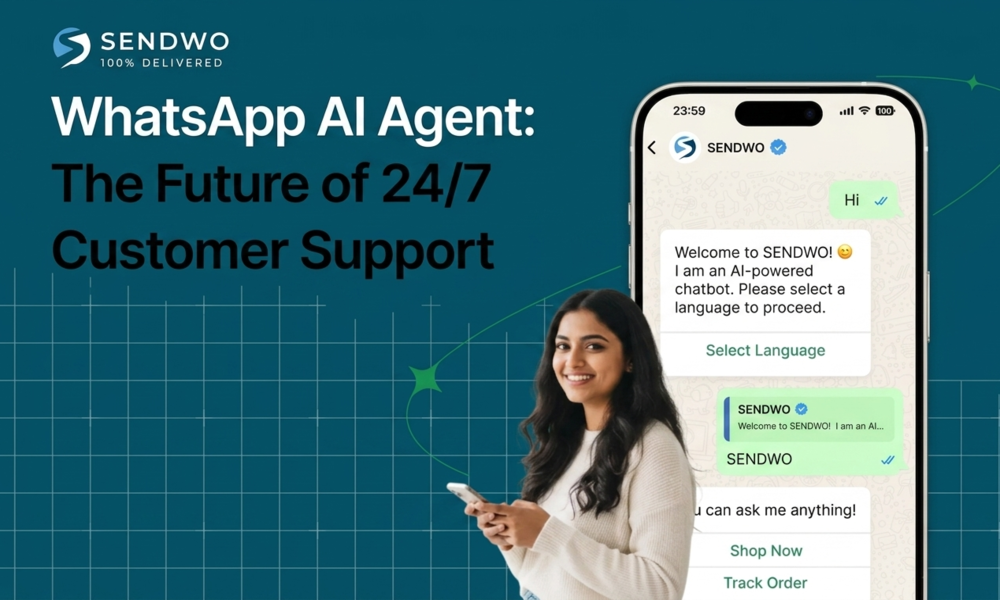
WhatsApp AI Agents deliver instant, 24/7 customer support on WhatsApp, automating FAQs and routine queries so businesses can boost.
Customer expectations are higher than ever: they want instant answers on their favorite platforms. With over 3.3 billion monthly active users, WhatsApp has become the world’s leading messaging app. Imagine texting a business at 2 AM and receiving an immediate, helpful reply – that’s the power of a WhatsApp AI agent. These intelligent chatbots, built on the official WhatsApp Business API, use AI and Natural Language Processing (NLP) to engage customers in human-like conversation any time of day. In fact, businesses that implement AI chatbots see a 22.3% jump in customer satisfaction. By delivering 24/7 automated support through a channel customers already use, WhatsApp AI agents are revolutionizing customer service.
In this fast-paced world, WhatsApp offers a 99% message open rate – far exceeding email. When customers message a business, they expect a speedy reply. AI agents on WhatsApp can ensure no query goes unanswered: they analyze the message with NLP, retrieve answers from FAQs or databases, and respond immediately. Because 88% of messages are read within five minutes, an instant AI response can prevent customers from abandoning a support chat. At the same time, human agents avoid routine queries and focus on complex issues – creating a true hybrid support model. Overall, using a WhatsApp AI chatbot means no more missed leads and happier customers, as every question is met with a quick, personalized reply.
1. What Is a WhatsApp AI Agent?
A WhatsApp AI agent (or chatbot) is an automated virtual assistant that talks directly to customers on WhatsApp. Powered by machine learning (ML) and language models, it can understand user intent (using NLP) and carry on a conversation like a human. Unlike simple rule-based bots, AI agents “learn” from every interaction and can be trained on company data: for example, you can upload product PDFs, FAQs, or website links to build the bot’s knowledge. When a customer asks a question, the AI agent quickly identifies the intent and fetches the correct response. If needed, the bot can also escalate to a human agent – a handoff that 81% of consumers expect.
How It Works: The Tech Behind WhatsApp AI Agents
- WhatsApp AI agents work by combining NLP, machine learning, and integration with your data. First, incoming customer messages are processed using NLP to detect intent and key entities (names, dates, products, etc.). Advanced AI models (like GPT or Google Gemini) then generate a human-like reply. Over time, the chatbot’s ML algorithms learn from past conversations and improve accuracy. A critical feature is intent detection: instead of hard-coded keywords, the AI understands the why behind a message and can trigger actions or flows automatically.
- Key features of a WhatsApp AI agent include: intent recognition, sentiment analysis (detecting emotions), and context memory, so the bot can remember previous exchanges. It may also use a “hybrid AI core” that leverages multiple LLMs (OpenAI GPT and Google Gemini) to ensure the best responses. In practice, this means customers experience natural, human-like replies on WhatsApp, while businesses scale support without extra staff.
2. Benefits of WhatsApp AI Agents for Customer Support
AI-powered chatbots on WhatsApp unlock many advantages over traditional support channels:
- 24/7 Instant Support: AI agents never sleep. They can answer customer questions any time of day or night, including outside business hours and on weekends. This ensures customers are never left waiting, which is crucial since over 50% of people prefer instant AI replies over human wait times. Quick bot responses (within 1-2 minutes) significantly boost conversion – delays of 5+ minutes cause site drop-offs to skyrocket.
- Scalable Conversation Volume: Unlike phone lines or email, an AI agent can engage hundreds of users simultaneously. Industry forecasts predict the chatbot market will nearly double by 2028, reflecting how businesses are using bots to handle mounting support queries. For example, large WhatsApp chatbots already process tens of millions of conversations in just weeks. This means smaller teams can manage big workloads without hiring more agents.
Consistent, Personalized Answers: Chatbots provide uniform responses based on the latest information, eliminating human error. They can use customer data (past purchases, location, preferences) to tailor replies. A Watson Institute report found that ML-driven chatbots can reduce resolution times by ~30% compared to rule-based bots. At the same time, features like sentiment analysis let the bot adjust tone for frustrated users, making support feel more empathetic. - Higher Customer Satisfaction: With faster and more precise replies, satisfaction scores tend to rise. In fact, companies that added AI into customer interactions saw a 22.3% jump in satisfaction. Since 61% of customers prefer to solve simple issues themselves, a well-trained AI agent enables self-service on WhatsApp. Additionally, personalized, proactive bot messages (like appointment reminders or order updates) keep customers happy and engaged.
Cost and Efficiency Gains: Automating routine tasks (FAQs, order tracking, appointment booking) frees support staff for complex cases. For example, Clickatell reports that integrating chatbots for commerce on WhatsApp reduced cart abandonment by 25%, directly improving sales without additional support calls. And by deflecting thousands of simple chats, businesses save on labor costs and call center volume.
Together, these benefits mean WhatsApp AI agents not only delight customers but also streamline operations. As one industry analysis puts it, brands that “get AI right” see a clear competitive edge.
3. Real-World Use Cases and Examples
WhatsApp AI chatbots are already transforming customer service across industries:
- E-commerce & Retail: Bots can recover abandoned carts by nudging shoppers with discounts or messages, suggest products based on browsing, and handle order updates. For instance, a retail chatbot could upsell complementary items in chat, increasing sales by 15–20%. Brands use WhatsApp bots for catalogs and even in-app checkout, enabling customers to browse and pay without leaving the conversation.
- Lead Generation & Sales: Startup founders and small businesses leverage WhatsApp AI for lead qualification. As one report notes, automated WhatsApp agents can instantly capture contact info, ask qualifying questions, and tag leads by interest or urgency. This rapid engagement (vs. waiting hours) keeps prospects warm and ensures no inquiry falls through the cracks. For example, an AI agent can greet a new website visitor, present a menu (“Reply 1 for Pricing, 2 for Demo…”), then connect hot leads to a salesperson in real time.
- Support & Troubleshooting: Common customer service tasks – shipping inquiries, billing questions, technical troubleshooting – are ideal for bots. A telecom chatbot (like Vodafone Germany’s) resolved 57% of inquiries on WhatsApp by itself, dramatically cutting call center load. In travel and hospitality, bots can handle bookings and send reminders. In healthcare, they can book appointments or offer preliminary symptom checks. And in finance or insurance, bots answer policy FAQs and initiate claims processes. By automating these routine dialogues, companies reduce support tickets and improve response times.
- Education & NGOs: Even non-profits and education platforms use WhatsApp AI. For example, an AI agent called Farmer.CHAT helped thousands of farmers in India, Ethiopia, and Kenya by answering agricultural queries in multiple languages. It handled over 35,000 questions, empowering users with instant expert advice on WhatsApp. This shows how AI chatbots can scale expert guidance to underserved communities, anywhere.
- Global Customer Engagement: Since WhatsApp is ubiquitous (reaching over 80% of users in many countries), companies engage international audiences. AI bots can switch languages or handle cultural nuances automatically. The expected shift to AI chat also turns WhatsApp into a strategic sales channel – Clickatell found that 36% of customers always follow chatbot suggestions in their buying journey.
These examples demonstrate that whether it’s a local café offering menu menus or a global brand processing millions of chats, WhatsApp AI agents provide personalized support at scale.
4. SendWo’s WhatsApp AI Chatbot: Key Features
SendWo offers a complete WhatsApp AI agent solution designed for businesses of all sizes. Built on the official WhatsApp Business API, SendWo ensures compliance with WhatsApp’s policies and eliminates the risk of message bans. You get an easy, no-code chatbot builder – just drag and drop conversation blocks to create flows. Then connect your AI model (ChatGPT or others) in a click for automated responses.
Key features of SendWo’s WhatsApp AI Chatbot include:
Turn this learning into your next WhatsApp campaign.
Start with Sendwo’s free plan, explore WhatsApp broadcasts, automation, AI chatbot flows, and upgrade only when your business needs more power.
- 24/7 AI Support: Engage customers on WhatsApp around the clock. The AI agent handles common queries instantly, and seamlessly hands off to your team if needed. This keeps customers happy and your agents focused on complex issues.
- Intent Detection & Smart Routing: SendWo’s AI is trained to detect intent in real time. You can define custom intents and responses, so the bot knows exactly what a user wants (e.g. “Schedule demo” vs “Billing question”). It then triggers the right workflow or routes to a human automatically, even tagging chats with labels like High Priority for fast follow-up.
- AI-Augmented Answers: Beyond rule-based menus, SendWo’s agent can pull answers from your knowledge base (FAQs, PDFs, website, Google Sheets) in seconds. It also uses sentiment analysis to adjust tone and suggest next steps to your team if needed.
- Omni-Channel Inbox: Manage all chats (WhatsApp, Facebook, Instagram, Telegram) in one shared team inbox. Whether a customer messages on WhatsApp or another channel, it lands in the SendWo inbox with context. Your agents can even collaborate on a conversation or transfer it across channels, ensuring no query is missed.
- Commerce and Forms: SendWo seamlessly integrates commerce on WhatsApp. You can set up product catalogs, let customers “Add to Cart” and pay directly in chat. Automated reminders can nudge customers to complete orders. You can also create WhatsApp forms to schedule appointments or capture leads, automating tasks like scheduling and feedback collection.
- No Markup Fees: SendWo charges 0% markup on the official API cost, meaning you pay Meta’s rate directly. This maximizes ROI on every conversation compared to other BSPs.
With these capabilities, SendWo’s AI Agent turns WhatsApp into a powerful, autonomous support channel. You get enterprise-grade features (secure hosting, scalability) in a user-friendly platform – plus a free trial to get started. Thousands of brands trust SendWo’s AI chatbot to engage customers and drive sales, and you can do the same.
5. Getting Started with SendWo’s WhatsApp AI Agent
Ready to empower your support team? Setting up a WhatsApp AI agent on SendWo is straightforward:
- Connect Your WhatsApp Number: Sign up for SendWo and link your WhatsApp Business API number (via Meta or a BSP). SendWo’s onboarding guides make this quick, with step-by-step docs and no-code setups.
- Build Chatbot Flows: Use the drag-and-drop flow builder to create conversation paths (greeting messages, menus, FAQ flows, etc.). You can also simply connect a ChatGPT-based bot: as SendWo says, “Anyone can now build an AI Chatbot on WhatsApp.” No programming is required.
- Train with Your Data: Upload FAQs, product catalogs, PDFs or set up integrations (Shopify, Google Sheets, CRM). SendWo’s AI will learn from these sources to answer questions accurately.
- Test and Deploy: Preview the chat flows and AI replies. The AI assistant can even improve replies’ clarity before sending. When ready, activate the bot. Customers who message you on WhatsApp will receive automated responses 24/7.
- Monitor and Iterate: Use SendWo’s analytics to track conversation metrics. Refine intents or add new content to keep the AI up-to-date. As customer needs evolve, your AI agent grows smarter too.
It’s that simple. Within a few hours, you can have a live WhatsApp AI agent handling customer queries. And because SendWo is a full communication platform, you can switch between automation and live chat anytime.
Get started for free now – join thousands of businesses that have added AI chatbots to their support toolkit. No credit card is needed for the trial.
6. The Future of 24/7 Customer Support on WhatsApp
- WhatsApp AI agents are just the beginning of a larger shift. As AI models advance, these chatbots will become even more natural and proactive. Future bots may detect emotions to adjust their tone, identify when a customer is frustrated, and fetch personalized offers before a customer even asks. Predictive chatbots might automatically reorder supplies or remind customers of routine needs based on past history. Integration with voice commands or real-time language translation could make support even more seamless.
- Meanwhile, the adoption trends point strongly toward AI-driven messaging. By 2025, most marketing and support leaders (over 75%) plan to use AI chatbots frequently. Consumers are already comfortable – 81% see AI as part of modern service
– and they will expect the convenience of WhatsApp chatbots as standard practice. In this landscape, businesses that deploy WhatsApp AI agents will gain a competitive edge. They’ll meet customers on the channel they prefer, respond instantly, and gather valuable customer insights through the conversation data. - Ultimately, the future of support is hybrid. The humans-in-the-loop model – where bots handle routine requests and seamlessly hand off to people for complex issues – will become the gold standard. According to Zendesk, 93% of CX leaders agree that humans and AI working together creates confidence for both agents and customers. SendWo’s WhatsApp AI solution embodies this hybrid approach, ensuring your team can provide always-on support without sacrificing the human touch.
Conclusion & Call to Action
- WhatsApp AI agents are transforming customer support by delivering instant, personalized, and scalable service. As messaging platforms take center stage in customer engagement, AI-powered chatbots on WhatsApp are the future of 24/7 support. They help businesses save time, reduce costs, and boost satisfaction – all while meeting customers where they already are.
- Ready to join the revolution? With SendWo, you get a proven platform to create, deploy, and manage your WhatsApp AI agent easily. Sign up today for a risk-free trial and start automating your customer support on WhatsApp. Your customers—and your team—will thank you for the faster, smarter service.
FAQs
Q: What is a WhatsApp AI Agent?
A WhatsApp AI Agent is an automated chatbot on WhatsApp that uses AI to understand messages and instantly respond to customer queries, like a virtual support executive available 24/7.
Q: How do WhatsApp AI chatbots work?
WhatsApp AI chatbots use NLP and machine learning to detect a user’s intent, pull answers from a knowledge base or connected systems (like CRM or order database), and reply instantly, escalating to a human agent when needed via the WhatsApp Business API.
Q: What are the benefits of using WhatsApp chatbots for customer support?
They offer 24/7 instant replies, reduce wait times, handle many chats at once, cut support costs, and provide consistent, personalized responses, which often boosts customer satisfaction and conversions.
Q: Can WhatsApp chatbots completely replace human support?
No; they’re best for repetitive FAQs and simple tasks, while complex or sensitive issues are still routed to human agents in a hybrid “bot + human” model.
Q: How secure is customer data on WhatsApp chatbots?
Chats via the WhatsApp Business API are end-to-end encrypted in transit, and trusted platforms like SendWo add strict data handling and access controls, so you can meet privacy and compliance requirements.
Aditi Kamini
Aditi, a content marketer at SendWo, is a passionate writer and marketing enthusiast. She excels in driving revenue campaigns, building client relationships, and mastering content creation, SEO, customer service, and project management.